7 Skills Artificial Intelligence Cannot Replace Yet and Why They Are Still Important
Artificial intelligence is reshaping work, but it cannot replace emotional intelligence, creativity, ethics, and human judgment. Read about the seven skills AI still cannot replicate and why they matter for the future of work.

Artificial intelligence now drafts emails, designs graphics, summarizes legal documents, writes code, and predicts consumer behaviour with unsettling speed. What once took hours now takes seconds. This shift has forced a hard question into the mainstream. If machines can think, write, and create, what exactly is left for humans?
The honest answer is not comforting, but it is clarifying. AI replaces efficiency. It does not replace human judgment. While algorithms excel at pattern recognition and scale, they remain structurally incapable of certain human functions. These gaps are not temporary glitches. They are embedded limitations tied to how artificial intelligence is designed and trained.
Below are seven human skills that AI cannot meaningfully replace yet, not because of sentiment, but because of architecture, cognition, and social reality.
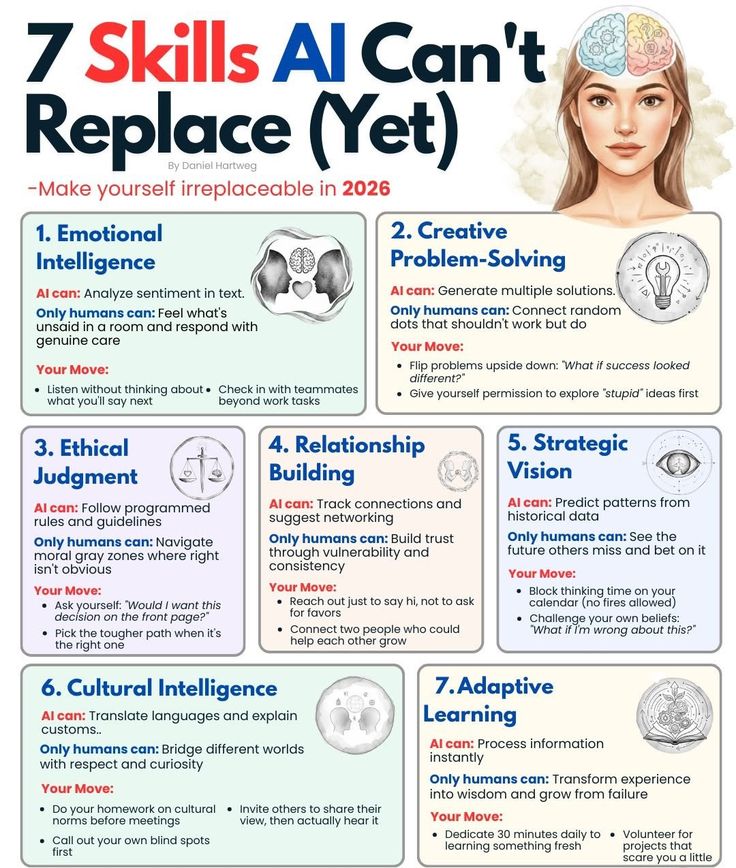
1. Emotional Intelligence Still Runs the Human World
Artificial intelligence can identify emotional language and generate responses that sound empathetic. What it cannot do is feel emotion or understand its consequences in a living social environment.
Emotional intelligence involves perceiving emotions accurately, interpreting them within context, and responding in ways that regulate relationships rather than fracture them.
Decades of research show that emotional intelligence is a strong predictor of leadership effectiveness, conflict resolution, and team performance.
A large-scale study published in Personnel Psychology found that managers with high emotional intelligence significantly outperformed peers in decision-making under stress. This matters because modern workplaces are increasingly volatile, remote, and digitally mediated.
AI does not experience tension in a meeting, discomfort in silence, or resentment hidden behind compliance. It cannot sense when a team is burning out or when morale is quietly collapsing. Humans can.
In industries like healthcare, education, journalism, diplomacy, and community organizing, emotional intelligence is not optional. It is operational.
As automation expands, emotionally intelligent humans become stabilizers in fragile systems. They translate logic into trust, policy into care, and authority into legitimacy.
2. Creative Problem Solving Requires Human Risk and Intuition
AI generates solutions by remixing existing data. Human creativity begins earlier, at the level of defining the problem itself. Creative problem solving involves reframing assumptions, tolerating ambiguity, and taking intellectual risks without knowing the outcome.
Research from cognitive science draws a clear line between combinational creativity and transformational creativity. AI excels at the former. Humans dominate the latter. Transformational creativity changes the rules of the system rather than optimizing within them.

History supports this distinction. Breakthroughs in art, science, and social movements did not emerge from probability alone. They emerged from contradiction, dissent, and imagination shaped by lived experience.
AI cannot rebel against norms it does not believe in. It cannot pursue ideas that appear irrational but later redefine reality.
For Gen Z creators navigating oversaturated digital spaces, originality is no longer about producing more content. It is about seeing what others miss and daring to explore it. AI can assist the process. It cannot replace the human leap.
3. Ethical Judgment Cannot Be Outsourced to Algorithms
Artificial intelligence follows objectives defined by humans and data shaped by history. It does not possess moral awareness. It cannot evaluate harm beyond numerical thresholds or weigh justice against efficiency.

Recent failures in automated systems make this clear. Algorithmic bias in hiring tools, facial recognition errors in law enforcement, and discriminatory credit scoring models did not occur because machines chose harm. They occurred because ethical judgment was reduced to technical optimization.
Ethical judgment involves navigating gray zones where rules conflict and consequences are uncertain. Philosophers describe this as moral reasoning under indeterminacy. No current AI system can do this independently because ethics is not a dataset. It is a social contract shaped by culture, power, and accountability.
In journalism, law, medicine, governance, and technology policy, ethical judgment remains a human responsibility. When mistakes occur, society does not hold machines accountable. It holds people accountable. That alone ensures the continued relevance of human moral reasoning.
4. Relationship Building Is Still a Human Monopoly
AI can recommend who to contact and when. It cannot build trust. Trust is created through consistency, vulnerability, shared time, and emotional reciprocity. These are not features of machine interaction.
Sociological research consistently shows that opportunities flow through relationships rather than credentials alone.
A landmark study by Mark Granovetter demonstrated that weak ties, not close friends, are often the source of career breakthroughs. AI can map these networks. It cannot activate them meaningfully.
In a world flooded with automated messages, genuine human connection becomes rare and therefore valuable. People respond differently when they feel seen rather than targeted. Relationship builders create ecosystems, not transactions.

For Gen Z professionals, this skill extends beyond networking events. It includes mentorship, collaboration, community engagement, and reputation built over time. AI accelerates access. Humans determine depth.
5. Strategic Vision Requires Seeing Beyond Data
AI predicts future outcomes by analyzing historical patterns. Humans imagine futures that break from precedent. Strategic vision is not about forecasting alone. It is about choosing direction amid uncertainty.
Economic history shows that major shifts often emerge from discontinuities rather than trends. The internet, social media, and mobile computing did not follow linear projections. They reconfigured behaviour, power, and culture.
AI struggles with these moments because it is anchored to existing data. Humans, by contrast, can sense weak signals, question dominant narratives, and commit to long-term bets that appear illogical in the short term.
Leadership depends on this capacity. Strategy involves judgment, courage, and accountability. When decisions fail, humans explain them. When they succeed, humans own them. Machines cannot assume responsibility for vision.
6. Cultural Intelligence Separates Global Thinkers From Global Tools
Artificial intelligence translates language with remarkable accuracy. It does not understand culture. Culture includes norms, history, power dynamics, and unspoken meaning. These elements cannot be reduced to syntax.
Cultural intelligence enables individuals to navigate diverse environments without imposing assumptions. Research from international management studies shows that culturally intelligent leaders reduce conflict, improve collaboration, and outperform peers in global organizations.
As work becomes increasingly borderless, this skill grows in value. Misunderstanding culture can derail negotiations, alienate communities, and distort storytelling. AI cannot sense offense before it occurs or respect before it is demanded.
For Gen Z, whose identities and careers often span multiple cultures online and offline, cultural intelligence is both a professional asset and a social necessity.
7. Adaptive Learning Turns Change Into Advantage
AI processes information instantly. It does not learn from failure in a human sense. It does not reflect, reinterpret identity, or grow wiser over time.
Adaptive learning involves updating beliefs, transferring insight across domains, and responding constructively to uncertainty. Psychologists distinguish between knowledge acquisition and wisdom formation. AI handles the first. Humans dominate the second.
The future of work will reward those who can evolve continuously. Roles will disappear. New ones will emerge. The ability to learn how to learn will matter more than any single technical skill.
Gen Z already lives inside rapid change. Those who treat learning as an ongoing practice rather than a phase will remain relevant. Experience becomes power only when it is examined.
The Bottom Line
Artificial intelligence is not the end of human relevance. It is the end of human complacency. The skills that endure are not those rooted in speed or scale, but those grounded in meaning, judgment, and connection.
Machines optimize systems. Humans define what those systems are for.
In a world shaped by algorithms, humanity is not a liability, It is the competitive edge.