Zelenskyy, Trump Face Off at UN Amid Russia-Ukraine Tensions
Amid ongoing aerial attacks, Ukrainian President Volodymyr Zelenskyy visits the UN General Assembly to meet world leaders, including Donald Trump, seeking help to end Russia's invasion and secure aid. Diplomatic efforts intensify as leaders discuss peace proposals, sanctions, and aid, while the conflict's global repercussions, including fuel shortages, are highlighted.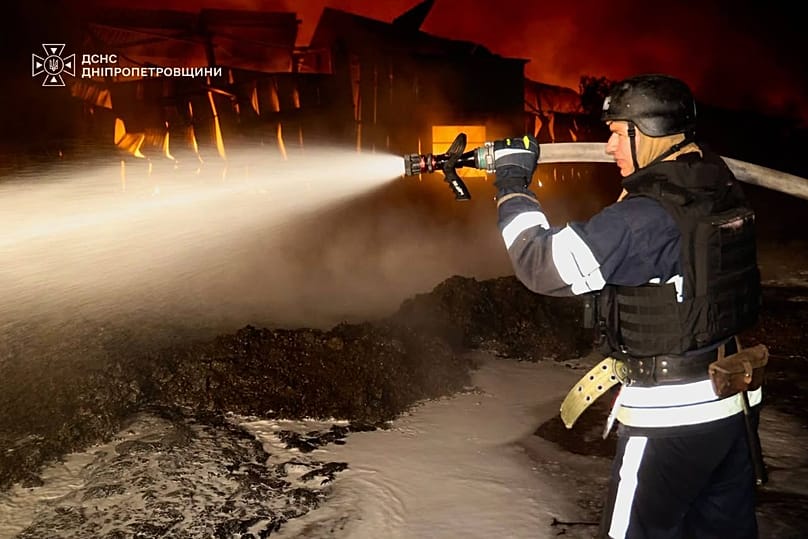
The geopolitical landscape is currently dominated by ongoing aerial warfare between Russia and Ukraine, coupled with intensive diplomatic efforts. Ukrainian President Volodymyr Zelenskyy is visiting the United States, where he is slated to meet with US President Donald Trump and other global leaders on the fringes of the UN General Assembly in New York. This high-stakes visit unfolds against a backdrop of persistent daily exchanges of missiles and drones, which continue to inflict casualties and damage critical infrastructure, even as front-line positions remain largely static.
Overnight, Russia launched extensive missile and drone attacks across a minimum of four Ukrainian regions, resulting in four fatalities and several injuries. Ukrainian officials reported widespread damage to homes, businesses, and storage facilities, with five individuals wounded in Kyiv alone. The assaults, which incorporated anti-ship missiles, ballistic missiles, cruise missiles, and over 200 drones, specifically targeted metallurgical and chemical industries, the fuel and energy sector, and military-industrial complexes, according to the Russian Defence Ministry. Identified targets included a Fire Point plant in Kyiv, responsible for producing components for long-range cruise missiles, and a tobacco factory in the central Poltava region, allegedly utilized for manufacturing small arms ammunition. Images from 22 September 2026 depicted infrastructure damage in the Dnipropetrovsk and Zaporizhzhia regions subsequent to these Russian strikes.
In response, Ukraine executed long-range strikes, damaging another Russian oil refinery. Ukrainian special forces confirmed a successful drone attack on the Kuibyshev oil refinery in Samara, located southeast of Moscow, which ignited a substantial fire. This Rosneft-owned facility is vital for supplying fuel to central Russia, producing gasoline, diesel, and fuel oil, and had reportedly been targeted by Ukraine in a previous strike last June. Regional Governor Vyacheslav Fedorishchev confirmed one death and four injuries in Samara, stating that “the enemy targeted industrial facilities.” Concurrently, Russia’s Defence Ministry claimed to have intercepted 297 Ukrainian drones over 14 Russian regions and the illegally annexed Crimean Peninsula during the same overnight period.
President Zelenskyy’s visit to the UN General Assembly is primarily focused on rallying international support to bring an end to Russia’s more than four-year full-scale invasion. His agenda includes seeking assistance to conclude the conflict, guaranteeing the secure passage of Ukrainian grain and agricultural products through the Black Sea – a route severely hampered by Russian attacks on cargo vessels, adversely affecting Kyiv’s economy and global supplies – and advocating for additional US-made Patriot air defense systems, which Kyiv urgently requires to counteract Russia’s ballistic missiles. He provided US senators with an update on his de-escalation proposals, expressing gratitude for their bipartisan support and for a recently enacted, tougher Russian sanctions bill that President Trump has signed into law.
Beyond the UNGA, diplomatic discussions are ongoing. French President Emmanuel Macron, following a meeting with Donald Trump, put forth proposals for a truce between Moscow and Kyiv regarding strikes on energy infrastructure and a “moratorium” on attacks in the Black Sea. France also pledged to supply Ukraine with more radars to bolster the protection of its power grid. Simultaneously, Vsevolod Chentsov, Ukraine's Deputy Prime Minister for European and Euro-Atlantic Integration, is actively engaged in related discussions. Broader European efforts encountered a setback as EU ambassadors failed to reach an agreement on Russia sanctions before the expiry of the existing regime. The global ramifications of the conflict encompass international shortages of diesel and corresponding price spikes, which Donald Trump attributed partly to the repeated attacks on Russian refineries, further noting that a global crunch also materialized after the Iran war led to curtailed oil shipments through the Strait of Hormuz. In a separate development, an overhaul of the EU’s migration rules now allows governments to establish migrant detention centers in non-bloc countries, raising questions about financial accountability, a subject explored by Mared Gwyn in an interview with Tasos Chatzivasileiou, the Greek Deputy Foreign Minister.