Zambia's Election Saga Deepens: The Presidential Petition Mystery!
The Constitutional Court Registry officially recorded no presidential petition within the filing deadline, leading to President-elect Hakainde Hichilema's scheduled inauguration. However, documents for a "people's presidential petition" were irregularly emailed to the Chief Justice, who exceptionally referred them to the Constitutional Court for a decision on their legal filing status.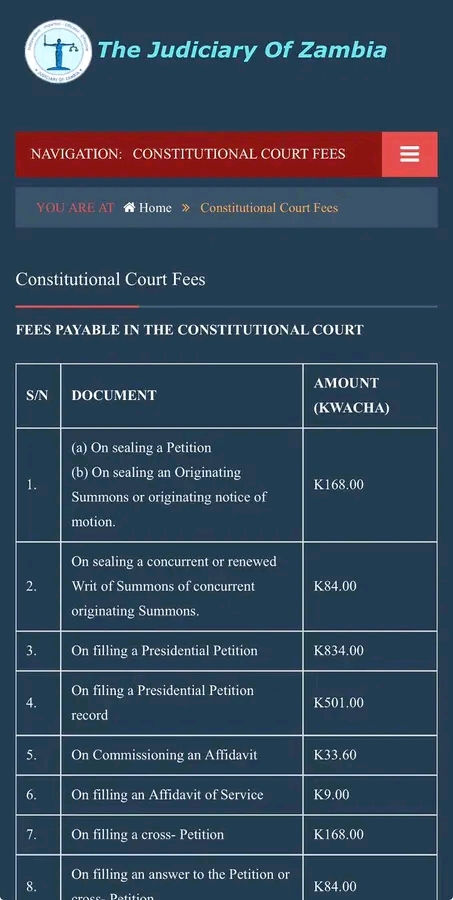
The Constitutional Court operates under strict rules regarding the filing of documents, including petitions. A crucial requirement states that any document necessitating filing will not be accepted by the Registry unless the prescribed fee has been duly paid. For an ordinary petition, the fee is K168.00, while a Presidential Petition commands a fee of K834.00. While these amounts may appear modest, failure to pay them renders a petition invalid and unable to be heard, underscoring the courts' demand for strict adherence to established regulations. It is important to note that the Constitutional Court holds final authority in constitutional matters, including presidential petitions, and operates at the same level as the Supreme Court, though the Chief Justice is not intrinsically a part of the Constitutional Court's panel.
A recent controversy surrounding a presidential election petition has brought these rules into sharp focus. The Constitutional Court Registry officially recorded no petition within the designated filing period. This was confirmed by Chief Administrator Nalishebo Imataa, who stated, "No petition had been filed in the Constitutional Court Registry as at 18:00 hours yesterday, 24th August, 2026." Consequently, the Cabinet Office announced the inauguration of President-elect Hakainde Hichilema for Tuesday, September 1, in accordance with Article 105 of the Constitution, based on the Judiciary's communication regarding the Registry's status.
However, the absence of a formally filed petition at the Registry did not mean that no documents challenging the election reached the Judiciary. In a separate statement issued on August 25, the Judiciary acknowledged that Chief Justice Mumba Malila had received an email from a member of the public. This email contained documents self-designated as "the people’s presidential petition," aimed at challenging the outcome of the August 13 presidential election. The Judiciary, in its communication, highlighted the importance of precise language, acknowledging social media claims about a "formally and duly filed" petition but explicitly not endorsing them.
The Judiciary described the transmission of official court documents through the Chief Justice’s private email address as "highly irregular." Despite this procedural irregularity, the Chief Justice did not simply dismiss the documents. In an exceptional move, utilizing his administrative powers, he referred the received documents to the Constitutional Court "for its consideration on the issue of the filing of the petition." This specific phrasing is crucial, as it indicates that the Chief Justice's receipt of the email was not a judicial determination that a valid presidential petition had been filed. Instead, it tasked the Constitutional Court with deciding the legal standing of these irregularly submitted documents.
This situation presents two distinct propositions: while documents labeled a presidential petition were indeed sent to the Chief Justice, they were not recorded as a properly filed presidential petition at the Constitutional Court Registry, according to the Judiciary’s official communication. Whether the exceptional method of email transmission can acquire legal standing is therefore a matter solely for the Constitutional Court to determine, not for social media discussions or political parties. The unusual method of transmission was partly contextualized by reports of courts being inaccessible on Monday due to security operations, which prompted concerns from the Law Association of Zambia and other groups regarding access to justice during the critical election-petition period. Allegations that President Hichilema ordered the court closures to obstruct an election challenge were rejected by State House.
For the time being, the Cabinet Office continues to operate on the Judiciary's communicated position: "at the expiration of the seven days provision allowed for filing in of a petition challenging a Presidential election, the Judiciary had not received any petition." This confirms President-elect Hichilema "shall be" sworn in on Tuesday, September 1, as per Article 105. Consequently, the current situation is more nuanced than online discourse often suggests. There is no confirmed, duly filed presidential election petition before the Constitutional Court based on the information released so far. However, there are petition documents before the court because the Chief Justice administratively referred them. These two conditions are not necessarily the same legal entity. The final, decisive word on the status of these emailed documents and whether they constitute a successfully filed or automatically valid challenge now rests squarely with the Constitutional Court.