When a Typo Cost $250 Million: The Mizuho Trade Disaster
In 2005, a tiny typo at one of Japan’s leading securities firms triggered a financial meltdown. What seemed like a minor input error spiraled into a $250 million disaster, shaking investor confidence and exposing cracks in the system. The true scale of the mistake left even seasoned traders in disbelief.
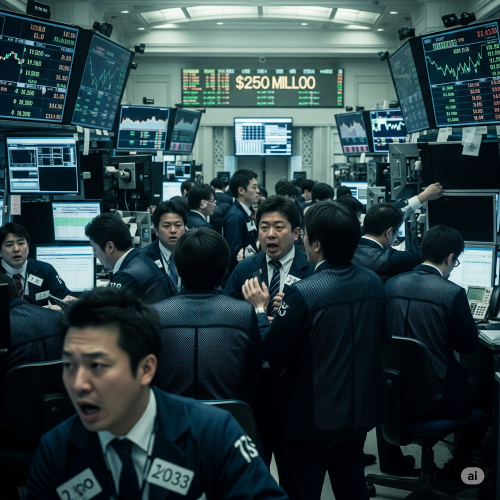
Setting the Stage: Tokyo’s Financial Powerhouse in the Early 2000s
In the early 2000s, Japan’s economy was struggling to recover from the “Lost Decade” — a period of stagnation following the bursting of its asset price bubble in the early 1990s. The Tokyo Stock Exchange (TSE), one of the world’s largest and most influential markets, was under immense pressure to modernize and restore investor confidence. Electronic trading was becoming the norm, designed to make markets more efficient but also introducing new risks.
Mizuho Securities, part of the Mizuho Financial Group formed in 2000 by merging three major banks, was one of the pillars of Japan’s financial sector. The firm prided itself on its scale and sophistication but also faced scrutiny as Japan’s market adapted to rapid technological changes.
December 8, 2005: The Day the Market Stumbled
On that crisp winter morning, J-Com Co., a relatively small recruitment firm, was set to debut on the Tokyo Stock Exchange. For most traders, it was just another IPO — but for one Mizuho employee, it became a day that would go down in infamy.
The trader, whose name was never publicly disclosed, was responsible for placing a sell order for J-Com shares. The intended order was to sell 1 share at 610,000 yen — roughly $5,000 at the time — reflecting the company’s true market value.
However, in what would prove to be a catastrophic slip, the trader entered 610,000 shares at 1 yen each. As the order hit the TSE’s electronic trading system, chaos erupted.
Within moments, thousands of buy orders flooded in, snapping up the shares at the dramatically undervalued price. The TSE’s systems, despite their sophistication, were unprepared for the sheer volume and speed. Critically, the exchange’s rules and technology did not allow for the cancellation or correction of orders once executed.
Attempts by Mizuho to halt or reverse the trade failed repeatedly. It was clear something was wrong, but the system just kept processing orders. It was like watching a slow-motion train wreck.
The result was a financial calamity: Mizuho Securities was left liable for approximately 40 billion yen (around $331 million) in losses. The incident shook the Tokyo Stock Exchange, sending the Nikkei 225 down over 300 points amid investor panic.
Aftermath and Accountability: A Market in Turmoil
The repercussions extended far beyond Mizuho’s balance sheets.
The Japanese government’s Financial Services Agency (FSA) launched a swift investigation. It issued a business improvement order to Mizuho, demanding urgent reforms in operational risk management and internal controls.
Meanwhile, the Tokyo Stock Exchange came under fire for the structural weaknesses in its trading platform. In a rare and dramatic move, Takuo Tsurushima, the president of the TSE, resigned shortly after the incident, taking responsibility for the systemic failure.
Market Impact and Lessons Learned
Some traders, quick to recognize the anomaly, capitalized on the mispricing, buying shares at a fraction of their value and reaping significant gains when prices corrected. While opportunistic, this further underscored the scale of the market disruption.
The incident became a landmark case study in the risks inherent in electronic trading systems and the dire consequences of human error in automated environments. The Mizuho error exposed a fundamental vulnerability—automation accelerates execution but does not eliminate the need for rigorous checks and balances. It forced exchanges worldwide to rethink their safeguards.
A Cautionary Tale for the Digital Age
The $250 million typo remains a sobering reminder of how a single keystroke can have outsized consequences.
Mizuho Securities rebuilt its controls, and the Tokyo Stock Exchange invested heavily in technology upgrades. Yet the incident is etched in financial history as a lesson in humility—proof that no matter how advanced the technology, human diligence and system resilience remain paramount.
In the relentless race for speed and profit, precision is not just a virtue—it is a necessity.