VanEck Sounds Alarm: Bitcoin Miners Stare Down $50 Billion Funding Abyss Amid AI Shift
VanEck has introduced a new framework to evaluate Bitcoin miners transitioning into AI infrastructure, highlighting a $50 billion near-term funding gap. The analysis shows the market favors companies with actual energized power and physical leases over those still in the pipeline. It also challenges the perceived strong correlation between the sector's valuations and Bitcoin prices for diversified companies.
A new framework from asset manager VanEck is drawing clear lines between Bitcoin miners that are genuinely transforming into artificial intelligence infrastructure providers and those that are still selling a story.
All of it comes with a sobering price tag: a roughly $50 billion near-term funding gap standing between the sector’s pipeline ambitions and actual delivery.
In a research note, VanEck investment analyst Griffin MacMaster and Head of Digital Assets Research Matthew Sigel laid out what they describe as the first structured valuation approach for the increasingly blurry category of companies that straddle both Bitcoin mining and AI data center hosting.
With financial disclosures varying widely across the sector and cash flows still nascent, VanEck argues the cleanest metric available to investors right now is gross energized power, essentially, how many megawatts a company has actually switched on, not just announced.
The disparity between announced capacity and actual energized power is already revealing, and companies that possess physical leases, such as Cipher Mining (CIFR), Hut 8 (HUT), and TeraWulf (WULF), are currently commanding valuations exceeding 10 times their gross energized power.
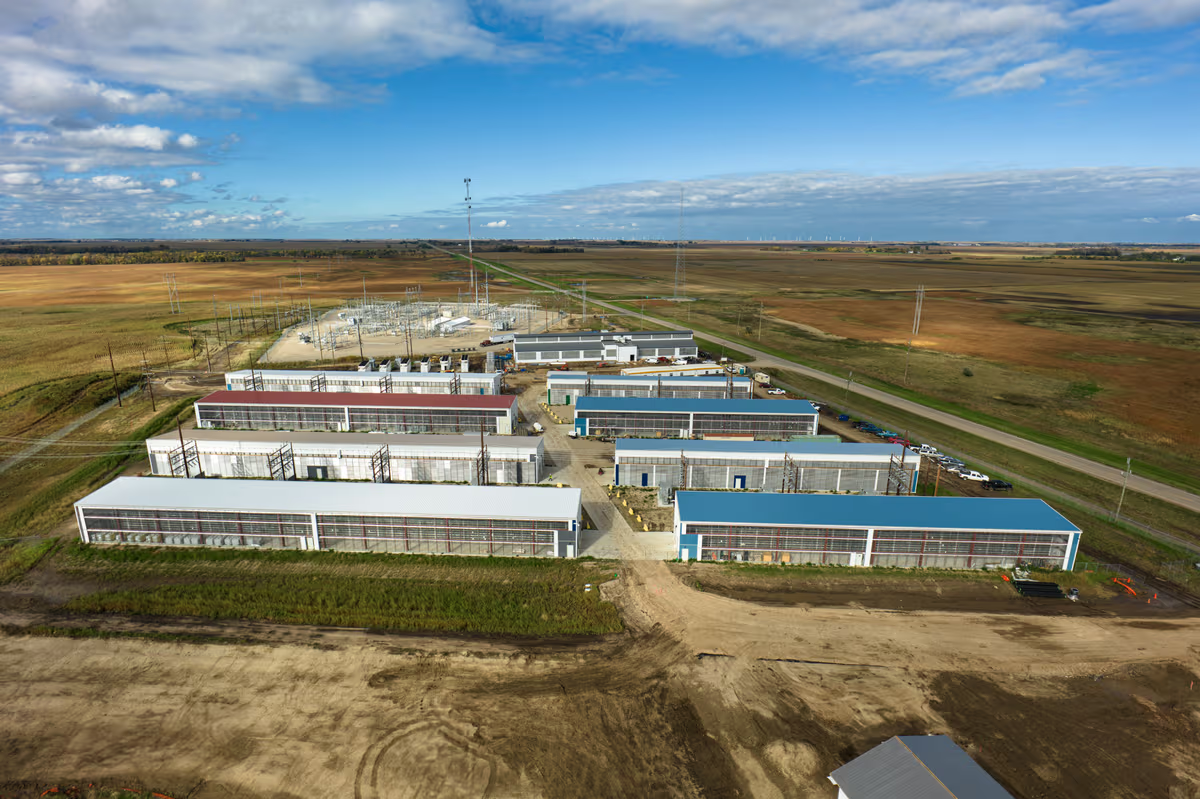
Meanwhile, names like Marathon Digital (MARA) and CleanSpark (CLSK), which remain more closely tied to Bitcoin mining with limited contracted AI capacity, are trading at just 2–6x that same metric.
VanEck analysts note that the market is presently rewarding contracted and energized capacity while heavily discounting projects still in the pipeline.
However, VanEck cautions that signing contracts, is only the beginning, and across the entire peer group, miners have delivered only approximately 25% of their leased capacity, with a figure that the firm expects to decline further before improving, as large-scale construction projects kick off in 2027 and 2028.
This execution gap is expected to become the primary driver of valuation moving forward, with companies failing to meet construction milestones facing potential “structural de-ratings.”
Furthermore, the analysts highlight that very few of these companies possess prior experience in constructing the complex infrastructure demanded by AI customers, underscoring the critical importance of project management credentials alongside megawatt counts.
VanEck’s deal tracker indicates an active second half of 2026, with several companies, including Bitdeer (BTDR), HIVE Digital (HIVE), Riot Platforms (RIOT), and Core Scientific (CORZ), engaged in various stages of active or advanced lease negotiations.
TeraWulf (WULF), for instance, is reportedly in “advanced negotiations” for a 480MW site in Kentucky, with a customer expected by the second quarter.
The shift toward AI infrastructure requires significant investment, with long-term capital needs estimated at $221 billion and a near-term funding gap of about $50 billion.
Companies such as HIVE, IREN, and KEEL face the greatest financial pressure, while WULF and CIFR are in a stronger position due to secured contracts that reduce funding risks.
Funding mechanisms also differ, and the companies holding substantial Bitcoin treasuries, such as MARA (35,303 BTC), CLSK (13,561 BTC), and HUT (13,696 BTC), can leverage Bitcoin monetization strategies to partially finance construction.
In contrast, companies like REN, which faces considerable near-term funding requirements without a Bitcoin treasury to draw upon, are left with a more constrained set of options, primarily dilutive equity issuances or incremental debt.
VanEck argues that many crypto mining companies are no longer as closely tied to Bitcoin prices as investors assume.
While firms such as MARA, CLSK, and RIOT remain highly exposed to Bitcoin fluctuations, others like CORZ, WULF, APLD, and IREN have significantly diversified their businesses.
As a result, changes in Bitcoin prices would have a much greater impact on some companies than others, highlighting the growing differences within the sector.

VanEck expects investors to increasingly value these companies based on profitability, cash flow, and operational performance rather than power capacity alone.
As their AI businesses grow, they may come to resemble data center REITs and could eventually be sold or converted into REIT structures.
The firm sees the greatest growth potential in HIVE, KEEL, IREN, and Bitdeer, though these companies also face the highest execution risks.
Meanwhile, WULF, CIFR, and HUT are viewed as safer investments due to their secured contracts and stronger market positions.