Uganda's Tense Election: President Nears Victory as Rival Cries Foul
Uganda's presidential election concluded with incumbent President Yoweri Museveni taking a significant lead, while challenger Bobi Wine alleged widespread fraud and reported being under house arrest. The election was marred by reports of post-election violence, an internet shutdown, and voting delays. Concerns about repression and intimidation had been raised prior to the contentious vote.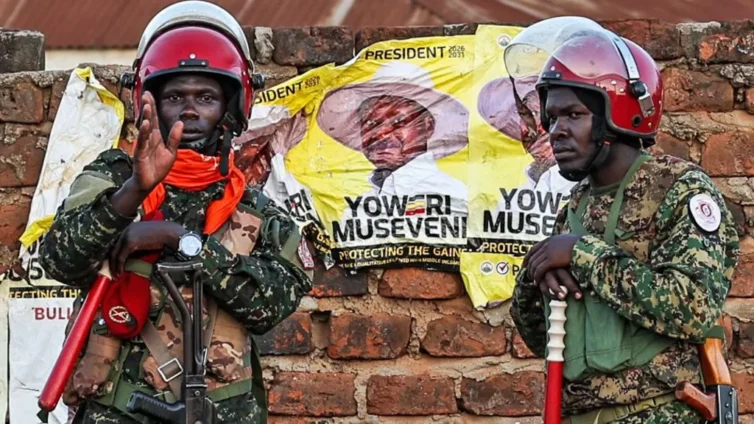
Uganda's recent presidential election concluded amidst significant controversy, with incumbent President Yoweri Museveni establishing a commanding lead over his main challenger, Bobi Wine. Initial figures, based on returns from 81% of polling stations, indicated Museveni with 74% of the vote against Wine's 23%. However, Wine's National Unity Platform (NUP) party immediately questioned the credibility of these results, alleging widespread fraud and vote-stealing by the authorities.
Adding to the election's tumultuous aftermath, Bobi Wine reported being placed under house arrest, with security forces surrounding his Kampala home. His party later claimed via social media that a helicopter had landed at his residence, forcibly removing him to an unknown location, and his son asserted that both parents had been seized by the military. These claims were difficult to verify due to a country-wide internet shutdown, which also hampered local journalists from accessing Wine's home. Local police, including spokesman Kituuma Rusoke, initially stated they were unaware of an abduction or that Wine was a "person of interest" whose security deployment was for his own protection.
The election period was marred by an often violent campaign and post-election incidents. Late on Thursday, at least seven opposition supporters were killed in disputed circumstances in Butambala, about 55km south-west of the capital. NUP MP Muwanga Kivumbi accused soldiers and police of firing tear gas and live bullets into a crowd, claiming ten deaths. This account was corroborated by human rights activist Agather Atuhaire. Conversely, local police spokesperson Lydia Tumushabe maintained that police fired in self-defence after NUP supporters, armed with machetes and axes, attacked a police station and planned to overrun a tallying centre, confirming at least seven deaths. The US embassy subsequently issued an alert to its citizens regarding reports of security forces using tear gas and firing into the air to disperse gatherings.
Significant logistical and technical issues also plagued election day. Voting was delayed by up to four hours in many polling stations due as ballot boxes arrived late and biometric machines, used for voter identity verification, malfunctioned. The internet access, suspended on Tuesday by Uganda's Communications Commission to prevent misinformation and incitement to violence, was condemned as "deeply worrying" by the UN Human Rights Office. Electoral chief Simon Byabakama, however, asserted that the internet blackout did not affect vote counting, as the commission utilized a "private system" to transmit results. Byabakama also stated that the final results would be announced within 48 hours, by 5 PM (14:00 GMT) on the following day.
President Museveni, 81, who first took power as a rebel leader in 1986, sought a seventh term, positioning himself as the sole guarantor of stability. Bobi Wine, a 43-year-old pop star-turned-politician, appealed to Uganda's largely young population (under 30), promising to tackle corruption and enact sweeping reforms. The United Nation's Human Rights Office had expressed concerns that the election would be characterized by "widespread repression and intimidation," a sentiment reinforced by disruptions to opposition activities, accusations of assault and detention of Wine's supporters, and the police dismissing these complaints, accusing opposition supporters of being disruptive.