Trump Teases Iran Peace Deal, Rattling Oil Markets
Oil prices plummeted as U.S. President Donald Trump canceled planned strikes on Iran, citing progress toward a peace deal that could reopen the Strait of Hormuz. Despite Trump's optimism, Iran denies a final agreement, maintaining its 'red lines' amidst ongoing tit-for-tat attacks and market volatility. The geopolitical tensions continue to influence global energy markets and regional stability.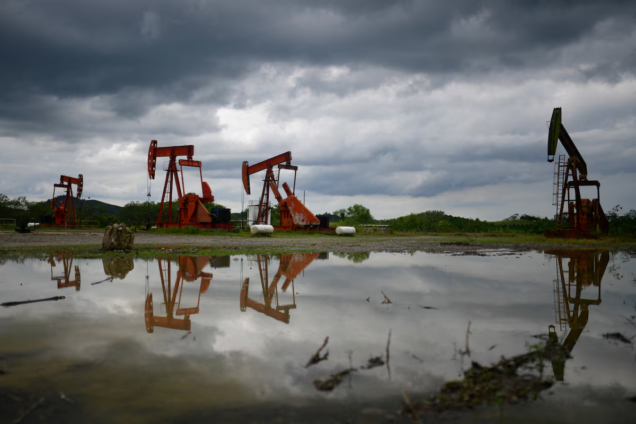
Oil prices experienced a significant fall on Friday, extending losses from the previous session, primarily due to U.S. President Donald Trump's cancellation of planned military strikes against Iran. This decision alleviated fears of a further escalation of hostilities that had been simmering after a week of tit-for-tat attacks between the two nations. Brent futures dropped by 2% to $88.55 a barrel, while U.S. West Texas Intermediate (WTI) crude saw a 1.8% decrease to $86.11.
Trump, who had previously threatened severe action against Iran, called off strikes on Thursday, citing progress in discussions and the potential for a peace deal to reopen the Strait of Hormuz to shipping as early as the weekend. However, Iran's semi-official Fars news agency reported that Tehran had not approved the text of any agreement, maintaining its stance on 'red lines' and indicating that a final decision was still under review by relevant bodies. Despite this, hopes for peace grew, leading to a strong global rally in Asian stocks and a drop in oil prices to two-month lows.
Market analysts, like IG's Tony Sycamore, noted the swift and decisive market reaction but cautioned that the situation could be another 'false dawn'. ING analysts also expressed wariness, stating that even if a ceasefire extension materializes, it could be fragile, potentially falling apart if nuclear talks do not progress. They warned of a potential 'inflexion point' in late July where, without resumed oil flows, inventory levels and stronger seasonal demand could push prices significantly higher, possibly towards $120-$130 per barrel.
The Strait of Hormuz, a critical waterway through which a fifth of global oil and liquefied natural gas shipments normally pass, has been a central point of tension. Iran had announced its closure on Thursday, saying it would fire on any ship attempting to transit, and its months-long blockade had kept energy prices elevated. State media reported on Friday that Iranian forces prevented a tanker from transiting the Strait of Hormuz without coordination, while the U.S. military stated that commercial ships continued to transit the waterway.
Trump has repeatedly claimed to be close to a deal with Iran to end the conflict since mid-March, providing various timelines throughout April, May, and June. His claims included a 'great settlement' of the war, an agreement that Iran would 'never have a nuclear weapon,' and the imminent reopening of the Strait of Hormuz. Vice President JD Vance was mentioned as attending a potential signing in Europe. However, Iran's Foreign Ministry spokesperson, Esmaeil Baghaei, consistently described reports of an agreement as 'speculative' and emphasized that 'nothing has been finalized,' citing 'excessive demands' and 'new requests' from the U.S.
The conflict has been marked by tit-for-tat strikes, including wide-ranging attacks by the US and Israel on Iran on February 28, followed by Iranian responses against Israel and US-allied states in the Gulf. This week, two rounds of reciprocal strikes occurred despite a ceasefire announced in April. On Thursday, US forces shot down two Iranian one-way attack drones after attempts to strike commercial ships. Earlier, Trump had threatened to hit Iran 'very hard' and seize its oil infrastructure, including Kharg Island, Iran's main oil export terminal. Iran's military threatened 'more severe' retaliation if further attacks occurred, warning that if oil and gas exports are not for everyone, they will be available for no one.
The conflict has become a political challenge for the White House, with Trump's approval ratings affected by voter anger over high gasoline prices and concerns among Republicans about losing control of Congress. Trump's political considerations also include satisfying Iran hawks within his party, who previously scuttled an agreement, ensuring any deal closes Tehran's path to developing a nuclear weapon.
The reaction of other Middle East powers is crucial. While Trump claimed the agreement had been approved by Israel, Saudi Arabia, Qatar, and the United Arab Emirates, Israeli Prime Minister Benjamin Netanyahu's office confirmed a conversation but stated Israel was 'not a party to the memorandum of understanding.' Netanyahu did, however, express appreciation for Trump's commitment to securing a deal involving the removal of enriched material, dismantling enrichment infrastructure, limiting missile output, and ending support for regional proxies.
The Organisation of the Petroleum Exporting Countries (OPEC) lowered its forecast for 2026 world oil demand growth to 970,000 barrels per day (bpd) from a previous 1.17 million bpd, marking its second consecutive downward revision. However, the producer group anticipates a rebound in consumption, raising its demand growth forecast for 2027 by 190,000 bpd to 1.73 million bpd.
International calls for de-escalation have been made, with the UN Secretary-General António Guterres expressing deep concern over the continuing escalation and urging parties to return to the full implementation of the ceasefire. Pakistan, Russia, China, Turkey, India, and Saudi Arabia have also called for de-escalation amidst the ongoing tensions and intermittent strikes, which have resulted in casualties and damage, including three Indian sailors killed in a US strike in the Gulf of Oman and an 11-year-old girl injured by an Iranian drone attack in Bahrain.