THE SILENT PRESSURE ON FIRSTBORNS IN AFRICAN HOUSEHOLDS
In African households, firstborns often carry the weight of tradition, leadership, and silent sacrifice. This article explores the cultural expectations, emotional toll, and gendered burdens they face—while calling for a healthier, more balanced approach to family dynamics and mental well-being..jpeg)
In many African households, the firstborn child is more than just the eldest sibling; they are seen as the foundation of legacy, tradition, and responsibility. From an early age, they are handed an invisible script: lead the home, represent the family well, and never falter. This expectation isn't arbitrary; it’s deeply rooted in cultural norms and ancestral values passed down through generations.
Among the Yoruba people of Nigeria, for example, the firstborn son (called Akobi) is expected to lead family prayers and take charge in the father’s absence. In Ghana, the Akan culture views firstborns as the link between the past and future, a role that often comes with the burden of preserving heritage.
In many East African communities, these expectations are tied to rites of passage, community leadership, and household decision-making. While these roles instill discipline and pride, they often come at the cost of childhood freedom and emotional rest.
Living Under the Weight of Responsibility
One of the first signs of pressure is academic. Firstborns are often expected to "set the pace" and become models of excellence. Their academic results are scrutinized, compared, and magnified not just as a measure of individual success, but as a symbol of family honour.
“You must be an example for your younger siblings” is a phrase almost every African firstborn has heard.
A 2024 study conducted in Benin revealed that firstborns often receive greater educational investments from their parents, significantly raising the bar for performance and responsibility.
Parents, especially in lower-income households, often invest their limited resources on the first child with the hope that they’ll “lift the family out of poverty.”
Beyond school, many firstborns step into parent-like roles at home, supervising chores, disciplining siblings, attending to errands, and standing in as the family's representative at social functions. For some, this fosters leadership. But for many, it becomes a cycle of unacknowledged sacrifice.
The phrase “You’re the eldest, behave like one” becomes a life sentence. They grow up too fast.
.jpeg)
Photo credit: X(formerly twitter)
When the Firstborn Is a Daughter
For many firstborn girls, the experience is even more layered. Not only are they expected to lead by example, but also to uphold traditional caregiving roles. In cultures where gender roles are rigid, firstborn daughters become pseudo-mothers, raising their siblings, cooking, cleaning, and protecting the household while still striving for academic and social success.
A 2022 UNICEF report observed that in many African homes, firstborn girls perform up to 65% more household chores than their male counterparts. They are trained to be selfless, emotionally mature, and composed, often at the expense of their own expression and rest.
They are often called the “Assistant Parents” or the “Parentified Children”, which shouldn’t be, but who is going against it?
Social Insight
Navigate the Rhythms of African Communities
Bold Conversations. Real Impact. True Narratives.
This silent labor is rarely acknowledged, and many young women grow up carrying emotional fatigue masked as maturity.
The Invisible Emotional Toll
Though the pressures are not always physical, they are deeply psychological. Firstborns live with the fear of failure, often internalizing the belief that if they fall short, the entire family suffers.
Common emotional impacts include:
Chronic anxiety: Firstborns constantly overthink decisions, fearing family disappointment.

Perfectionism: A need to prove worthiness often leads to burnout.
Suppressed identity: Many suppress their passions in order to meet the expectations of “respectable” careers.
Despite their silent battles, firstborns are rarely encouraged to express emotional vulnerability. In cultures where mental health remains taboo, seeking therapy or counseling is often viewed as weakness.
A Bloomberg report noted that less than 20% of young Africans experiencing mental strain have access to psychological support. Many firstborns suffer in silence, with no language to describe their emotional weight.
Stories That Speak Volumes
The pressure on firstborns is best understood through their lived experiences. The voices from across the continent speak the same pain:
“I became the caretaker of my siblings at 13 when my mom traveled for work. I had to juggle my studies, housework, and their emotional needs. I love them, but it nearly broke me.”
“As the firstborn, I’m expected to send money home, settle disputes, and perform family rituals—even though I live abroad now.”
“I was forced to study medicine because my father said I had to inspire my younger ones. But I’ve always wanted to be a writer.”
These testimonies reflect a shared reality: the struggle of living for others while silencing yourself.
.jpeg)
Social Insight
Navigate the Rhythms of African Communities
Bold Conversations. Real Impact. True Narratives.
Image credit: The Kenya times
How Families Can Create Healthier Dynamics
To lift this silent burden, African families must rethink their approach to birth order. Here’s how:
Open Communication
Encourage regular check-ins where children can express their struggles, without being shamed. Emotional support should never be earned; it should be automatic.
Shared Responsibilities
Duties like babysitting, cooking, or representing the family should be evenly distributed among siblings. Firstborns are siblings, not surrogate parents.
Individual Growth Over Assigned Roles
Support each child's unique path. Not every firstborn is a natural leader and that’s okay. Celebrate artistic, vocational, and entrepreneurial interests as valid.
Promote Mental Health
Normalize therapy, mentorship programs, and school counseling. Create safe spaces where emotional strain can be addressed without stigma.
African parenting must evolve from “control” to intentional support.
The Role of Community, School, and Society
It is not just up to parents. Society must also step up:
Schools should provide firstborn leadership programs with emotional support tools, not just responsibility.
Social Insight
Navigate the Rhythms of African Communities
Bold Conversations. Real Impact. True Narratives.
Religious institutions can preach balance, celebrating diligence without glorifying silent suffering.
Local governments and NGOs should invest in community mental health, youth leadership training, and family planning education.
According to the African Union, investing in family well-being is a step toward a healthier continent. A future where firstborns are supported, not overstretched.
Redefining Leadership in the Family
The idea that “eldest means strongest” must be reframed. True leadership isn't about sacrifice, it’s about balance, compassion, and sustainability.
Firstborns should not have to dim their light to brighten others’. They can be loving siblings, cultural role models, and high achievers without carrying the world alone.
Let’s build homes where firstborns are allowed to be children, make mistakes, and choose their own destinies, not just fulfill inherited scripts.
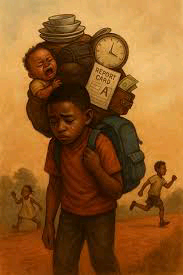
Image Credit: Google
Conclusion:
In every African household where tradition and love intersect, the firstborn stands at the center often praised, but rarely protected. It's time to change that.
Let us move toward a culture that respects heritage while championing mental well-being. One that redefines leadership as a shared journey, not a lonely road.
Because being first should be a blessing, not a burden.