Nvidia Dominates: Q2 Revenue Forecast Shatters Expectations
Nvidia has once again exceeded Wall Street's expectations with a strong Q1 performance and an impressive Q2 revenue forecast, driven by massive global investments in AI infrastructure. The company's chips are central to this growth, though concerns about supply constraints and competition persist as it unveils new products like the 'Vera' CPUs.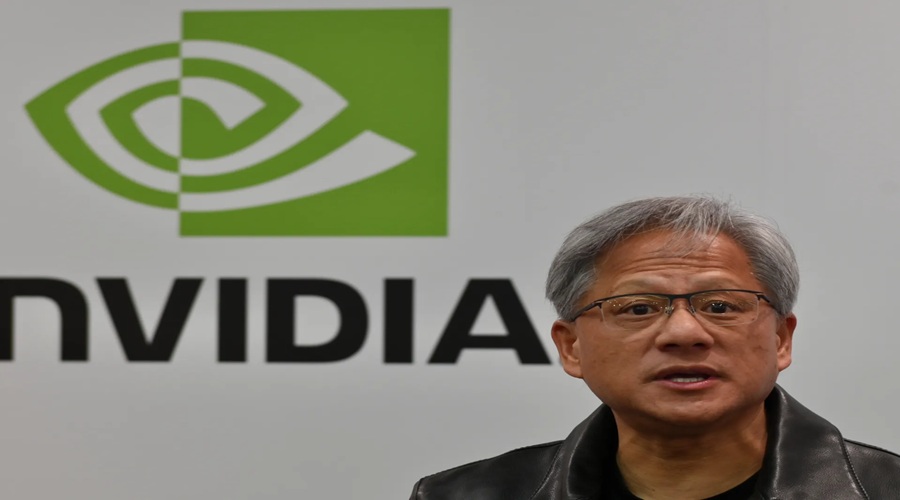
Nvidia has once again surpassed Wall Street's expectations, announcing a second-quarter revenue forecast of an impressive $91 billion, significantly higher than analyst estimates of $86.8 billion. This robust performance is attributed to the company's central role in the global surge of investment in artificial intelligence (AI) infrastructure.
CEO Jensen Huang revealed these figures on Wednesday, capping a first quarter that saw Nvidia report revenues of $81.6 billion, exceeding the average analyst estimate of $78.9 billion. The data center division, which is critical for powering advanced AI applications from ChatGPT to Google's AI products, generated $75.2 billion in revenue, also surpassing the $72.8 billion analysts had anticipated. On an adjusted basis, the company's earnings per share stood at $1.87, compared to market estimates of $1.76.
Alongside these strong financial results, Nvidia announced an substantial $80 billion share repurchase program and a significant increase in its quarterly cash dividend, from $0.01 to $0.25 per share. These staggering numbers reflect the immense investment driving the AI industry. Analysts project that tech giants like Alphabet, Amazon, and Microsoft could collectively invest over $700 billion in AI infrastructure this year, a sharp increase from approximately $400 billion in 2025. Nvidia's advanced chips are fundamental to nearly all this infrastructure, powering the data centers that train and operate the world's most sophisticated AI models.
Huang highlighted a new and rapidly expanding segment of customers within the data center business: AI-specific cloud companies. He noted that sales to these clients are now roughly equivalent to Nvidia's largest tech customers but are exhibiting even faster quarter-over-quarter growth. Huang stated on a conference call with analysts, "We should be growing faster than hyperscale capex."
The company also unveiled its new "Vera" central processing units (CPUs), which Huang described as opening access to a new $200 billion market. He expects these Vera chips to generate $20 billion in revenue by the end of the current fiscal year. This projection was not included in Nvidia's earlier $1 trillion forecast for its flagship Blackwell and Rubin AI chips spanning 2025 to 2027, with Huang remarking, "I expect Vera to be the second largest sales contributor. All of our customers are quite excited about Vera."
Despite the outstanding financial performance, Nvidia shares experienced a 1.6% decline in extended trading. This indicates that investors are starting to pose more challenging questions regarding the sustainability of this rapid growth. Jacob Bourne, an eMarketer analyst, commented, "Nvidia delivered another beat, but at this point that’s essentially priced in. The lingering question is whether it can convince investors the AI buildout has durability into 2027 and 2028, especially as the narrative shifts toward inference workloads and competing silicon from Google, Amazon, AMD and Intel."
Huang also acknowledged a persistent challenge: supply constraints. He stated, "My sense is that we’ll be supply-constrained through the entire life of Vera Rubin," referring to the combined technology platform scheduled for launch later this year.
Nvidia's results hold significant implications for the tech industry and beyond. For technology and business stakeholders, Nvidia's quarterly performance acts as a critical health check for the entire AI industry. Consistent beats signal that the AI spending wave continues unabated, with companies pouring capital into the infrastructure essential for building, training, and running AI systems. This has ripple effects across cloud computing firms, software companies, chip manufacturers, and any business connected to technology.
For the general public, the connection, though less direct, is equally real. Every interaction with an AI-powered service—whether a chatbot, a Netflix recommendation, or a phone translation—likely involves Nvidia's chips operating in the background. The company's sustained growth ensures that AI tools will continue to be developed, enhanced, and made widely available, often at no or low cost.
The relevance extends specifically to Africa, where Nigerian and other African startups are increasingly leveraging AI infrastructure for diverse applications, including fintech fraud detection, health diagnostics, and customer service automation. The availability, cost, and performance of the chips powering these systems directly impact their progress. A constrained Nvidia supply chain invariably leads to higher global cloud computing costs, which ultimately affect the prices African companies pay to run AI workloads on platforms such as AWS, Google Cloud, and Azure. Nvidia's success is more than just a Wall Street narrative; it signifies who controls the fundamental engine room of the modern digital economy, a position currently held firmly by Jensen Huang's company.