NATO Leaders Pledge Record Spending Amidst US Drawdown Plans, Trump Weighs In
The Ankara NATO summit marks a pivotal moment for the alliance, pushing for a "Europeanisation of NATO" amidst US disengagement and President Trump's criticisms of European allies. Increased defense spending by Europe and Canada aims to bolster capabilities, yet strategic control remains with the US, highlighting persistent tensions and the challenges of adapting to modern warfare.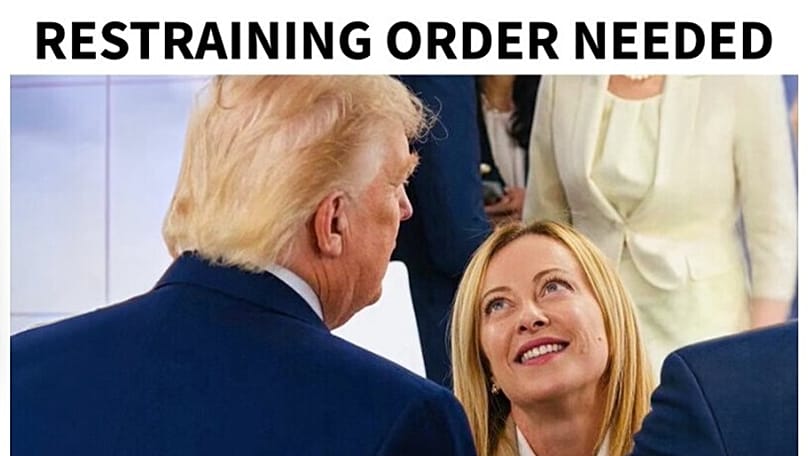
Recent months have seen a significant deterioration in international relations, particularly between the United States and key European allies, against a backdrop of escalating global tensions and strategic realignments within NATO. A prominent example is the ongoing public spat between US President Donald Trump and Italian Prime Minister Giorgia Meloni, which highlights deeper rifts concerning defense responsibilities and geopolitical priorities.
The friction between Trump and Meloni intensified following a social media post by the US President, featuring an image of himself with Meloni and the caption "Restraining order needed." This came after a previous accusation by Trump that Meloni had "begged" him for a photograph to boost her political ratings, claiming her popularity in Italy was declining due to her alleged refusal to deny Iran access to nuclear weapons – a stance he controversially extended to NATO. Meloni vehemently rejected these assertions as "senseless," retorting that her friendship with Trump had not aided her popularity and suggesting he focus on his own approval ratings. The animosity between the two leaders, once seen as close allies, has deepened due to the economic repercussions of the US-Israeli war in Iran and Italy's subsequent denial of its air base in Sicily to US aircraft bound for the Middle East. Furthermore, they publicly disagreed over Pope Leo XIV, with Trump criticizing the pontiff as "weak on crime and terrible for foreign policy," while Meloni staunchly defended the Pope's calls for peace and condemnation of war. Despite Trump's claims, recent surveys suggest Meloni's Brothers of Italy party remains the most popular political force in Italy, though her personal approval ratings have seen a slight decline from their post-election peak in 2023, yet showing no signs of political collapse.
These bilateral tensions coincide with a critical period for the North Atlantic Treaty Organization, as the alliance gathers in Ankara for a summit described by Secretary General Mark Rutte as one of the most consequential in its history. This summit is poised to mark the beginning of what is being termed "NATO 3.0" – a significant "Europeanisation" of the alliance, driven by a perceived US disengagement from European security. The "Trump factor" looms large over these discussions; just six months prior, Washington threatened to "take" Greenland, a territory of NATO ally Denmark, further fueling allied anxieties. President Trump has openly expressed outrage over what he calls allies' "abandonment" of the US in its war against Iran, pointing to denials of access to military bases by countries like Spain and Italy (though Germany and the UK eventually granted certain basing rights). Trump has publicly denounced European governments as "cowards" and labeled NATO a "paper tiger."
A central theme of the Ankara summit is the urgent need to transform Europe's historic defense spending into tangible capabilities suited for modern warfare. Despite Rutte's efforts to project unity, the alliance grapples with the implications of the US withdrawing significant assets available to European security architecture. This includes a review by US Secretary of War Pete Hegseth aimed at drawing down approximately 80,000 US troops from Europe, alongside announced cuts to crucial military capabilities such as long-range bombers, cruise missile-armed submarines, and fighter jets. Consequently, European nations are under immense pressure to fill these critical gaps and ramp up their own investment for continental defense, especially with the shift towards a European-led alliance less reliant on conventional US military support.
In response to these demands, Europe and Canada have significantly increased their defense expenditures. NATO Secretary General Rutte highlights a massive 20% year-on-year surge in core defense spending, amounting to an extra $139 billion in the last year alone, and a total of $258 billion over two years. Rutte often refers to this substantial injection of funds since Trump's first administration as "Trump’s trillion," implicitly acknowledging the US President’s pressure. Allies have also pledged to meet a formidable 5% GDP defense target by 2035. The Ankara summit is expected to see the announcement of major deals with arms companies, including over $1 billion for 200 Patriot missiles for Poland, $1.15 billion for precision-guided artillery shells, and $12.8 billion for advanced systems like Arctic satellite communications, GlobalEye, Airbus, and Triton.
However, despite this financial commitment, challenges persist. Rasmussen Global CEO Fabrice Pothier points out that the issue is not a lack of cash, but rather the unwillingness of some governments and the defense industry to take necessary risks and produce systems tailored for today's evolving theaters. He criticizes manufacturers in countries like Germany, France, and Spain for "sitting comfortably with national contracts," producing advanced but overly complex systems that are too slow to manufacture and respond to current needs. Moreover, the alliance is urged to learn from Ukraine's innovative, cost-effective solutions, particularly in drone defense. Former US ambassador to NATO Kurt Volker notes the "unsustainable position" of using multi-million dollar Patriot missiles to shoot down inexpensive drones, advocating for low-cost, high-tech alternatives developed by Ukraine.
Further complicating the dynamic is President Trump's continued skepticism regarding the alliance and his unique leverage. He recently reiterated his view on Truth Social that Europe has "abandoned" the US in the Iran war and that Washington's one-sided NATO relationship is "ridiculous." Despite the substantial European financial contributions, much of which flows back to US defense firms, Washington is actively reducing its wartime resource pool available to Europe. US Ambassador to NATO, Mathew Whittaker, explicitly warns Europeans against "freeriding" on American taxpayers. Trump's ultimate leverage, however, lies in the monopoly the US holds over next-generation military AI models, such as Claude Mythos. Washington treats this software as a tactical weapon, imposing strict export bans, thereby allowing Trump to dictate which allies receive digital protection. While the draft declaration of the Ankara summit includes an "iron-clad commitment" to Article 5 – NATO's mutual defense clause – Trump has frequently cast doubt on this commitment, raising concerns even with a shortened summit agenda designed to minimize potential confrontations and keep him engaged. This situation underscores a paradox: Europe is significantly increasing its contributions to the alliance, yet the US, particularly under Trump, continues to exert decisive control and leverage, maintaining the "keys" to strategic defense capabilities.