Ghana Plunges into Darkness: Akosombo Fire Fuels Political Storm Over Worsening Power Crisis
Ghana's Minority in Parliament is challenging the government's narrative on the nation's severe power crisis, asserting it's a deep-rooted issue exacerbated by policy failures, not just isolated incidents like the Akosombo fire. They demand full accountability for a special fuel levy and call for the Energy Minister to brief Parliament on the true state of the sector, rather than engaging in "semantic deception."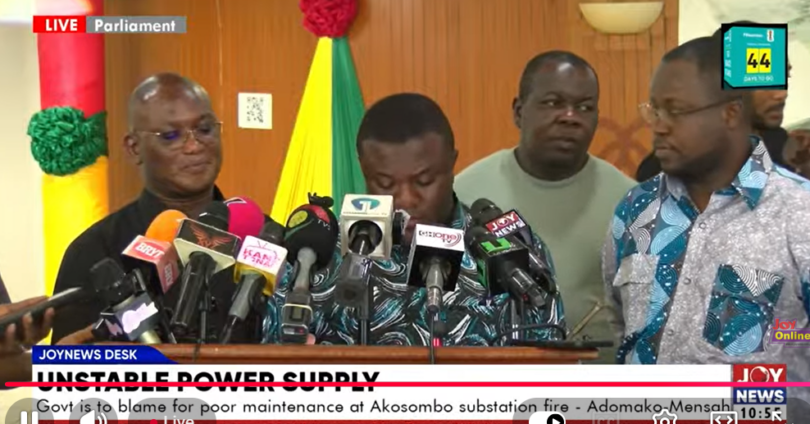
The Minority in Parliament has launched a scathing attack on the government, accusing it of deliberately misleading Ghanaians regarding the true severity of the nation's escalating power crisis, widely known as "dumsor." Led by Collins Adomako-Mensah, the Deputy Ranking Member on Parliament’s Energy Committee, the Minority asserts that what the government describes as routine maintenance and transformer upgrades is, in reality, a full-blown supply crisis. Adomako-Mensah condemned the government’s approach as "semantic deception," designed to downplay widespread outages attributed to ongoing grid challenges. He explicitly stated that the lights are out due to the government's failure to implement the Energy Sector Recovery Programme (ESRP) it inherited, rather than any scheduled engineering works.
This strong criticism comes amidst heightened tensions over Ghana’s electricity supply stability, following recent disruptions across the country. The Minority firmly believes that the current situation stems from significant policy and implementation failures, particularly the alleged non-execution of the ESRP from the previous administration. They maintain that the crisis significantly predates the highly publicized fire incident at the Akosombo substation on April 23, 2026. Adomako-Mensah, speaking on April 28, emphasized that "Ghana's power crisis, the dumsor that millions of Ghanaians have been enduring since January 25, was not caused by any accident at Akosombo. It was caused by this government." He described the Akosombo fire, which damaged a critical transmission system and temporarily removed over 1,000 megawatts of capacity, as merely "the latest and most dramatic symptom" of a deteriorating power sector, cautioning against using it as an alibi for a deeper, pre-existing problem.
In response to the Akosombo incident, the government took administrative steps, including directing the Chief Executive of GRIDCo, Ing. Mark Awuah Baah, to step aside pending investigations, with his deputy, Frank Otchere, assuming interim responsibility. This directive was announced by Felix Kwakye Ofosu on April 26. However, the Energy Minister, John Jinapor, vehemently rejected claims of negligence or policy failure, characterizing the disruptions as the result of an "unprecedented and unforeseeable" incident compounded by long-standing infrastructure deficits. He pledged transparency, stating, "We will not shirk responsibility. We will not deceive you. We will not live in denial — when we face challenges, we will tell Ghanaians."
Despite the conflicting political narratives, both sides acknowledge the strain on the power sector. The government has initiated emergency interventions, including a nationwide transformer upgrade and replacement programme, with approximately 200 transformers installed in April 2026 and another 140 expected soon, as part of a larger plan to deploy 2,500 units. Transmission reinforcement works in Kumasi are also scheduled for June.
However, the Minority views these administrative actions and planned upgrades as insufficient and lacking genuine accountability. Collins Adomako-Mensah specifically criticized the suspension of the GRIDCo CEO, arguing that such measures constitute "choreography of an administration desperate to be seen acting while refusing to confront the true altar of this catastrophe itself." Dr. Bernard Tutu-Boahene, a political marketing lecturer, echoed this sentiment, questioning the justification for suspending the CEO for a fire incident that could be a "natural occurrence and beyond direct control," especially when staff directly involved in control room operations were not similarly scrutinized. The Minority insists that stability in the energy sector demands sustained investment, long-term planning, and institutional strengthening, not punitive measures against individuals.
Furthermore, the Minority has demanded transparency and accountability regarding the controversial GH¢1 per litre fuel levy, which was introduced as a dedicated funding mechanism to address the energy crisis. Adomako-Mensah revealed that despite citizens accepting the levy amid economic hardship, no report on its utilization has been presented to Parliament, and no public accounting or independent audit has been published. The Minority questioned how much revenue has been collected, where the funds were paid, and what specific budgets and payments were made, alleging that over $500 million is still owed to Independent Power Producers (IPPs) and $200 million to fuel suppliers, contradicting government claims of debt clearance. They called for a comprehensive, independently verified report on the "Dumsor Levy" upon Parliament's resumption.
The Minority is also demanding that Energy Minister John Jinapor appear before the full House of Parliament to provide a detailed briefing on Ghana’s power sector challenges. They argue that parliamentary oversight is a constitutional duty that cannot be supplanted by media briefings or executive press engagements. Adomako-Mensah emphasized the need for the Minister to account for generation capacity, transmission constraints, outstanding debts to IPPs, the status of the ESRP, and a credible, costed, and time-bound plan to end "dumsor." The Minority cautioned against politically motivated scapegoating of public servants, stressing that accountability should extend to the Energy Minister and the President, as their policy choices allegedly created the conditions for the deterioration of critical national infrastructure.