Four Schools of Thought That Define Artificial Intelligence
What is AI really? Understand artificial intelligence through four key schools of thought, explaining how machines think, act, and make decisions.
We get to talk about Artificial Intelligence like it’s one clear, unified idea, but it really isn’t.
Ask ten people what AI means, and you’ll likely get ten different answers.
Some think of robots, others think of algorithms, and a few imagine something closer to science fiction, and this difference exists because AI has never had just one definition.
At its simplest, AI refers to machines that can perform tasks that would normally require human intelligence, things like learning, decision-making, problem-solving, or understanding language.
But even that definition isn’t complete.
To really understand AI, experts don’t rely on a single explanation.
Instead, they break it down into four different ways of thinking about intelligence itself, what it means to think, act, and make decisions.
The Four Ways of Understanding Artificial Intelligence
One of the most widely used frameworks comes from researchers Stuart Russell and Peter Norvig, who grouped AI into four “schools of thought.”
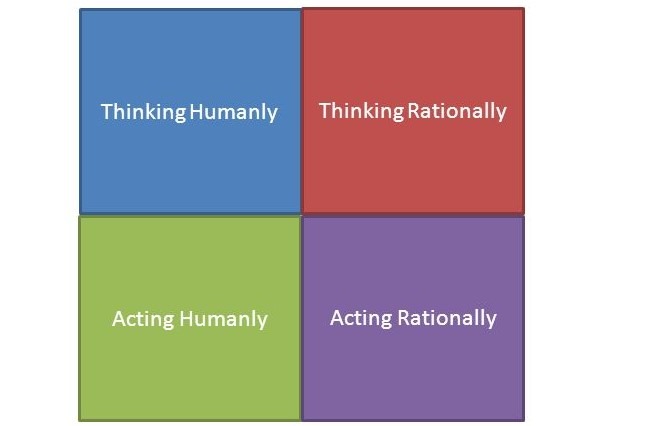
Each one answers a slightly different question: should machines think like humans, or just act intelligently? And should intelligence be based on logic, or behaviour?
Systems that think humanly
This first approach is where AI overlaps with psychology and neuroscience.
The idea is simple: if we can understand how the human brain processes information, we can try to recreate that process in machines.
This approach focuses on how humans learn, reason, and make decisions and attempts to simulate those patterns digitally.
Systems that act humanly
This is where the famous Turing Test comes in.
Proposed byAlan Turing in his 1950 paperComputing Machinery and Intelligence, the test doesn’t ask whether a machine thinks, but whether it can behave like a human convincingly enough. If you can hold a conversation with a system and can’t tell whether it’s a person or a machine, then it passes.

This approach focuses more on behaviour than internal thinking.
To get there, systems need abilities like language understanding, learning from experience, and reasoning with information. More advanced versions even require vision and physical interaction.
Systems that think rationally
The third approach shifts direction. Instead of copying human behaviour, this model is based on logic.
Machines are programmed to follow structured rules and draw conclusions from them, like solving a puzzle step by step.
It’s clean and precise in theory, but difficult in practice, because real-world situations rarely follow perfect logical patterns.
Systems that act rationally
Finally, this is the most modern approach and the one most AI systems today are built on is the idea of a rational agent
The goal here is not to imitate humans at all. It’s simply to make the best possible decision based on available information.
These systems are known as “rational agents”, they analyse data, weigh outcomes, and choose what works best.
This approach is more flexible and easier to apply in real-world systems, which is why it dominates modern AI development.
Why This Framework Matters More Than the Hype
Most conversations about AI jump straight to extremes like job loss, fake content, or futuristic machines. But those discussions often skip the most important point: AI isn’t one thing.
It’s a field shaped by different ideas of what intelligence actually is.
Some systems try to mimic humans, others ignore human behaviour entirely and focus on efficiency. Some rely on strict logic, while others learn from patterns and probabilities.
Understanding these four schools of thought makes it easier to see what AI is and what it isn’t.
Most systems today don’t “think” like humans or pass as humans.
They are built to act rationally within specific tasks, whether that’s recommending content, detecting fraud, or analysing data.
So when AI shows up in headlines, it helps to ask a better question:
What kind of intelligence is this system actually using?
Because once you understand that, AI stops feeling mysterious and starts making sense.