Filmmaker's Favorite: Rian Johnson's Surprising Christopher Nolan Thriller Pick
Rian Johnson reveals the personal inspirations behind "Wake Up Dead Man: A Knives Out Mystery," detailing its grounded, faith-based narrative and star-studded cast. The acclaimed director shares insights into his challenging writing process, his collaborations with long-time partners, and the cinematic influences that shape his unique filmmaking approach.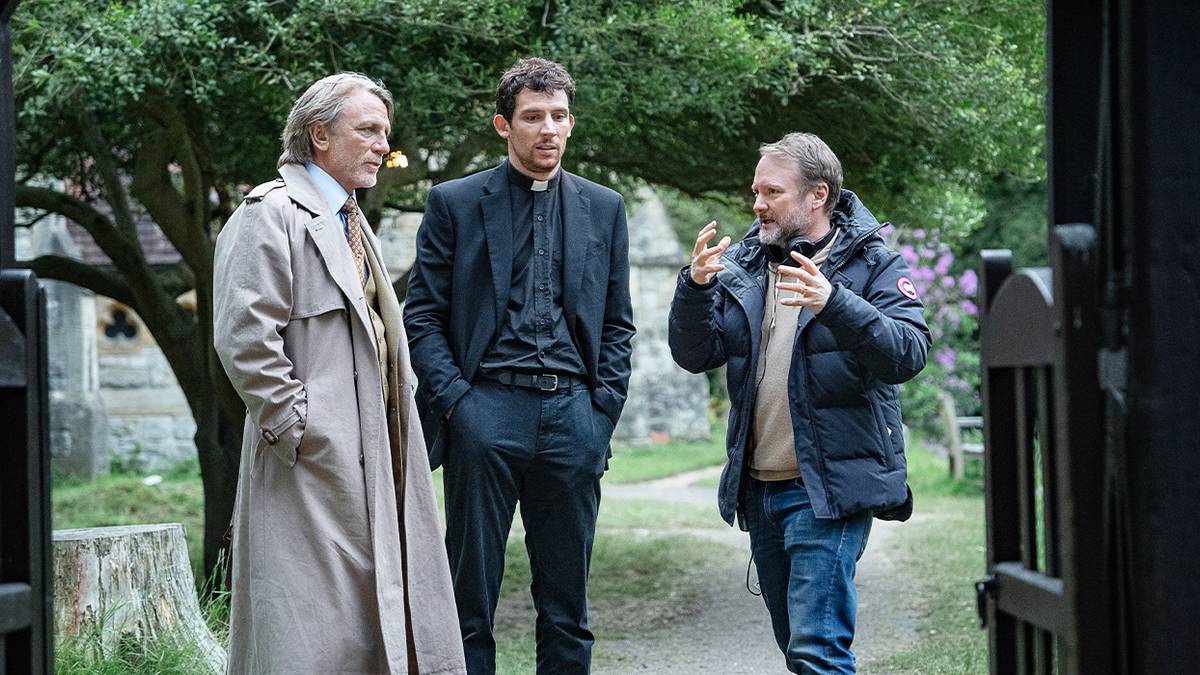
Rian Johnson's latest cinematic endeavor, "Wake Up Dead Man: A Knives Out Mystery," marks a significant shift for the acclaimed writer-director, taking a more grounded and personal approach than its predecessors. Collider's Steve Weintraub recently moderated an FYC Q&A session, where Johnson delved into the profound inspirations behind the third Benoit Blanc mystery, offering insights into his intricate writing process, collaborative spirit, and the standout performances of his ensemble cast.
Following the broad comedy of "Glass Onion," Johnson and star Daniel Craig, who reprises his role as the private detective Benoit Blanc, sought to create something more introspective and rooted. Johnson revealed that his personal journey with faith served as a foundational inspiration for "Wake Up Dead Man." Having grown up deeply Christian until his mid-twenties, he now explores these complex feelings through the film's narrative. This personal connection dovetailed with the concept of the "impossible crime," a hallmark of author John Dickson Carr, leading to a story where the miraculous aspects of faith intertwine with a seemingly unsolvable mystery, even featuring a literal resurrection scene. The film also returns to a moodier, overcast atmosphere, reminiscent of the original "Knives Out," as Blanc is summoned to an upstate New York hamlet to assist police chief Geraldine Scott (Mila Kunis) in unraveling an "impossible crime." A stellar cast joins Craig, Kunis, Josh O’Connor as young priest Jud Duplenticy, and Josh Brolin as Monsignor Jefferson Wicks. The ensemble includes Glenn Close as Martha Delacroix, Cailee Spaeny as Simone Vivane, Kerry Washington as Vera Draven, Daryl McCormack as Cy Draven, Jeremy Renner as Nat Sharp, Andrew Scott as Lee Ross, and Thomas Haden Church as Samson Holt. "Wake Up Dead Man" is slated for a theatrical release on November 26 and will premiere on Netflix on December 12.
Johnson's work is deeply influenced by the cinematic masters he admires. He articulated his difficulty in choosing a single favorite Steven Spielberg film, torn between the perfection of "Raiders of the Lost Ark" and the profound emotional impact of "E.T." Similarly, Christopher Nolan's "The Prestige" stands out to Johnson as a perfect movie among a collection of great works, alongside films like "Interstellar" and "Memento." When pressed on Stanley Kubrick, Johnson ultimately named "2001: A Space Odyssey" as his favorite, though he holds "Barry Lyndon" in exceptionally high regard. He lauded "Barry Lyndon" for its revelatory layers, visual beauty, humor, and particularly its groundbreaking cinematography, noting Kubrick's development of special, NASA-developed lenses to shoot by candlelight, creating stunning, painting-like images with incredibly shallow depths of field. Johnson also shared a fascinating anecdote from his time making "The Last Jedi," where he learned from visual effects artist Brian Johnson (no relation), who worked on "2001," about how deep depth of field in model shots was achieved by photographing 2D models, showcasing the pioneering spirit of early special effects.
The writing process for Johnson, especially for his intricate mysteries, is far from painless. He describes it as "slowly. Painfully. Miserable." His approach is highly structural, dedicating about 80% of his time to outlining in notebooks, where he meticulously develops character, theme, and sometimes even dialogue. He likens this to starting with Google Earth, zooming out to grasp the entire shape of the movie, aiming to fit its full arc onto a single page of a Moleskine notebook. Crucially, Johnson emphasizes that the mystery elements—the clue gathering and whodunit—are not the "load-bearing structure" of the film. Instead, the focus must remain on the protagonist, their desires, the obstacles they face, and crafting an emotionally satisfying, character-based ending that resonates with themes planted at the story's outset. He estimates that a script typically takes him about eight months to complete.
Editing, another critical phase of filmmaking, tends to be structured for Johnson, a process he shares with his long-time editor, Bob Ducsay, since "Looper." Pacing and running time are paramount. Johnson recounted an unusual experiment for "Wake Up Dead Man" where, feeling insecure about the film's length just two weeks before the final mix, he and Ducsay created an "asshole studio head" cut, ruthlessly trimming 30 minutes from the movie. Watching this drastically shortened version helped Johnson realize the essential nature of most of the excised material, giving him the confidence to preserve the original vision, which ultimately settled at around two hours and eighteen minutes. He acknowledges the inherent challenge of editing: making crucial decisions while creatively burnt out and lacking perspective, often requiring the instinct to allow scenes to breathe and finding solutions for a film that feels "sick" without obvious flaws.
Johnson's success is also a testament to his long-standing collaborations. Director of Photography Steve Yedlin, whom Johnson met when Yedlin was in high school and has shot all of Johnson's films, shares a deep shorthand, akin to an "old married couple," allowing them to push creative boundaries, such as the dramatic lighting changes in the church scenes of "Wake Up Dead Man." Regarding camera work, Johnson, who learned to use a second camera on "Breaking Bad," typically designs shots for a primary camera while strategically finding valuable uses for additional cameras, especially crucial for capturing reaction shots in ensemble scenes. His cousin and composer, Nathan Johnson, has scored all of his films except "The Last Jedi," having collaborated since childhood. Johnson also highlighted his method of casting ensembles, seeking actors who genuinely enjoy working as part of a collective. He expressed immense admiration for Glenn Close, a "bucket list" collaborator whose infectious, childlike enthusiasm on set inspired everyone. Josh O’Connor was a clear standout, chosen after his magnetic and versatile performances in "Challengers" and "La Chimera," with Johnson predicting O'Connor's career is "taking off into the stratosphere."
Finally, Johnson confirmed intriguing connections within his creative universe. Sharp-eyed viewers might spot a bottle of "Renning Hot," Jeremy Renner's fictional hot sauce brand from "Glass Onion," in the bar scene featuring Renner as Dr. Nat in "Wake Up Dead Man." Furthermore, Johnson confirmed that his series "Poker Face" exists within the "Knives Out" universe, referencing a Zoom call in "Glass Onion" where Natasha Lyonne's character plays a video game with Benoit Blanc, Stephen Sondheim, Kareem Abdul-Jabbar, and Angela Lansbury. This cameo was filmed in Lyonne's trailer during the production of "Poker Face." The film's setting in London for various reasons, including tax incentives and access to historic churches, also fostered a "family reunion" atmosphere with shared crew members. Joseph Gordon-Levitt makes a voice cameo as a baseball announcer, with Johnson meticulously setting a Cubs game on Good Friday 2025—a timeline playfully disrupted by the untimely fictional death of the Pope.