Europe on Edge: UK & France Prepare Troops for Ukraine Post-Ceasefire
France and the UK have pledged to deploy troops to Ukraine after a ceasefire as part of new security guarantees against future Russian aggression. This commitment, signed in Paris by French, British, and Ukrainian leaders, includes multinational military hubs, a US-led ceasefire monitoring mechanism, and a legally binding obligation for assistance, though key issues like territory and parliamentary approvals remain complex.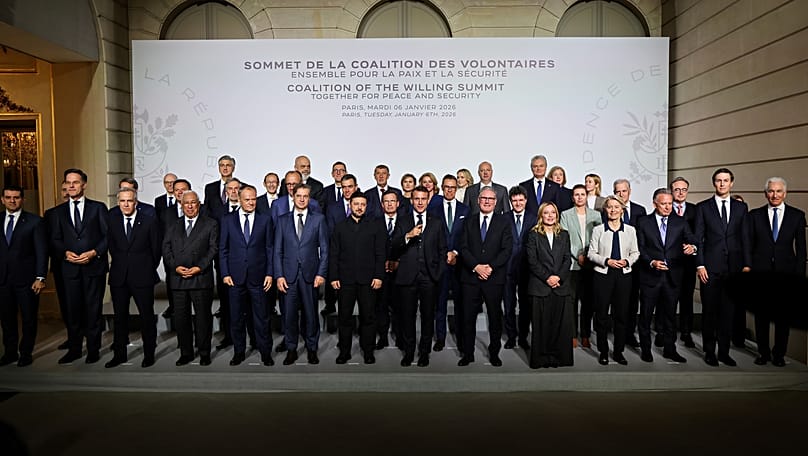
France and the United Kingdom have formally declared their intention to deploy soldiers on Ukrainian soil after an eventual ceasefire, as a critical part of a comprehensive package of security guarantees for Kyiv. This commitment aims to prevent any future full-scale invasion by Russia and was solidified in a declaration signed by French President Emmanuel Macron, British Prime Minister Keir Starmer, and Ukrainian President Volodymyr Zelenskyy following a meeting of the "Coalition of the Willing" in Paris on Tuesday.
British Prime Minister Keir Starmer announced that "following a ceasefire, the UK and France will establish military hubs across Ukraine and build protected facilities for weapons and military equipment to support Ukraine's defensive needs." President Macron further clarified that this multinational force would be deployed "away from the contact line" and operate across air, sea, and land domains to provide essential "reassurance" against future Russian attacks. He also indicated that Turkey would contribute to this operation with maritime support. Macron emphasized that these security guarantees are paramount to ensuring "a peace agreement can never mean the surrender of Ukraine or a new threat to Ukraine."
The security guarantees discussed in Paris are structured around five main pillars. These include a high-tech verification mechanism to monitor a ceasefire, to be led by the United States, robust military support for the Ukrainian army, the multinational force spearheaded by France and the UK, a legally binding obligation to assist Ukraine in the event of a renewed Russian attack, and long-term defence cooperation. The obligation to assist Ukraine, drawing comparisons to NATO's Article 5 of collective defence, would encompass military aid alongside logistical, economic, and diplomatic support. Crucially, such a commitment would necessitate ratification by national parliaments, a step that could prove challenging in some countries where support for Ukraine faces political hurdles, such as the US Congress for American involvement or the Bundestag for Germany's contribution.
German Chancellor Friedrich Merz, while stating his country "fundamentally don't rule anything out," noted that Germany's contribution would require Bundestag consent and would likely limit the deployment of military troops to countries neighboring Ukraine. In contrast, Spanish Prime Minister Pedro Sánchez announced plans to discuss Spain's potential troop contribution with main parties, expressing optimism that "There's an open door for 2026 to become the year when the war ends." However, Italy's Georgia Meloni and Poland's Donald Tusk explicitly stated their nations would not contribute troops to any mission in Ukraine.
The gathering in Paris brought together leaders from nearly 30 Western countries, along with representatives from Turkey, Australia, Japan, and New Zealand. The US delegation, notably featuring Steve Witkoff and Jared Kushner—President Donald Trump's chief negotiators—marked their first in-person attendance at this format. Witkoff conveyed President Trump's mandate for peace in Ukraine, stating, "The president does not back down from his commitments, he is strong for the country of Ukraine and for a peace deal. We will be there for the Ukrainians in helping them to get to that final peace." He affirmed that the security guarantees were "as strong as anyone has ever seen" and designed to both deter and defend against any further attacks.
Ukrainian President Volodymyr Zelenskyy hailed Tuesday's meeting as a "huge step forward" but cautiously added that these efforts were "still not enough," as he believes they will only be sufficient "when the war in Ukraine will end." For Kyiv, a credible deterrent is an indispensable condition to potentially forgo its constitutional aspiration to join NATO, which Moscow vehemently opposes and the Trump administration does not support. However, the path to an Article 5-like guarantee is complex, requiring European governments to secure parliamentary approval for such a significant commitment.
A crucial element of the security guarantees is the mechanism to monitor an eventual cessation of hostilities. This system, envisioned with high-tech sensors along the contact line, would verify potential breaches and assign responsibility. If allies determine Russia is responsible for a breach, the Article 5-like assistance would be triggered, though European officials clarify this would be a political, not an automatic, decision. Russia, for its part, has not indicated a willingness to compromise on a peace deal, maintaining its drone and missile strikes and consistently warning that any foreign troops on Ukrainian soil would be considered "legitimate targets." Moscow currently controls approximately 20% of Ukrainian territory, including significant portions of the Donbas region, and insists on Ukraine's withdrawal from all of eastern Donbas as a condition for peace.
The issue of territory remains the most critical and "thorny" sticking point in negotiations. While Zelenskyy has ruled out ceding any territory, he has suggested a mutual troop withdrawal to agreed points. Starmer acknowledged the difficult reality, stating, "We are closer to [peace] than ever but of course the hardest yards are still ahead. We can only get to a peace deal if Putin is ready to make compromises. Putin is not showing he's ready for peace." Despite the "milestone" reached in Paris, real progress hinges on Russian support, which has been conspicuously absent in recent diplomatic efforts. The prospect of a negotiated deal followed by troop deployment thus remains uncertain in the short term, with pressure growing on both sides to find compromises to end the costly, attritional war.