Deep Dive: The 'Cloverfield'-Inspired Mystery of 'The End of Oak Street'
'The End of Oak Street' plunges the Platt family into a prehistoric world after their suburban neighborhood mysteriously vanishes, forcing them to confront dinosaurs and their crumbling marriage. The film explores second chances through time alteration, allowing Denise to save her husband and reclaim her ambitions. While debunking 'Cloverfield' theories, the movie shares spiritual similarities in its mysterious marketing, ground-level disaster perspective, and unexplained phenomena.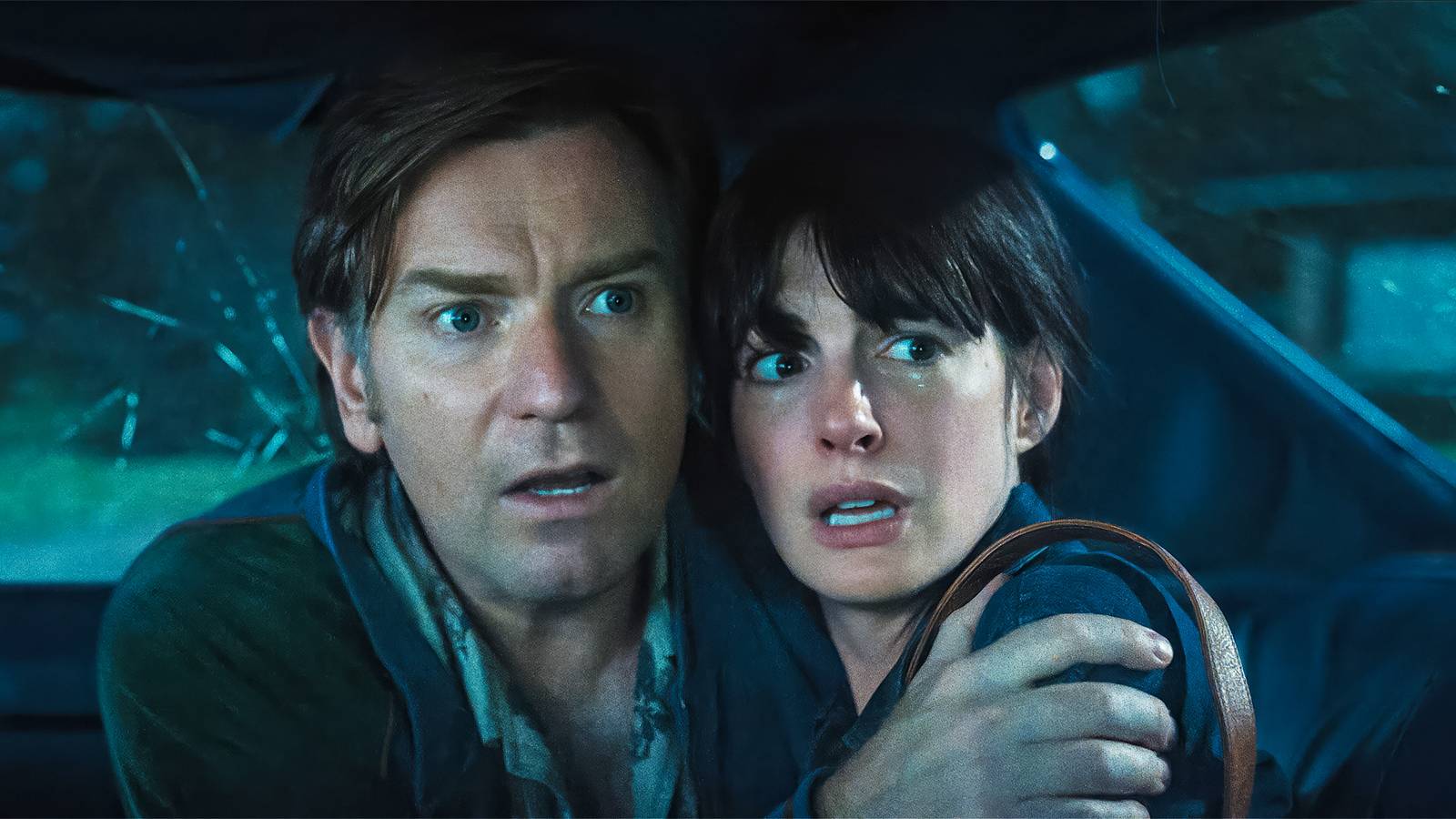
David Robert Mitchell's 'The End of Oak Street', a J.J. Abrams-produced sci-fi thriller, presents a compelling premise: what if an ordinary suburban neighborhood suddenly faced a dinosaur problem? The film, set in an idyllic 1982 suburban neighborhood, delves into the more complex reality of the Platt family – Denise (Anne Hathaway), Greg (Ewan McGregor), and their children Audrey (Maisy Stella) and Brian (Christian Convery) – whose Oak Street is mysteriously displaced millions of years into prehistoric Earth, leaving them to fight for survival against creatures from the past.
Before the cataclysmic event, Denise and Greg's marriage was already faltering, plagued by unhappiness and financial woes. The desperate struggle for survival in a dinosaur-infested past forces them to confront their marital issues, offering an unexpected opportunity for reconciliation. However, the path to mending their relationship is fraught with danger and tragedy, culminating in Greg's brutal death by a dinosaur in the original, dire timeline.
The key to the film's narrative lies in a glowing anomaly that not only serves as a potential gateway back to their own time but also offers Denise a profound second chance. Crucially, the anomaly doesn't return them to the exact moment Oak Street disappeared, but rather sends them back to a point shortly before it happened, enabling them to alter the original timeline. Armed with the harrowing memories of their prehistoric ordeal and Greg’s death, Denise recognizes the opportunity to prevent past tragedies.
Denise takes decisive action, leveraging her foreknowledge to save her husband. By subtly arranging for Greg to be away from Oak Street (specifically, by ordering a pizza) at the precise moment the anomaly strikes, she ensures his survival. The subsequent reunion is deeply emotional for Denise and her children, who have just witnessed his demise, while the "new" Greg, oblivious to the horrific events, is bewildered by their intense relief. Extending this newfound power, Denise also uses a payphone to warn several neighbors, allowing them to escape the neighborhood before it vanishes. Consequently, when the anomaly reoccurs, Oak Street still disappears, but its residents are spared from its perilous journey.
Two years later, the Platts enjoy a complicated happy ending. Greg is alive, Denise has found renewed ambition, and is preparing to publish a book aptly titled 'The End of Oak Street'. The enormous complication, however, is Greg’s complete lack of memory regarding their prehistoric ordeal or the transformative conversations that mended their relationship. Denise has her beloved husband back, but he is not entirely the same man she lost. Yet, tangible evidence of their other life persists, such as a wonderfully ridiculous photograph of Greg posing in front of mating dinosaurs, which the current Greg has no recollection of taking. The film also introduces a fascinating anomaly with Jeannette (Jordan Alexa Davis), showing two versions of her in the new timeline: the one who traveled back with the Platts and her younger counterpart who already existed, implying that the time-travelers physically inserted themselves into their past, a detail the movie doesn't extensively explain.
'The End of Oak Street' ultimately transcends its time-travel and dinosaur premise, using its "bonkers science-fiction" to explore deeper themes. David Robert Mitchell isn't interested in an airtight time-travel puzzle but rather in giving Denise the opportunity to make different choices and reclaim her life. Her initial life saw her marriage crumbling and her ambitions sidelined. Losing Greg forces her to confront what she truly desires from their relationship. By writing 'The End of Oak Street', Denise ensures that their shared, traumatic experience, particularly the memory of the Greg she lost, remains tangible and honored, even if the man beside her doesn't remember it. The film's surprisingly simple final idea is that while Denise cannot change what happened to the Greg who died, she can fundamentally change what happens to him next, sometimes necessitating a break in the space-time continuum for a truly happy ending.
In the lead-up to its release, 'The End of Oak Street' generated considerable fan speculation about its potential connection to the 'Cloverfield' franchise, given producer J.J. Abrams' involvement and a shared last name (Platt) with a 'Cloverfield' character, alongside geographical links. However, the film decisively shuts down these theories, making no indication of a direct connection. Abrams himself clarified that the only link was Ewan McGregor's real-life partnership with Mary Elizabeth Winstead, who starred in '10 Cloverfield Lane'.
Despite the lack of a direct canonical link, 'The End of Oak Street' shares a spiritual kinship with the 'Cloverfield' trilogy through several storytelling elements. One strong conceptual link is Audrey's wormhole theory, which suggests rifts in space could transport people and places across time. This echoes 'The Cloverfield Paradox', where a particle accelerator experiment causes tears in reality, leading to creatures from alternate dimensions appearing on Earth, and news reports within that film even mention city blocks disappearing.
Another shared characteristic is the ground-level perspective of disaster. Unlike typical disaster movies with multiple viewpoints, 'The End of Oak Street' remains strictly with the Platt family, showcasing ordinary people struggling to survive an inexplicable catastrophe. This mirrors the 'Cloverfield' franchise's approach, from the found-footage perspective of the first film to Michelle's bunker experience in '10 Cloverfield Lane', and even the space crew's helpless observation in 'The Cloverfield Paradox', where fantastical events are witnessed intimately by regular individuals.
The film's initial marketing also drew parallels to 'Cloverfield's' trademark enigmatic campaigns. 'The End of Oak Street' began with restrained trailers, obscuring dinosaurs and offering minimal plot details, much like the first 'Cloverfield' trailer that arrived untitled. This "less-is-more" approach generated anticipation and mystery, a hallmark of the 'Cloverfield' marketing strategy, which included viral Easter eggs and the surprise Netflix release of 'The Cloverfield Paradox'.
Ultimately, 'The End of Oak Street' embraces a sense of the dreaded unknown. The 'how and why' of Oak Street's transportation remains unexplained at the film's conclusion, leaving audiences with a chilling mystery. This aligns with the 'Cloverfield' franchise's enigmatic tone, where creature origins and alien invasion reasons are often opaque, offering implications rather than concrete answers. The terrifying aspect lies in the unexplained: if the cause is unknown, its recurrence remains a terrifying possibility. While it stands as a standalone thrilling adventure, directed by David Robert Mitchell and starring Anne Hathaway and Ewan McGregor, its storytelling evokes the captivating spirit of 1980s Amblin movies.