Celestial Spectacle: Africa Prepares for Rare Blood Moon Eclipse, Blending Science with Ancient Beliefs!
Kenyans witnessed a spectacular 'Blood Moon' total lunar eclipse on September 7, 2025, coinciding with the launch of the country's first dedicated astro-tourism experience in Samburu. This initiative combines celestial observation with cultural and scientific exploration, aiming to diversify tourism and offer unique stargazing opportunities.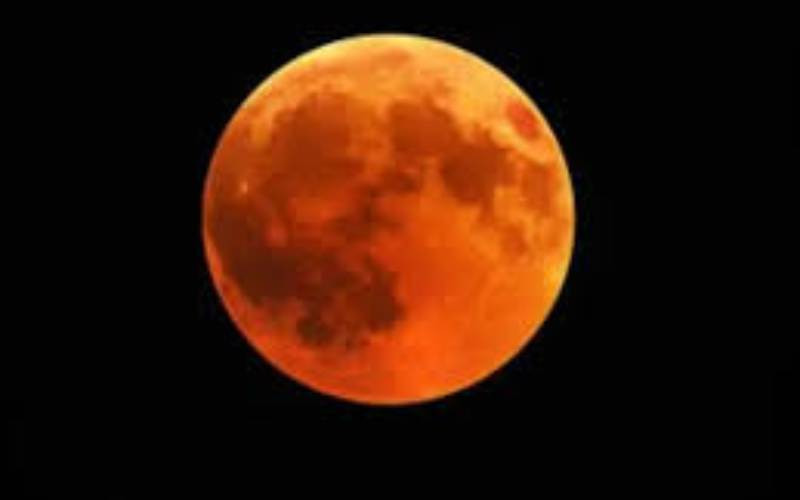
On Sunday, September 7, 2025, Kenyans and skywatchers across much of Africa and the world were treated to a mesmerizing total lunar eclipse, commonly known as a “Blood Moon.” This spectacular celestial event, where the Moon takes on a deep red or coppery glow, occurs when the Earth passes directly between the Sun and the Moon, casting its shadow across the lunar surface. The distinctive crimson hue is a result of sunlight bending through Earth’s atmosphere, filtering out blue light and leaving the red and orange spectrum.
The eclipse unfolded in four distinct stages. It began with the penumbral eclipse at 6:28 p.m. in Nairobi, a subtle shading as the Moon entered Earth’s outer shadow. This was followed by the partial eclipse at 7:27 p.m., where the Moon progressively darkened from one side. The total eclipse phase commenced at 8:31 p.m., when the bright moonlight vanished, and the Moon began to glow with its deep red hue. The maximum eclipse occurred at 9:12 p.m., lasting approximately 41 minutes, with the Moon sitting entirely in the darkest part of Earth’s shadow. Depending on atmospheric conditions, its glow ranged from vivid red to dusky orange or brownish grey. The total celestial show lasted for more than five hours, with the red moon visible for about one hour and 22 minutes at its peak. Unlike solar eclipses, the Blood Moon is completely safe to view with the naked eye, requiring no special glasses or filters, and was fully visible across Kenya.
Coinciding with this stunning lunar event, Kenya launched its first dedicated astro-tourism experience. The inaugural initiative took place in Samburu County, at Sopa Lodge in Samburu National Reserve, an event graced by Tourism and Wildlife Cabinet Secretary Rebecca Miano. This pioneering move aims to expand Kenya’s tourism catalogue beyond traditional safaris, wildlife, beaches, and cultural tourism. Other locations across the country, including Waterfront in Karen (Nairobi), The Landing in Nanyuki, Ileret Campus of Turkana Basin Institute, and Fort Place Grill in Kabete (Kiambu County), also hosted enthusiasts for the lunar event.
Samburu County stands out as an ideal location for astro-tourism due to its remote and protected environment, boasting some of the darkest skies in the world. Its pristine night skies, minimal light pollution, and clear equatorial skies offer an exceptional experience for observing celestial events, including the Milky Way, constellations, meteor showers, stars, and planets. The unique landscape and cool breeze further enhance this promising experience, attracting astronomy enthusiasts and adventure travelers.
The rise of astro-tourism is fueled by a renewed global interest in celestial wonders. Kenya, strategically located along the equator with pristine skies across several locations and nearly equal night-day hours year-round, is well-positioned to unlock the potential of this new frontier. This diversification is expected to create new jobs for local guides, hospitality workers, and artisans, promote community-led tourism projects that preserve cultural heritage, stimulate investment in infrastructure and environmental conservation, and boost Kenya’s appeal in high-value niche markets for eco-tourists and astronomy enthusiasts.
The astro-tourism catalogue assembled by Magical Kenya features a range of experiences: guided night sky tours with expert astronomers, astrophotography expeditions to capture rare celestial events, educational workshops, and starlit camp experiences. A crucial aspect of this initiative is the integration of indigenous astronomical knowledge from Samburu communities, offering visitors a unique cultural perspective on the stars. Visitors can also combine night sky explorations with daytime wildlife safaris and nature walks, enriching their overall experience.
Beyond its spectacular visual appeal, the lunar eclipse holds significant cultural and scientific importance. Historically, across many groups of people, the event inspired myths and deeply held beliefs. Among the Samburu of Kenya, a lunar eclipse signals an unfavorable period, suspending celebrations until universal balance is restored. The Maasai interpret it as a struggle in the heavens, with communities responding with shaming chants. Along Kenya’s coast, various tribes view eclipses as powerful omens of misfortune, enforcing prohibitions on activities like cooking and childbirth and necessitating ritual cleansing. In West Africa, the Yoruba imagine it as a quarrel between cosmic siblings, requiring prayers and offerings, while the Bambara and Dogon of Mali regard eclipses as profound thresholds through which ancestors offer prophecy and guidance.
In contrast to these ancient interpretations, modern science encourages viewing eclipses with curiosity. Unlike solar eclipses, lunar eclipses pose no harm to the eyes, and no special glasses or filters are required. For scientists, lunar eclipses serve as natural laboratories. By analyzing the sunlight filtered and refracted through Earth’s atmosphere during totality, researchers can detect atmospheric gases, dust content, and pollutants, contributing to climate models. The soft red illumination also highlights lunar surface features, aiding in mapping and understanding lunar composition. Moreover, the precise geometry of eclipses is invaluable for orbital mechanics, allowing astronomers to refine calculations of Earth-Moon distance, orbital tilts, and gravitational forces. Historically, eclipses were crucial for timekeeping, helping ancient civilizations refine calendars and predict future celestial phenomena, with the Saros cycle remaining a foundational predictive tool. Thus, while a total lunar eclipse dazzles as a public spectacle, for scientists, it continues to be a gateway into discovery, revealing secrets about our atmosphere, our nearest neighbor, and the delicate orbital choreography that binds them together.