Bitcoin's Ghost Revealed: Satoshi Nakamoto's Identity Rocks Crypto World

The true identity of Satoshi Nakamoto, the enigmatic creator of Bitcoin, has been shrouded in mystery since the digital currency's unveiling on Halloween 2008. For over 17 years, Nakamoto's anonymity has fueled speculation, with various individuals being put forward as potential candidates. However, a recent extensive investigation by the New York Times, involving artificial intelligence and forensic linguistics experts, has claimed to unmask the anonymous architect as Adam Back, a 55-year-old British computer scientist and entrepreneur.
The New York Times's report details a years-long effort to uncover Nakamoto, focusing on Back. The investigation involved meticulously trawling through thousands of decades-old internet postings and analyzing commonalities in public writings. John Carreyrou, the journalist behind the report, unearthed similarities in offhand comments—such as “I’m better with code than I am with words”—and shared niche interests between Back and Satoshi. Timelines were compared, noting Back's sudden dormancy on cryptography-related forums at the same time Satoshi Nakamoto emerged. Advanced artificial intelligence was also employed to compare their language use.
The linguistic analysis formed a critical part of the evidence. Researchers identified an idiosyncratic dialect that peculiarly alternated between British and American spellings. A list of over a hundred words and phrases stood out, including “dang,” “backup” (used as a verb in one word), “human-friendly,” “on principle,” “burning the money,” “abandonware,” “hand tuned,” “partial pre-image,” and the unique phrase “a menace to the network.” Beyond specific vocabulary, unique linguistic quirks were noted, such as Back and Satoshi both frequently confusing “it’s” and “its,” inserting “also” at the end of sentences, and being “pathologically incapable” of using hyphens correctly. They also inconsistently wrote compounds like “backup” and “bugfix” as single words. Robert Leonard, a forensic linguistics expert at Hofstra University, confirmed these patterns as “markers of sociolinguistic variation,” akin to syntactical fingerprints.
Further evidence emerged from the consistent hyphenation of cryptographic concepts like “proof of work” and “partial pre-image,” both crucial for describing Bitcoin’s Hashcash-like mining function, by both figures. The phrase “burning the money,” which Satoshi used to mean destroying bitcoins, was previously found to have been used by only one other individual on community mailing lists: Adam Back in April 1999. Computational text analysis on a merged archive of Cypherpunks, Cryptography, and Hashcash mailing lists identified Back as overwhelmingly sharing the same dialect as Satoshi, leading a search of 620 candidates to place him at the top, sharing 521 synonym-less words.
When confronted by the New York Times at a Bitcoin conference in El Salvador, Back resolutely denied being Satoshi, stating, “Ultimately, it doesn’t prove anything. And I will reassure you, it’s really not me.” However, his body language reportedly told a different story; he reddened, shifted uncomfortably, and made a conversational slip, appearing to speak as if he were Satoshi. Similar reactions were observed when he was questioned for an HBO documentary. Despite the mounting evidence, Back maintained his denials on X, stating, “I’m not Satoshi” and attributing the similarities to “a combination of coincidence and similar phrases from people with similar experience and interests.” He also famously posted, “We are all Satoshi.”
Adam Back's background makes him a compelling figure in this mystery. A University of Exeter-educated cryptographer, he is the CEO of Blockstream, a blockchain technology company he founded in 2014. Critically, Back invented Hashcash in 1997, a proof-of-work algorithm cited by Satoshi in the original Bitcoin white paper as the basis for its mining function. He was an early member of the Cypherpunks, an online anarchist cryptography community from the early 1990s that advocated for using cryptography to ensure individual privacy. If Back were indeed Nakamoto, he would possess an estimated 1.1 million Bitcoin coins, currently valued at tens of billions of pounds, a fortune that would necessitate disclosure to the Securities and Exchange Commission due to its material effect on the Bitcoin market.
While some, like Polymarket gambler Domer, were 99% convinced by the article’s findings, others remained skeptical. Stephen Murdoch, a professor of computer science at University College London, acknowledged “some indication that it’s him, but there’s no smoking gun,” still betting on Hal Finney, who received the first Bitcoin transaction from Satoshi. Dr. Jacky Mallett, an assistant professor of computer science at Reykjavík University, suggested Satoshi was “almost certainly more than one person,” citing updates to the Bitcoin code indicative of multiple contributors and a deeper understanding of financial structures. Despite Back's firm denials, the New York Times's investigation presents a compelling, albeit still debated, case for identifying Adam Back as the long-sought Satoshi Nakamoto.
You may also like...
It's Easier to Fly to Europe Than to Another African Country, And That's Not by Accident

Intra-African travel remains harder than trips to Europe due to colonial-era borders, weak passports, and policy choices...
What If Your Body Could Heal Arthritis Instead of Just Managing It?

Duke University’s breakthrough in regenerative arthritis therapy could shift treatment from pain management to joint rep...
Countries A Nigerian Passport Holder Can Enter Without a Visa in 2026

A Nigerian passport holder can access 44 destinations visa-free or with simplified entry in 2026. Here is the full list ...
10 Countries That Grant Easy Citizenship by Birth

These are 10 countries that offer easy citizenship by birth, providing children with access to education, healthcare, an...
WGA Deal: Senatorial Pressure Mounts Amidst $321M Health Fund Details

The Writers Guild of America has struck a four-year deal with major studios, significantly overhauling its health care p...
Halle Bailey & Regé-Jean Page's 'You, Me & Tuscany' Sparks Divided Reviews

Halle Bailey and Regé-Jean Page star in "You, Me & Tuscany," a new romantic comedy set in Italy about an impulsive journ...
Historic Musical Fusion: Andrea Bocelli to Share Stage with Cumbia Stars Los Ángeles Azules and Ximena Sariñana in Mexico

Andrea Bocelli is set to perform a free concert at Mexico City's Zócalo on April 18, joined by Los Ángeles Azules and Xi...
Mystery Solved: Osas Ighodaro & Johnny Drille Finally Address Relationship Rumors!
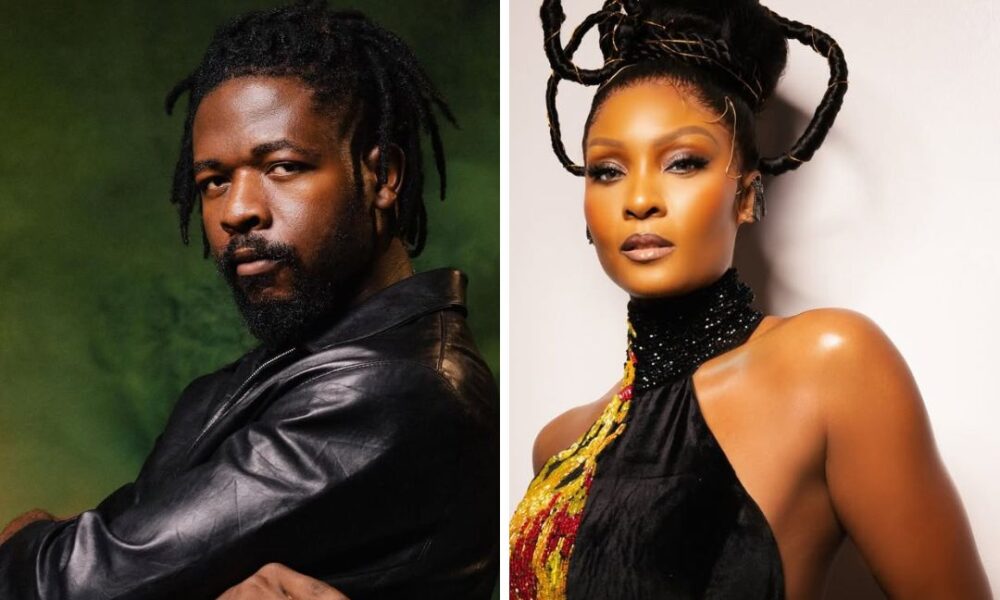
Nigerian actress Osas Ighodaro and singer Johnny Drille recently appeared on THE BTML POD to address long-standing specu...