Before Vanilla Was Everywhere, There Was Edmund Albius
Before vanilla became a global staple, a 12-year-old boy named Edmund Albius changed history. This piece explores the origin of vanilla, the invention that made it global, and the legacy behind the flavour.
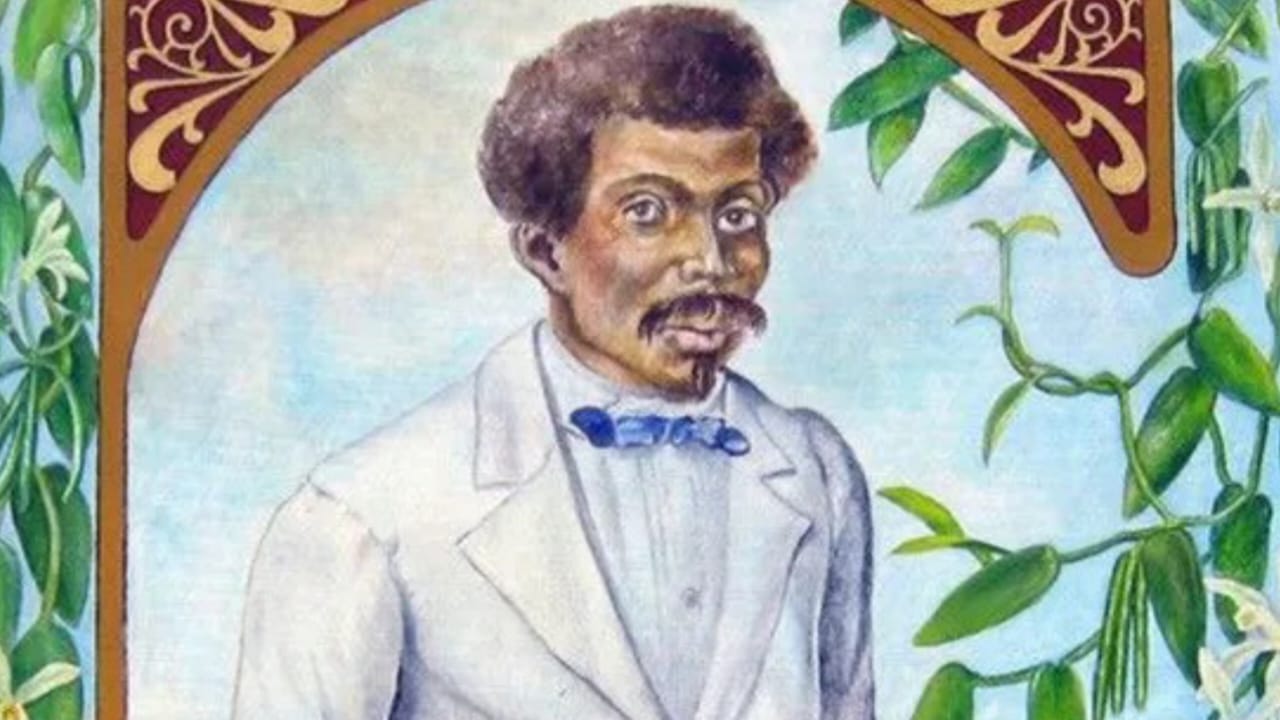
Vanilla is everywhere, and maybe you love it without thinking twice. We see it everywhere quietly added to our everyday life and food; ice cream, perfumes, candles, cakes, lotions, even memories.
For many of us it is familiar, comforting, almost invisible in its ubiquity. But have you ever paused to wonder how vanilla became so common? How the vanilla flavour has ended up woven into daily life across the world?
What many people do not know is that the global vanilla industry exists because of a child—a black child, his name was Edmund Albius. Long before vanilla became a staple commodity and a multi-billion-dollar global trade, it was a stubborn plant that refused to cooperate outside its native home and it took the ingenuity of a 12-year-old boy in 1841 to unlock its secret.
This is not just about a story that talks about flavour but a story about knowledge, innovation, and how history often remembers the product but forgets the person who made it possible.
Vanilla Before the World Knew What to Do With It
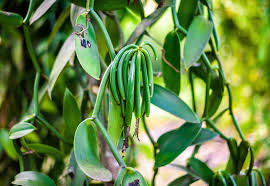
Vanilla did not actually begin as a global ingredient, it originated in Mexico, where Indigenous farmers had cultivated it for centuries. The word ‘vanilla’ itself actually means ‘little pod’; it is derived from the Spanish word ‘vainillia’, a diminutive of ‘vaina’, which means ‘sheath’ or ‘pod’.
The most widely known is the vanilla orchid, and it is the only one cultivated for vanilla production and it is a flat-leaved vanilla plant (Vanilla planifolia)
The cultivation of the vanilla orchid in Mexico thrived because nature had already solved the problem humans elsewhere could not, which was undisturbed pollination. Specific native bees and insects made the process effortless. Flowers bloomed and pollination happened naturally, and vanilla beans followed.
So when the early Europeans encountered vanilla, they immediately saw its economic potential and immediately transported the plant out of Mexico, hoping to grow it in other tropical colonies in their regions and replicate its value on a larger scale.
What they did, didn't actually yield any results, the lands they used were fertile and its climate suitable for planting and obviously they had abundant labour in the form of physical manpower, yet something crucial was missing.
History
Rewind the Stories that Made Africa, Africa
A Journey Through Time, Narrated with Insight.
Outside Mexico, the vanilla flowers bloomed beautifully and then died,no beans, no harvest and predictably there was no profit.
For decades, botanists, plantation owners, and scientists failed to make vanilla reproduce. The plant resisted every attempt and although colonisers had the infrastructure and resources for the planting process, they did not have the solution. Vanilla remained rare, expensive, and limited, it was a luxury without scalability.
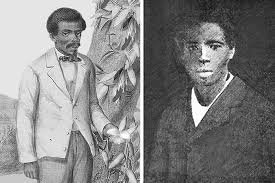
Then, on the island of Réunion, a French colony in the Indian Ocean near Madagascar, a young boy observed something others had overlooked and brought about the whole vanilla industry we know today.
Edmund Albius and the Quiet Genius That Changed Everything
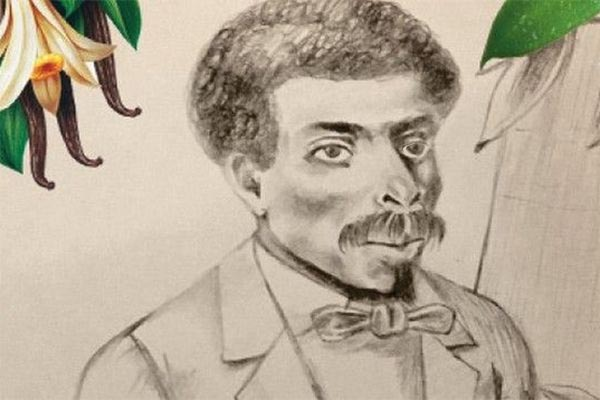

In 1841, Edmund Albius was 12 years old, who was actually born into slavery and was living and working on a plantation in Réunion. He did not have formal scientific training, but he had something just as powerful, curiosity and close observation. Edmond worked in fields where a single Vanilla Orchid vine grew. There, he discovered a way to pollinate the flowers by hand with a technique still used to produce vanilla today.
He noticed the structure of the vanilla flower, specifically, a thin membrane that prevented self-pollination. Using a simple, precise motion, he devised a method to pollinate the plant by hand.
That single act that he did changed the future of vanilla forever.
For the first time, vanilla could be cultivated outside Mexico. Not experimentally, but reliably and vanilla plants grew without any complication. The method spread quickly across Réunion and then into Madagascar, which would later become the world’s largest producer of vanilla.
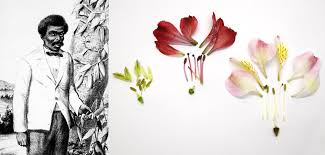
Entire economies were built around this discovery, because after his discovery and way of pollination, vanilla became scalable, exportable, and profitable outside the borders of Mexico.
And here is the most striking part: every natural vanilla bean produced today is still hand-pollinated using Edmund Albius’ method; nearly two centuries later, the process has not fundamentally changed.
History
Rewind the Stories that Made Africa, Africa
A Journey Through Time, Narrated with Insight.
And why the world adopted his knowledge, industries flourished, markets expanded and wealth accumulated. The brain behind all of this did not get his full accolades.
Edmund did not receive any royalties or any form of recognition in his lifetime to commensurate with his contribution. His freedom came later, in 1848, not as a reward for innovation but as a consequence of France abolishing slavery in its colonies. The system absorbed his genius but did not centre his humanity.
While it is said that there were petitions to the government of Réunion to provide Edmond some form of monetary compensation for his significant contribution to the economy, the petitions were ultimately unsuccessful. Edmond died in poverty in St. Suzanne, Réunion in 1880.
Still, his legacy has persisted, not in monuments or fortunes, but in practice. Quietly and repeatedly across the globe, farmers still depend on Edmund techniques for their means of livelihoods and farm practices, a technique invented by a boy history nearly forgot.
What Vanilla Teaches Us About History and Recognition
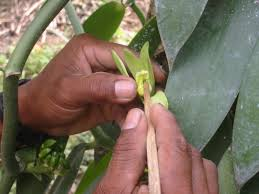
Today, vanilla is a global commodity worth billions of dollars. It flavours desserts, anchors perfumes, and scents homes. It feels ordinary now, almost inevitable and seen everywhere. But its journey reminds us that history is often shaped by overlooked minds, especially those far removed from power.
Edmund Albius did not write books or file patents. His innovation lived in action, it travelled hand to hand, field to field, generation to generation and yet, his name rarely appears alongside the industry he made possible and this piece intends to do so.
This story is not only about loss or injustice, though those elements exist quietly in the background. It is about recognition and also about how knowledge can come from anywhere. About how a child, observing carefully, can change the trajectory of global trade centuries after his existence.
When you consume vanilla today, you are participating in a legacy that began with a moment of insight on a small island. Remembering Edmund Albius does not diminish the product, it deepens it and gives life to the curiosity of a young boy.
History
Rewind the Stories that Made Africa, Africa
A Journey Through Time, Narrated with Insight.
It reminds us that behind even the most familiar things are stories of human brilliance, sometimes uncelebrated, often uncompensated, but undeniably transformative.
You may not have heard about the black genius who transformed the future of vanilla, but now, you know.