Zelenskyy's Inner Circle Rocked by Escalating Anti-Corruption Probes
Ukraine is grappling with a series of high-profile corruption probes, implicating several senior officials and close associates of President Volodymyr Zelenskyy, including his former chief of staff and a long-time friend. These investigations, such as "Operation Midas" and "Operation Forest Gump," involve allegations of money laundering and kickbacks, creating a challenging political environment for Zelenskyy and intensifying scrutiny amidst Ukraine's EU accession efforts.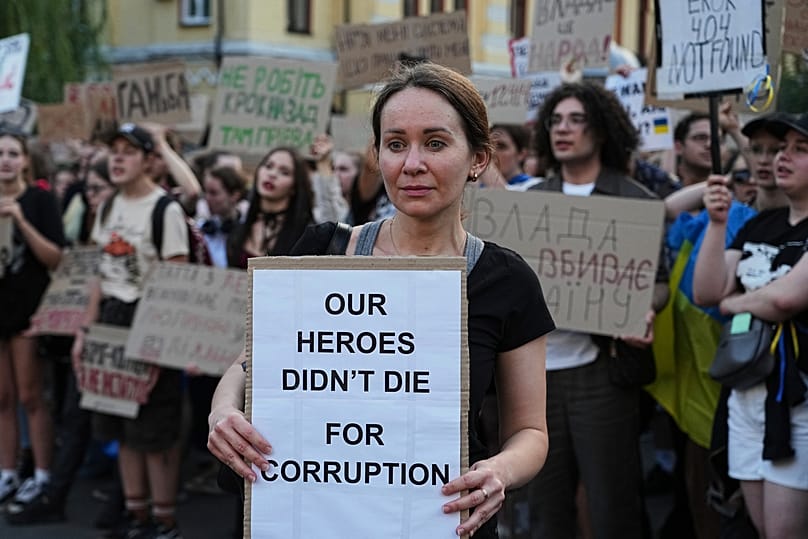
Ukraine's President Volodymyr Zelenskyy recently dismissed deputy chief of staff Iryna Mudra amidst a significant anti-corruption probe targeting an alleged criminal organization with ties to the president's office. The National Anti-Corruption Bureau (NABU) identified Mudra, a current member of parliament, a former lawmaker, and top officials from a state-owned bank, believed to be Sense Bank, as suspects in this widespread investigation. The group is accused of laundering approximately €3 million (150 million Ukrainian hryvnia), funds that were posted as bail for a suspect involved in another major corruption case, known as Operation Midas.
Operation Midas, unveiled by NABU and the Specialised Anti-Corruption Prosecutor's Office (SAPO) in November 2025 after more than a year of investigation, is considered the largest corruption probe of Zelenskyy's presidency. It focuses on alleged corruption within Energoatom, Ukraine's state nuclear power company. Investigators claim members of a criminal organization, despite holding no formal positions, influenced Energoatom to extract kickbacks ranging from 10-15% of contract values from suppliers. It's estimated that around €85 million was laundered through this scheme, which implicated former Justice and Energy Minister Herman Halushchenko in money laundering and participation in a criminal organization. NABU reported in February that over $7.4 million, €2.4 million, and 1.3 million Swiss francs connected to the alleged scheme had been transferred to his family. The €3 million central to the latest probe, dubbed Operation Forest Gump, was allegedly Halushchenko's bail money.
Sense Bank reportedly facilitated the transfer of a portion of the bail funds. Audio recordings released by NABU feature Iryna Mudra discussing Sense Bank and alleged efforts to influence decisions related to it. In one recorded conversation from June, Mudra mentioned being informed of a visit from the bank's chief executive and supervisory board head, also referring to a person named “David” and a parliamentary committee head seeking to provide political cover for the bank. It remains unclear if “David” refers to David Arakhamia, the head of Zelenskyy's Servant of the People faction. In another recording, Mudra spoke of “Timur,” described as “an Israeli refugee,” asking her to take responsibility for Sense Bank. This description appears to refer to Timur Mindich, Zelenskyy's long-time friend and former business partner, who is an alleged ringleader of the €85 million Midas corruption scheme.
Mindich, a co-owner of Kvartal 95, the production company co-founded by Zelenskyy, was part of the president's inner circle before his entry into politics. A suspect in Operation Midas, Mindich departed Ukraine for Israel in November 2025. He has also been implicated in the Dynasty investigation, where NABU and SAPO allege that over €8.8 million was laundered through a luxury residential development near Kyiv, with funds partly sourced from corruption schemes, including those at Energoatom.
The Dynasty investigation also involves Andriy Yermak, Zelenskyy's former chief of staff and a prominent figure in Ukrainian politics from 2020 to 2025. In May 2026, NABU and SAPO named Yermak a suspect in the Dynasty money-laundering case, leading to a court-ordered €2.7 million bail, which was subsequently paid. Yermak has consistently denied these allegations. Additionally, former deputy prime minister Oleksiy Chernyshov, a long-time friend of the president's family who held several senior government positions, was also implicated in the Dynasty probe.
Other former officials from the President's Office have also faced investigations. Rostyslav Shurma, a former deputy head responsible for economic policy, was named a suspect in January in a separate case involving alleged abuses of Ukraine's renewable-energy subsidy system. NABU and SAPO suspect Shurma, his brother Oleh, and others of embezzling approximately €2.7 million. Both brothers were placed on a wanted list in February, and a court ordered their detention in absentia in April. Shurma, currently abroad, has denied any wrongdoing.
These extensive investigations come at a critical juncture for Ukraine's aspirations to join the European Union. Kyiv and Brussels commenced the 'Fundamentals' cluster of Ukraine's accession negotiations in June, which encompasses crucial areas like rule of law, judiciary, public procurement, and financial control. A second cluster, covering external relations, followed in July. The EU has explicitly stated that progress on the 'Fundamentals' cluster will dictate the overall pace of Ukraine's accession negotiations, thereby placing significant scrutiny on the independence and effectiveness of the country's anti-corruption institutions.
The ongoing series of probes creates an increasingly challenging political landscape for President Zelenskyy. With his former chief of staff, former deputy chiefs of staff, long-time friends, former business partners, and ministers from his administration all implicated, the proximity of these investigations to his inner circle carries a heavy political cost. Public sentiment is also strong, with tens of thousands of Ukrainians protesting in 2025 to safeguard the independence of NABU and SAPO. For a president who ascended to power in 2019 on a platform of dismantling Ukraine's corrupt political establishment, the current situation presents a formidable test, despite Zelenskyy himself not being named a suspect in any of the investigations.