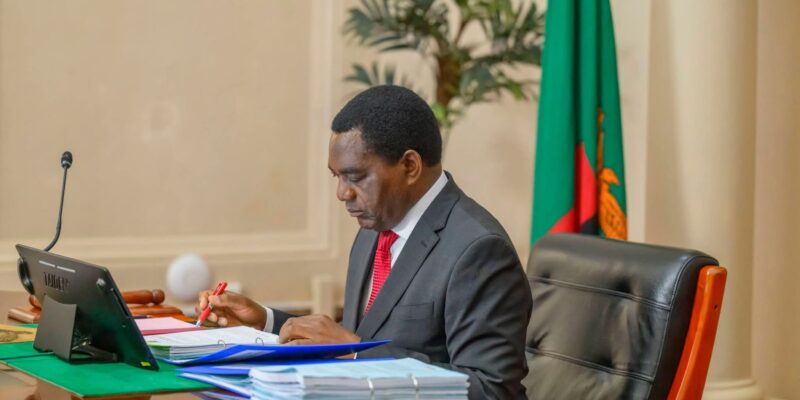
Zambia's Electoral Showdown: HH Faces Intense Competition, Election Fraud Allegations Surface

The political landscape in Zambia is increasingly charged as the nation approaches the 2026 General Elections, characterized by internal party dynamics within the ruling United Party for National Development (UPND), crucial electoral integrity concerns, and a tightening contest between the incumbent and the opposition. President Hakainde Hichilema’s ambitious target of securing 5 million votes is reportedly jeopardized by some UPND senior officials, whose provocative statements and conflicting narratives are creating an unfavorable environment for party unity and public confidence. The party's internal disunity is exacerbated by issues like the controversial double adoption process, which saw many candidates filing as independents.
According to Deputy Secretary General Ms. Getrude Imenda, the double adoption was initially a strategic ‘gimmick’ to ensure a standby candidate if the primary one failed to file. However, the nationwide fallout from this exercise, including widespread confusion and disunity, suggests a failure in proper communication and sensitization regarding candidate protocols. This has led to a significant number of UPND candidates running independently, numbers crucial for the 5 million vote target. While Copperbelt Provincial Chairperson Mr. Elisha Matambo advocates for winning back these independent candidates, some UPND officials are unfortunately demonizing them, a move described as ‘suicidal and unpolitical’ by observers. The Citizens in Charge (CIC) platform notes that UPND has often suffered more from its internal inertia than external opposition pressure, citing instances like by-election losses in Chawama and Petauke due to negligence, contrasting with victories led by Hon. Elvis Nkandu, who is praised for his strategic political acumen.
Further complicating matters for the UPND, former local government minister Hon. Gary Nkombo's independent candidacy in Mazabuka Central has caused significant internal friction and even violence. Warnings from Southern Province Chairperson Mr. Billy Makwembo against independent candidates using the President's name highlight the deep-seated divisions. Despite Nkombo’s past issues, he retains national leverage and respect, a factor that some excited officials are reportedly overlooking. However, UPND spokesperson Cornelius Mweetwa dismisses claims of internal wrangles, stating that the double adoption process is a legitimate measure to manage emerging issues during nominations and is not unique. Mweetwa expresses confidence in the party's victory, citing progress in economic recovery, transformation, stability, and resilience.
Parallel to the political maneuvering, Zambia’s democratic framework and electoral integrity are under scrutiny. Tobbius Hamunkoyo critiques Michael Mulusa's analysis, emphasizing that Zambia operates on constitutional systems, electoral laws, and institutions, not personal decisions of individuals. The role of the Returning Officer for presidential elections, which shifted from the Chief Justice (under the 1991 Constitution) to the Chairperson of the Electoral Commission of Zambia (ECZ) after the 2016 constitutional amendments, is administrative – managing and declaring verified election outcomes based on the will of the people, not choosing a president. Zambia's history of peaceful power transfers (1991, 2011, 2021) underscores that it is the millions of citizens voting, not individual ECZ officials, who decide national leadership.
The Examinations Council of Zambia (ECZ) has also reported critical developments, detecting 10 forged Grade 12 certificates during the verification process for aspiring candidates ahead of the 2026 elections. ECZ Executive Director Dr. Michael Chilala expressed concern over candidates presenting false qualifications, which violate constitutional academic requirements for public office (Articles 70(1)(d), 100(1)(e), 153(4)(c), and 154(2)(d)). Despite the reduction in forged documents compared to 2016, these cases have been reported to law enforcement, demonstrating ECZ’s commitment to electoral integrity with robust systems dating back to the 1960s. The council successfully issued 10,731 qualification confirmation letters, predominantly through its online system.
The Independent Broadcasting Authority (IBA) has introduced new guidelines for media coverage during the electoral period to ensure fair, balanced, and responsible reporting. Key provisions include equitable allocation of advertising airtime, professional conduct in political interviews, and full disclosure for opinion polls. The guidelines also prohibit campaign interviews on polling day, prediction of election results before official confirmation, and the broadcasting of hate speech, tribalism, incitement to violence, or misinformation. IBA Director General Webster Malido emphasized that professional media coverage is vital for peaceful and credible elections, pledging to monitor compliance and take action against violations.
As the campaign intensifies, the UPND faces real pressure from the high cost of living, which provides a strong campaign message for the opposition. However, the ruling party benefits from incumbency, possessing the most organized political structure and functioning networks, alongside tangible campaign achievements like debt restructuring, mining investments, and infrastructure development. The opposition, conversely, struggles with a fragmented anti-UPND vote, internal wrangles, and a failure to project a united national front. The 2026 election is shifting from a contest of 'hope' (2021) to a 'performance assessment,' making voters' daily experiences critical. The political environment is further polarized by the detention of figures like Raphael Nakacinda, with opposition leaders claiming a weaponized justice system, while the government asserts its commitment to accountability. This intertwining of legal processes and campaign narratives, coupled with the complexities introduced by independent candidacies, signifies that while President Hichilema retains an advantage, the political landscape is becoming increasingly tight and unpredictable, demanding strategic unity and caution from all political actors.
You may also like...
Usyk's Victory Reshapes His Future: A Deep Dive into the Aftermath of the Verhoeven Bout

Heavyweight champion Oleksandr Usyk faced a surprisingly tough challenge against kickboxer Rico Verhoeven, sparking deba...
Emotional Farewell: Oliver Glasner and Crystal Palace Eye Conference League Finale After Tumultuous Season
Crystal Palace, under outgoing manager Oliver Glasner, prepares for a historic European final in Leipzig, a culmination ...
Blockbuster Horror Franchise Unleashes Terrifying Return, $700M Hit Promises Summer Scares!

The Insidious franchise expands its terrifying universe with 'Insidious: Out of the Further,' introducing a new protagon...
Paramount+ Shatters Records: New Western Series Becomes Biggest Streaming Premiere!
Taylor Sheridan continues to dominate the television landscape with new hit series. His latest "Yellowstone" spin-off, "...
Olivia Rodrigo Unleashes 'You Seem Pretty Sad' Tracklist, Teasing Shocking Song Titles!

Olivia Rodrigo has unveiled the full tracklist for her upcoming third studio album, "You Seem Pretty Sad for a Girl So i...
Drake Shatters Hot 100 Records: First to 400 Hits & 42 Songs in a Week!

Drake makes history on Billboard's charts, becoming the first artist to simultaneously hold the top three spots on the B...
Michelle Monaghan Dishes on De Niro, Past Roles, and 'Family Plan 3'

Michelle Monaghan shares details about her latest projects, including the film "The Whisper Man" with Robert De Niro and...
Andor's Diego Luna Reveals Sci-Fi's Impact on His Directing Return
Diego Luna's latest film, "Ashes," delves into the complex journey of migration from Mexico to Spain, inspired by Brenda...