Zambia Election Row: Church's Candlelight Prayer for Peace Sparks UPND Opposition, ECZ Urged to Intervene!
The Archdiocese of Lusaka confirms that its Candlelight Prayers for Peace will proceed as scheduled, emphasizing their purely spiritual nature and connection to the Novena of the Assumption. The Church clarifies the historical and biblical symbolism of candles, refuting any political connotations. Furthermore, the Electoral Commission's mandate does not extend to regulating religious practices, reinforcing the prayers' legitimacy.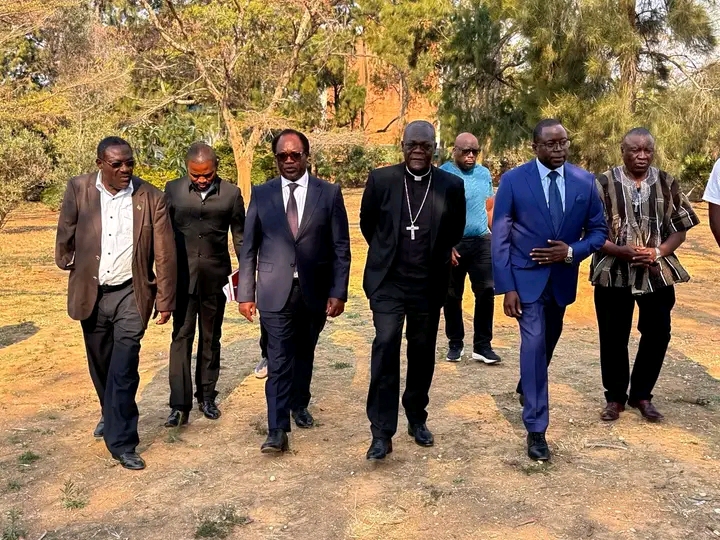
The Archdiocese of Lusaka has unequivocally confirmed that the Candlelight Prayers for Peace will proceed as scheduled in all its parishes. This affirmation aligns with a communiqué issued by Fr. Felix Banda, Rector of the Marian Shrine, on August 4th, 2026, which clarified the purely spiritual intent of the prayers. Their purpose is to invoke God’s peace upon the nation throughout the electoral process, explicitly stating that they carry no political connotations and should not be misconstrued as supporting or opposing any political entity, candidate, or interest group.
These candlelight prayers are an integral part of the ongoing Novena of the Assumption of the Blessed Virgin Mary, which commenced on August 6th, 2026, and is set to conclude on August 14th, 2026, the eve of the Solemnity of the Assumption. The Novena is a longstanding devotional practice observed in every parish across the Archdiocese of Lusaka and is also broadcast daily by Radio Maria Zambia – Yatsani Voice. It is rooted in prayer, repentance, hope, and the intercession of the Blessed Virgin Mary. The Archdiocese considers any attribution of political motives to this sacred devotion as both unfortunate and a complete misunderstanding of its true purpose, reiterating that the prayers scheduled for August 12th are entirely spiritual.
The faithful are encouraged to participate prayerfully in these services. After their conclusion, attendees are invited to donate their used candles to their respective parishes, where they can continue to serve in the liturgical life of the Church. The use of candles in Catholic worship and devotional life is not an innovation but a deeply embedded tradition, tracing back to the earliest centuries of Christianity and rooted in Sacred Scripture and the Church’s liturgical tradition.
Candles profoundly symbolize Christ, referred to as “the Light of the World” (John 8:12), who dispels the darkness of sin and death. Our Lord Himself proclaimed, “I am the light of the world. Whoever follows me will not walk in darkness, but will have the light of life.” (John 8:12). Furthermore, the faithful are reminded of Christ’s instruction: “You are the light of the world… let your light shine before others, so that they may see your good works and give glory to your Father in heaven.” (Matthew 5:14–16). The Church’s liturgical tradition, as outlined in the General Instruction of the Roman Missal (GIRM), No. 117, mandates the use of candles in every celebration of Mass “as an expression of reverence and festiveness.” Significant instances, such as the Easter Vigil, proclaim Christ’s triumph over darkness through the lighting of the Paschal Candle, from which the faithful light their own, signifying their shared light of Christ. The Catechism of the Catholic Church (cf. CCC 1145–1152) further explains that visible signs and symbols are employed in liturgy to signify invisible spiritual realities. Thus, the use of candles is neither an innovation nor a carrier of hidden political symbolism, but a sacred expression of prayer, hope, vigilance, and faith in God’s saving presence.
The Catholic Church has historically used candles during daily Holy Mass, Eucharistic Adoration, baptisms, funerals, weddings, processions, Marian devotions, the Easter Vigil, and numerous other liturgical celebrations. Therefore, the planned Candlelight Prayers for Peace are neither unusual, suspicious, nor sinister. Candlelight prayer services have long served as a recognised expression of Christian solidarity with those who suffer and a means to pray for important national and global concerns. For instance, many Catholic communities observe World AIDS Day on December 1st with candlelight services to remember the deceased, show solidarity with those living with HIV and AIDS, and pray for healing and hope. Such gatherings are consistently understood as moments of Christian compassion and intercession, not political events.
The Archdiocese respectfully submits that prayer should never be politicized, as it is neither the property of any political party nor the preserve of any ideological persuasion. Every Zambian, irrespective of political affiliation, needs God’s peace, wisdom, and protection. The Catholic Church’s mission is to proclaim the Gospel, sanctify God’s people, and promote peace, justice, reconciliation, and the common good, not to advance partisan interests. When the Church calls the faithful to prayer, it acts in fidelity to its divine mandate and pastoral responsibility to entrust the nation to God’s providence. Consequently, the Archdiocese urges all political stakeholders and the public to refrain from attributing political motives to genuine acts of worship and devotion. Instead, all people of goodwill are invited to join in praying for peaceful elections, mutual respect, national unity, and lasting reconciliation in Zambia. The Archdiocese of Lusaka remains committed to fostering peace, dialogue, and national unity through prayer, fulfilling this sacred mission without fear or favour, as reminded by Matthew 5:9: “Blessed are the peacemakers, for they shall be called children of God.”
Adding to this clarification, Mr. Chali, in a letter to the Chief Electoral Officer, stated that the matter of regulating church operations falls outside the Electoral Commission’s mandate and should not be treated as an electoral issue. He emphasized that the Commission lacks constitutional authority over religious practices, with its responsibility limited to ensuring free, fair, and non-violent elections free from intimidation or corruption. Mr. Chali cited Articles 45(C) and 229(2) of the constitution, which he argued do not grant the Commission powers over religious practices. He further highlighted the long-standing use of candles in Christian worship and other church services, affirming that the planned activity is a religious practice, not a political one. According to Mr. Chali, the attempt by the UPND to cancel the service has no legal basis, and cancelling it would result in a breach of Articles 45(c) and 229(2) of the constitution.