Unveiling Ghana's Constitutional Future: CRC Proposals Spark Intense National Dialogue
The recent submission of Ghana's Constitution Review Committee report has ignited widespread debate. Key figures like Oliver Barker-Vormawor, Dr. Nyaho Nyaho-Tamakloe, and Charlotte Osei weigh in on proposals ranging from parliamentary power and presidential accountability to the handling of ex-gratia payments and the term of office. The discussions highlight the complex path ahead for Ghana's constitutional reform.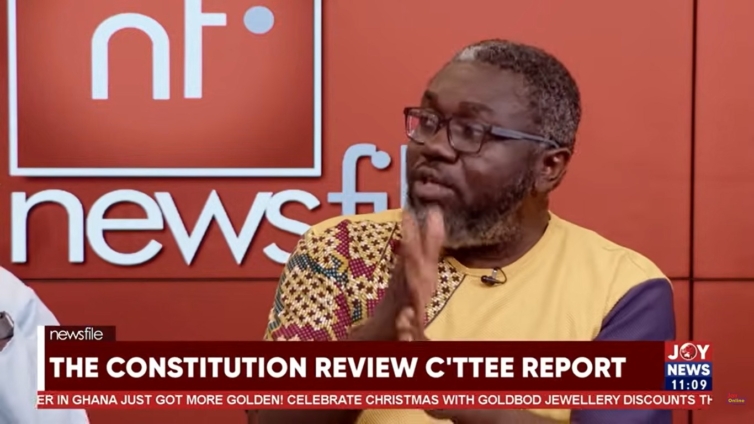
Ghana's constitutional reform process has intensified with the submission of the Constitution Review Committee's (CRC) summary report to President John Dramani Mahama on Monday, December 22. Discussions surrounding the report's recommendations and the path forward have since dominated national discourse, featuring prominent voices like Oliver Barker-Vormawor, Dr. Nyaho Nyaho-Tamakloe, and Charlotte Kesson-Smith Osei, a member of the CRC.
Oliver Barker-Vormawor, Convener of the FixTheCountry Movement and a constitutional rights and policy strategy advisor, highlighted that any attempt to amend the Constitution would necessitate the support of at least 75 percent of Members of Parliament. This high threshold, he explained on JoyNews' Newsfile on Saturday, December 27, significantly enhances the influence of the minority in Parliament, regardless of their size, by preventing any single political bloc from unilaterally driving constitutional changes. He noted that even a parliamentary majority like the National Democratic Congress (NDC) would be unable to meet this requirement alone, thus compelling broader consensus and cross-aisle negotiation. Barker-Vormawor urged President Mahama to take a hands-on approach in steering the reform process, emphasizing that personal supervision is crucial for the process to become a lasting legacy. He also advocated for an implementation committee that builds on the CRC's work, ensuring continuity and institutional memory, rather than forming an entirely new body. Furthermore, he called for a collaborative approach, involving international partners and legal drafting experts, and the creation of a dedicated parliamentary committee to study the proposed changes to avoid partisan entrenchment.
Adding to the imperative for effective implementation and public engagement, Daniel Kwame Ampofo Adjei, a development consultant, argued for an extended and clearly defined mandate for the CRC, or a successor structure, focused on strategic public communication. He stressed that constitutional reform succeeds or fails in the public arena through how ideas are explained and owned by citizens. Adjei noted that without structured, sustained explanation, complex reforms can be easily misunderstood, reduced to partisan talking points, or distorted by mis/disinformation. He proposed that an extended communication role would provide authoritative, non-partisan clarification, ensuring that debate is informed rather than confused, thereby supporting executive decision-making and reducing uncertainty. He emphasized the CRC's unique credibility, institutional memory, and demonstrated capacity for public engagement as reasons it is best positioned to play this role.
Veteran Ghanaian statesman Dr. Nyaho Nyaho-Tamakloe offered a strong critique of the 1992 Constitution, asserting that it