Tornado Cash Shocker: Roman Storm Found Guilty, Crypto World Reacts
The Tornado Cash trial has concluded, with co-founder Roman Storm found guilty of conspiracy to operate an unlicensed money transmitting business. This verdict carries significant implications for crypto developers and privacy software, as legal experts had previously argued against such a finding while the prosecution celebrated it as a win against financial crime.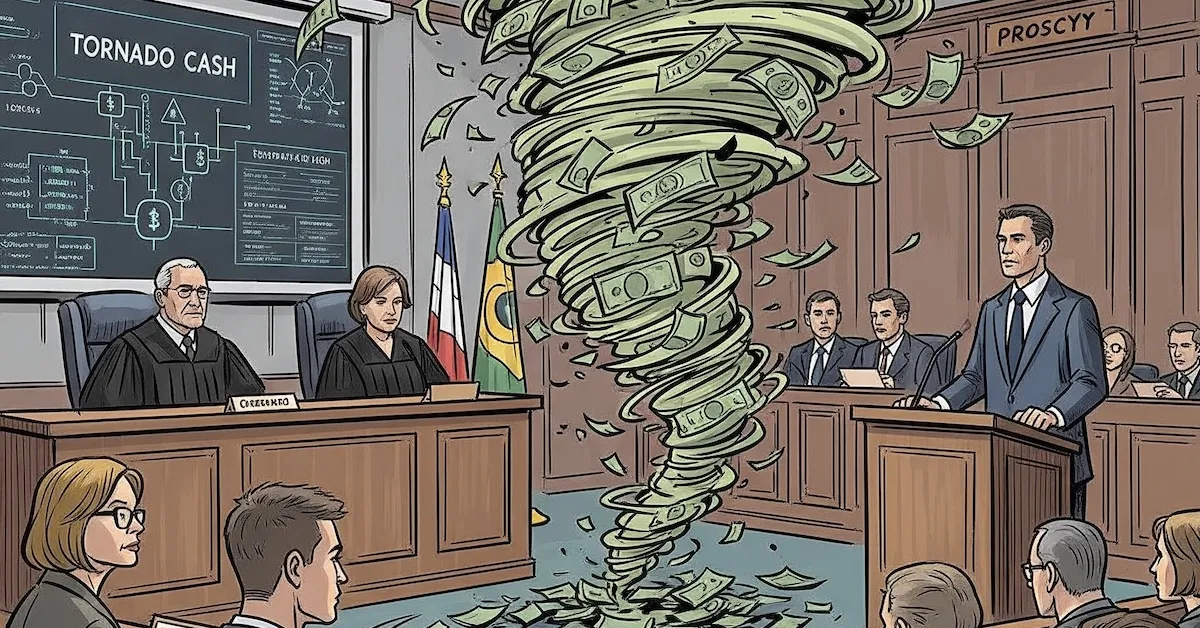
The high-stakes Tornado Cash trial, particularly concerning co-founder Roman Storm, has concluded with significant implications for developers of noncustodial Bitcoin and crypto technology, as well as privacy-preserving software. Amanda Tuminelli, executive director and chief legal officer for the DeFi Education Fund, an organization that includes Bitcoin in its scope, provided an insightful overview of the case, highlighting the broader legal landscape.
Storm faced three charges, with particular attention paid to the accusation of conspiracy to operate an unlicensed money transmitting business. Tuminelli, an expert on 18 U.S. Code § 1960 — the federal law prohibiting the operation of such a business without a proper license — argued that Storm had not violated this statute in creating and operating Tornado Cash, a crypto mixing service built on Ethereum. She emphasized that legislation like the CLARITY Act and the Blockchain Regulatory Certainty Act (BRCA) includes language designed to protect developers of "non-controlling" or noncustodial crypto technology, stipulating they do not require a money transmitting license and should not be subject to existing money transmission laws.
Furthermore, Tuminelli expressed concern over the Department of Justice’s (DoJ) perceived shift away from 2019 FinCEN guidance, suggesting it threatens innovation within the crypto space. She warned that this shift might lead to continued prosecutions of developers like Storm, despite an April memo from U.S. Deputy Attorney General Todd Blanche stating the DoJ would cease targeting crypto entities, including mixing and tumbling services, for the actions of their end users. Tuminelli also shared her perspectives on the trial's progression and the defense's strategy, mentioning the amicus briefs submitted by the DeFi Education Fund for both the Tornado Cash and Samourai Wallet cases, though the brief for Tornado Cash was ultimately rejected by the court.
Ultimately, the trial concluded in the Southern District of New York (SDNY) with Roman Storm being found guilty on the second count of his indictment: conspiracy to operate an unlicensed money transmitting business. The jury, after three and a half days of deliberation following a trial that commenced in the middle of the previous month, did not reach a unanimous verdict on the other two charges—conspiracy to commit money laundering and conspiracy to violate sanctions. As a consequence of this guilty verdict, Storm now faces a potential prison sentence of up to five years.
Following the verdict, the prosecution moved to remand Storm into custody, citing him as a flight risk. However, Judge Failla rejected this motion. The defense, represented by Ms. Klein, successfully countered the prosecution's assertion by highlighting Storm’s strong ties to the United States: his Washington state home was secured by a $2 million bail bond, his daughter (of whom he has partial custody) and girlfriend reside in the U.S., and his parents are green card holders. Additionally, much of the crypto community that supports Storm is U.S.-based and expected to continue its support through the appeal process. Judge Failla deemed the "stability of the verdict still in play," indicating the likelihood of an appeal, and noted that Storm's "incentives have shifted tremendously," before denying the motion to remand.
Shortly after the verdict, U.S. Attorney for the SDNY, Jay Clayton, issued a statement. Clayton asserted that "Roman Storm and Tornado Cash provided a service for North Korean hackers and other criminals to move and hide more than $1 billion of dirty money." He acknowledged the promise of digital assets but maintained that such promise cannot excuse criminality, vowing that his office and partner agencies are committed to holding accountable those who exploit emerging technologies for crime. Notably, Clayton did not reference Deputy Attorney General Todd Blanche's memo, which outlined the DoJ’s intention to stop "regulation by prosecution" in the crypto space and to no longer target virtual currency mixing services for the actions of their end users. Furthermore, Clayton did not address the fact that the vast majority of funds moved through Tornado Cash users were not proven to have been obtained illicitly.