Talksign Built an AI That Understands Sign Language Like a Real Person Does
Nigerian-UK startup, Talksign has launched Palm 1.0 and Echo 1.0, AI models that translate sign language into speech and text in real time.
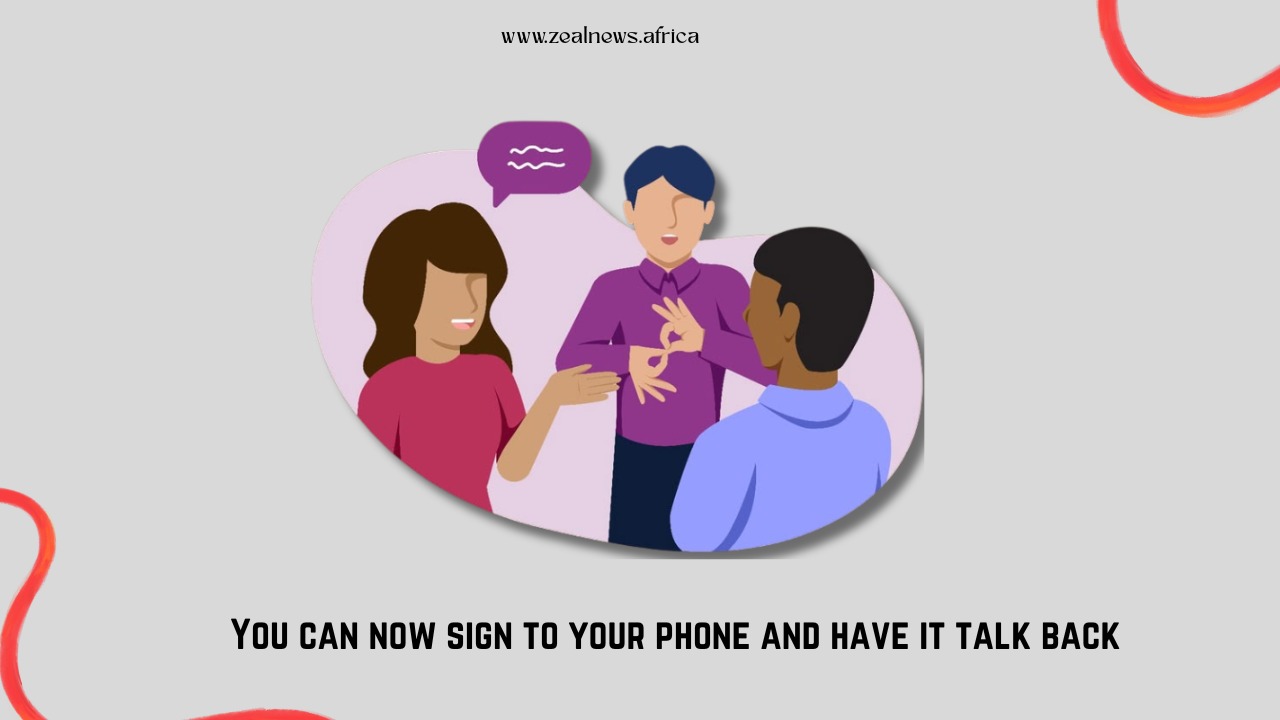
You can now sign to your phone and have it talk back
Talksign just gave Deaf users in Nigeria, the UK, and beyond two new tools that turn sign language into a two-way conversation with machines.
The Lagos- and UK-based AI company launched Palm 1.0 and Echo 1.0 on May 20, and together they do something most apps still can't which is understand American Sign Language (ASL) as it's actually signed, in real time, then respond in kind.
Palm 1.0 watches you sign and turns it into text or speech. Echo 1.0 takes written or spoken words and generates a photorealistic avatar that signs back to you, at 30 frames per second with about 29 milliseconds of lag.
Put the two together and you get something close to a live interpreter, except it's running on your device.

You can now have a continuous conversation, not just trade isolated words. Talksign's earlier model, Talksign-1, released in February, could only handle 250 individual signs.
It couldn't follow a sentence or read fingerspelling. Palm 1.0 fixes that with SAGE, short for Spatial Attention Graph Encoder, which tracks 133 points across your hands, head, and shoulders.
Trained on more than 71,000 ASL samples, it hits 84.2% semantic accuracy and 79.6% word-level accuracy, reading signing the way a person would: as flow, not flashcards.
You can now get a response that looks like a person, not a stick figure. Echo 1.0 trained on 94,410 ASL sentence pairs, run through 15 times for fluency. It doesn't translate English word for word.
It converts text into ASL gloss first, preserving the grammar and word order that ASL actually uses, then maps each gloss token to a 3D motion sequence rendered through a neural engine. Feed it a single photo, and it'll build a personalised avatar that signs in your likeness.
You can now use sign language as the interface itself. Kazi Mahathir Rahman, Talksign's co-founder and CTO, framed it as signing becoming "a first-class interface" for talking to AI, no speech, no keyboard required.
Edidiong Ekong, the company's CEO and co-founder, put it more simply: Palm 1.0 is the first model the team trusts putting in front of Deaf users at scale. The plan is to get it onto phones, smart glasses, classrooms, hospitals, anywhere a Deaf person needs to communicate.
You can now expect this where interpreters usually aren't available. Talksign is positioning both models for emergency alerts and live news broadcasts, situations where a human interpreter is rarely on hand.
Landmark extraction happens on your device, so raw video never leaves your phone. Only the processed data points get sent to Talksign's servers, which the company built in consultation with Deaf advisors, educators, and accessibility advocates.
What you can't do yet: speak anything other than English to Echo 1.0. Spanish, French, and Arabic are coming, but not live.
Specialised vocabulary in medicine, law, and engineering still needs fine-tuning, and Palm 1.0 isn't fully optimised for every continuous signing scenario. Multi-word ASL phrases are only partially modeled.
The full rollout, on desktop and on Meta Ray-Ban smart glasses, lands August 20, 2026. Talksign also says British Sign Language, German Sign Language (Deutsche Gebärdensprache), and Nigerian Sign Language are on the roadmap.
Talksign isn't alone in this race. SignVrse's Terp 360 already offers real-time translation from spoken language into sign via a 3D avatar.
But Talksign's bet is that solving both directions at once, sign-to-speech and speech-to-sign, with the kind of accuracy numbers it's publishing, is what finally makes the technology usable outside a lab demo.

For now, the gap between "AI translates sign language" and "AI translates sign language well enough to trust in an emergency room" is still being closed. August will tell us how close Talksign actually got.