Suella Braverman Wants Former Colonies to Repay Britain. Repay It for What, Exactly?
Suella Braverman's remark that former colonies should repay Britain reopens an old question: was the empire remembered as investment or extraction? From railways built to move resources to the wealth behind Europe's industrial rise, the debate over colonialism, identity, and reparations refuses to fade.

A tweet does not usually travel far enough to reopen a two-hundred-year-old argument; tweets usually ignite banter, controversies and social hot takes, but Suella Braverman's did.
The former UK Home Secretary posted that the British Empire did a great deal of good for the world, that slavery was abhorrent but too distant to expect the British of today to pay for it, and that if reparations were ever seriously considered, former colonies should instead repay Britain for the investment, effort and contribution that built the foundations of many flourishing democracies today.
It is a short statement, but it carries a much older assumption:that the British Empire was, on balance, a civilising investment with some regrettable side effects, rather than a system whose development projects were inseparable from extraction.
That assumption is worth examining, not to attack anyone personally, but because it reflects a much older way of remembering colonialism: measuring what was built while paying far less attention to why it was built, who benefited from it, and what it cost those living under imperial rule.
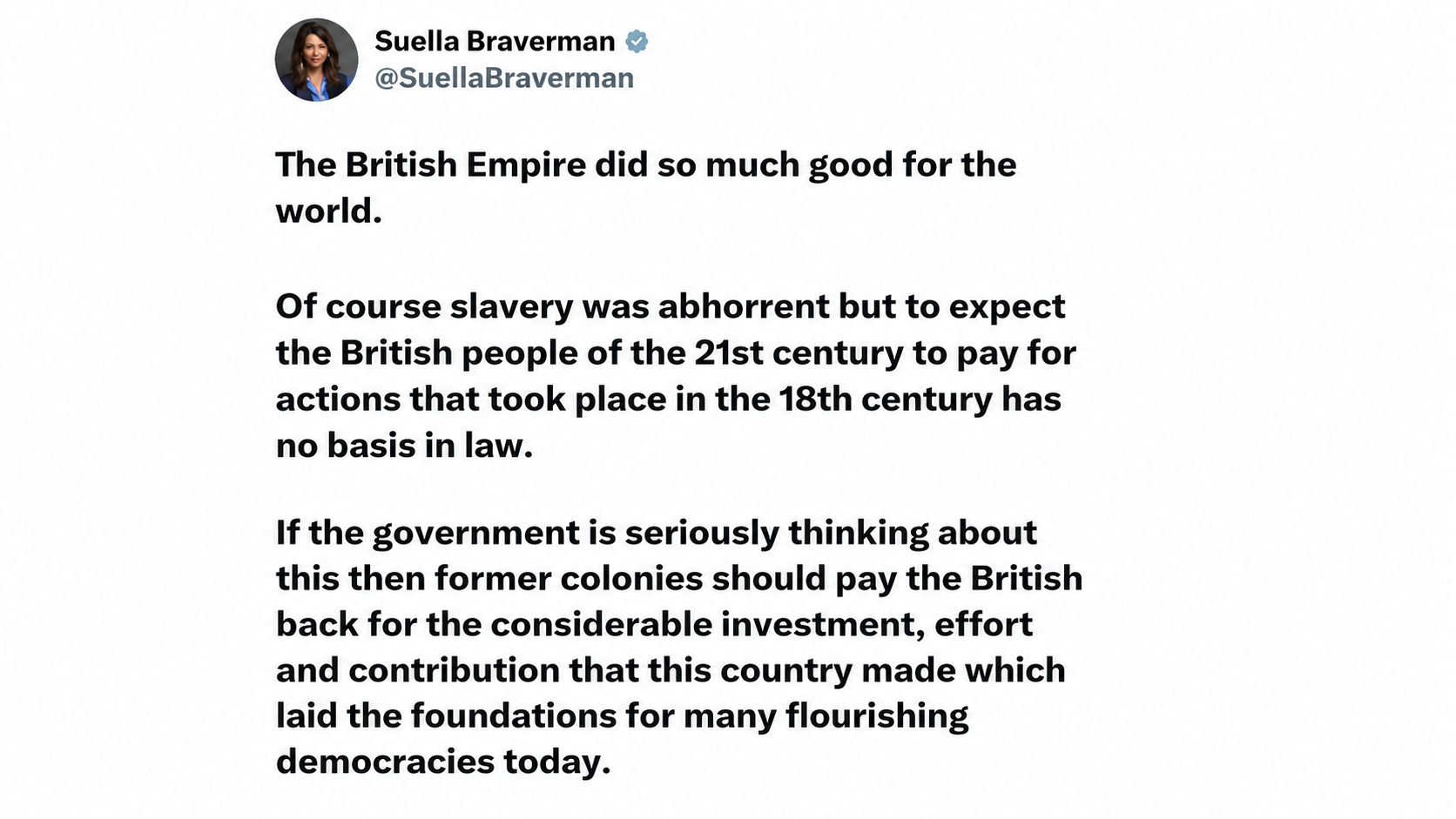
The real question her comment raises is not simply who owes whom. It is whether colonialism is remembered primarily as development that happened to involve domination, or as domination that happened to leave behind development. It is exactly what we are counting, and whether colonialism is remembered as charity or as extraction.
What Investment Are We Actually Talking About?
Braverman's argument rests on the idea that Britain gave more than it took, treating colonial infrastructure as evidence of generosity rather than asking whether those investments primarily served imperial economic interests. Railways, roads, ports, legal systems, parliamentary institutions, universities, and the English language are usually cited as evidence of that investment.
Nobody, absolutely nobody, disputes that these things exist. The debate has never really been about whether railways, ports or institutions were built; it is about whether their primary purpose was to develop colonised societies or to make extraction more efficient.

The more useful question is why they were built and for whom they were built for. Many colonial railways across Africa were never designed to connect African communities to one another or to grow local economies. They ran from mines and plantations straight to the coast, built to move raw materials to waiting ships rather than to move people between towns, reflecting an economic logic that prioritised empire over local development.
Some of those tracks still sit deep in the Sahara today, monuments to a purpose that had little to do with the people who lived alongside them.
A railway can be an engineering achievement and an instrument of extraction at the same time. Those two things are not mutually exclusive, and pretending otherwise flattens a complicated history into a single, convenient line.

This is where the conversation often becomes misleading, because development and extraction are treated as though they cancel one another out. In reality, colonial infrastructure frequently enabled both at the same time.
Hospitals were built, and systems were introduced that privileged colonial populations over native ones. Governments were established, and self-rule was denied.
If someone builds you a house while taking your labour, the house does not cancel the labour taken to build it. Legality complicates this further, since Braverman is likely correct that there is no legal basis for reparations today.
But slavery was legal, too, once. Apartheid was legal once. Legal and just have never been the same word, and a statement built on legal footing does not automatically settle a moral one.
The Wealth That Built Modern Europe
Social Insight
Navigate the Rhythms of African Communities
Bold Conversations. Real Impact. True Narratives.
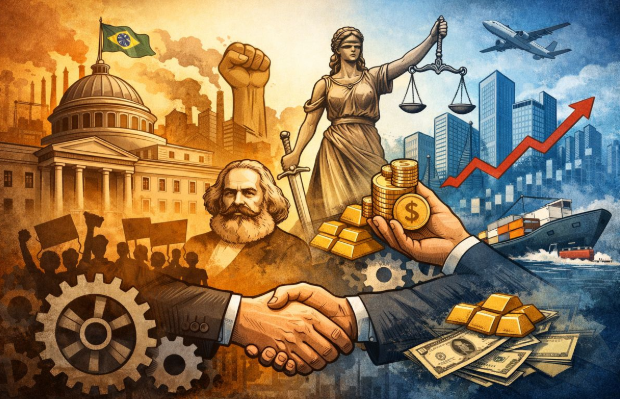
The Industrial Revolution did not happen in a vacuum. European empires accumulated enormous wealth through colonial trade, forced labour, taxation, mining and plantation agriculture.
Gold, diamonds, rubber, palm oil, cotton, cocoa, copper, and tin moved out of colonised territories in volumes that most modern balance sheets would struggle to represent.
Many historians, notably figures like Walter Rodney in his famous work How Europe Underdeveloped Africa (1972), argued that the extraction of African human and material resources was foundational to European industrialization, while slowing industrial development inside the colonies themselves. Seen from that perspective, colonial prosperity was not simply wealth creation but wealth transfer.
If today's prosperity was partly financed by yesterday's extraction, then the conversation cannot begin with infrastructure alone while excluding the economic system that made that infrastructure profitable.
The artefact question sits inside this same wealth story. Thousands of African cultural objects still remain in European museums, and while some, like a number of the Benin Bronzes, have been returned in recent years, many have not.

The negotiations around returning them quietly answer a question people are often too polite to ask directly. If nothing was improperly taken, why are museums negotiating returns at all?
That single admission complicates any invoice for what Africa supposedly owes in return because it acknowledges that the British empire involved in taking as well as building. Any serious ledger would have to account for both.
Conquest Beyond Land
Colonialism was never only a conquest of geography. It was also a system for reorganising knowledge, identity, language and memory in ways that survived long after the formal British empire ended.
Many African children grew up learning the names of European kings, kingdoms, and mythology before the names of African kingdoms in their own backyard.
Indigenous languages increasingly became associated with being local or backward, while European languages came to signify education, authority, and progress, which have now become shorthand for intelligence and progress. That conquest of perspective did not end with independence; it simply changed address.
Language still carries the fingerprints of empires in places people rarely think to look. The term Middle East is not a geographical fact but a European vantage point.
Middle relative to where, and east relative to whom? From London, the region sits east; from Beijing, it sits west; from Johannesburg, it sits north.
Yet that label has become global today, sitting comfortably in maps, government documents and international institutions, while a term like Middle West would sound almost absurd if anyone tried to coin it today.
That asymmetry is a quiet but telling reminder of how far colonial influence reached beyond borders and into vocabulary itself.
There is also a quiet irony worth noting, not as a personal attack, but as context. Braverman's family heritage traces back to India, a country whose parents migrated from former British colonies, one that lived through economic extraction, famine, and political repression under British rule, and whose own resistance movements fought hard against the very system her statement now seems to defend.
Social Insight
Navigate the Rhythms of African Communities
Bold Conversations. Real Impact. True Narratives.
If former colonies were ever expected to start repaying Britain for its investment, India would likely be near the front of that queue, given how extensively it was governed, taxed, and resourced under the same empire now being described as the foundation of flourishing democracies.
That irony does not disprove her argument, nor should it become a personal criticism. It simply illustrates how deeply contested the legacy of the British empire remains, even among people whose own family histories intersect with it.
Why This Debate Won't Go Away

People sometimes ask why the world is still relitigating colonialism decades after independence.
The honest answer is that colonialism did not disappear with independence. Many of its political, economic, and cultural structures simply outlived the empire that created them: Borders, languages, trade routes, economic dependency, museum collections, land ownership, and legal systems all still exist today.
A recent United Nations vote recognising slavery as a matter of ongoing human concern, with some countries voting for it and others against, shows that this is not merely a historical debate confined to lecture halls.
It remains an active diplomatic question, which means it is as much about the present and future as it is about the past.
It also helps to remember that reparative justice was never only about money. Returned artefacts, debt relief, educational investment, technology transfer, formal apologies, archival access and historical acknowledgement all sit under that same umbrella.
Recognition carries its own weight because reparative justice has never been reducible to financial compensation alone. If this conversation keeps circling back to payment, whether Africa owes Britain or Britain owes Africa, it may be because money is easier to calculate than historical responsibility.
The harder question is whether colonialism is fundamentally remembered as an act of investment that produced unfortunate harms, or as a system of extraction that inevitably produced infrastructure in service of itself.
Everything else, the railways, the artefacts, the language, the institutions, and the debt, depends on which of those histories we choose to begin with.
Perhaps the real invoice will never be about who pays first. It may instead be about whether we can first agree on what colonialism actually was, because every argument about reparations begins with that answer long before it reaches a balance sheet.
History rarely settles for a single balance sheet; maybe that is the point, and we all need to face it.