Samourai Wallet Developers Face Legal Battle: A Standoff for Financial Privacy
The Samourai Wallet case highlights a critical trial for financial privacy and code as speech in the U.S. Founders Keonne Rodriguez and William Lonergan Hill face charges that challenge existing legal precedents regarding money transmission and software development. This case has created a chilling effect on the crypto industry, prompting calls for President Trump to pardon the developers and uphold the right to self-custody and digital privacy.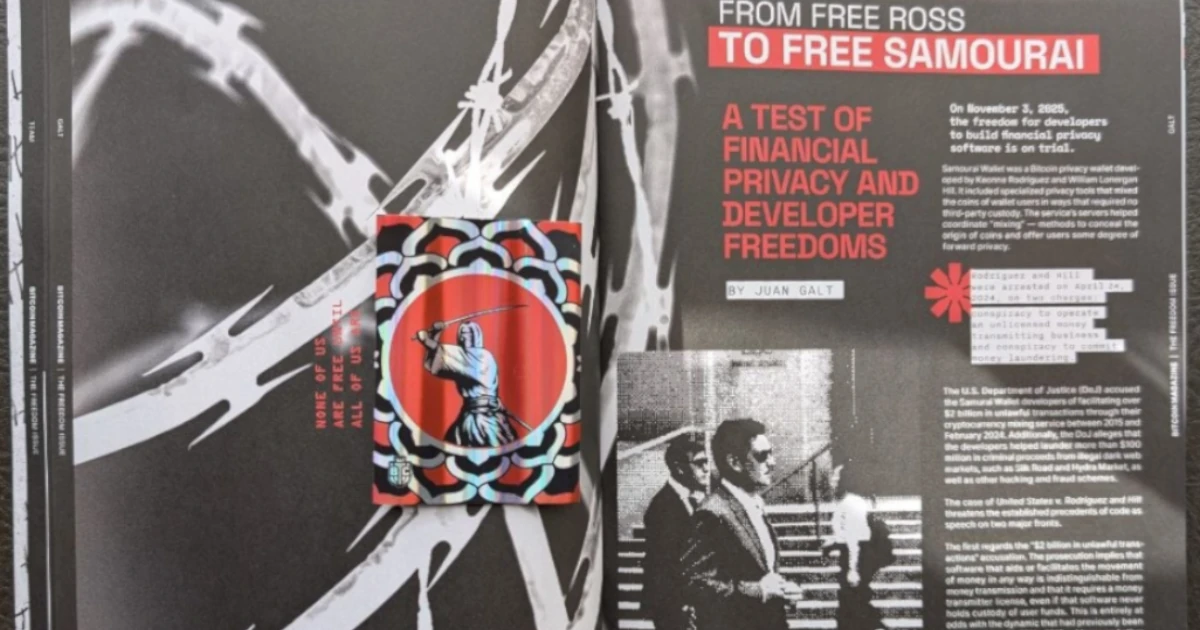
The freedom for developers to build financial privacy software is currently on trial, exemplified by the case of Samourai Wallet co-founders Keonne Rodriguez and William Lonergan Hill. Arrested on April 24, 2024, Rodriguez and Hill faced charges of conspiracy to operate an unlicensed money transmitting business and conspiracy to commit money laundering. The U.S. Department of Justice (DoJ) accused them of facilitating over $2 billion in unlawful transactions and laundering more than $100 million in criminal proceeds through their Bitcoin privacy wallet, which offered coin-mixing tools without third-party custody of user funds. This case, United States v. Rodriguez and Hill, fundamentally challenges established precedents regarding code as speech and the definition of money transmission.
A core issue in the Samourai case is the DoJ's novel interpretation of money transmission. Prosecutors argue that software aiding the movement of money, even without holding user funds, requires a money transmitter license. This directly contradicts FinCEN’s 2019 guidance, which stated that non-custodial services are not money transmitters because they do not control money flows. Remarkably, this crucial FinCEN stance was allegedly withheld from the defense for nearly a year, and the judge denied its presentation in court, leading to accusations of prosecutorial misconduct akin to a Brady v. Maryland violation.
The legal tradition of defending freedom of speech in the United States has historically protected software development. Landmark cases such as Texas v. Johnson (1989) affirmed functional speech, and Bernstein v. United States (1996-1999) established that cryptographic source code is protected speech under the First Amendment, not a munition. This precedent was a critical victory for Cypherpunks, whose work laid the foundation for Bitcoin. However, the Universal City Studios v. Corley (2001) case introduced a nuance, suggesting that software, when gaining a “function” like breaking an encryption lock, could be seen as a tool and thus subject to regulation, creating a distinction that now threatens the Samourai developers.
The legal assault on Samourai Wallet has created a significant