Royal Seal on Digital Gold: UK Officially Recognizes Crypto as Property
King Charles III has given Royal Assent to the Property Act (Digital Assets etc.) 2025, legally recognizing crypto and other digital assets as personal property under UK law. This landmark legislation ends decades of legal uncertainty, granting digital holdings the same protections as tangible property and positioning the UK as a significant player in the global crypto economy.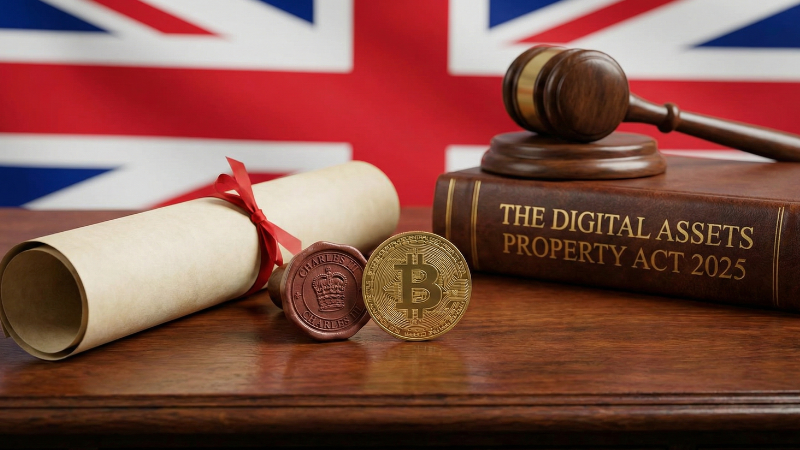
In a landmark development for the global digital economy, King Charles III on Tuesday appended the Royal Assent to the Property Act (Digital Assets etc.) 2025. This pivotal legislative action officially grants legal recognition to cryptocurrencies and other digital assets as personal property under UK law, fundamentally transforming their legal standing.
The passage of this Act marks the culmination of years of legal uncertainty surrounding digital holdings. Previously, digital tokens such as Bitcoin and Non-Fungible Tokens (NFTs) existed within a legal grey area. They did not fit neatly into traditional classifications of property: neither as "things in possession," which are tangible physical items like gold or cars, nor as "things in action," which represent intangible rights such as debts or contractual claims. The new legislation, which codifies a key recommendation from the Law Commission of England and Wales, resolves this ambiguity by creating a distinct third category of personal property specifically for digital-only assets.
Under the new Property Act, digital or electronic assets can now attract comprehensive property rights, irrespective of their inability to conform to conventional property definitions. This means that cryptocurrency wallets, individual tokens, and various other digital holdings are now afforded the same legal protections as traditional, tangible property. This statutory clarity carries profound and immediate practical implications for individuals, businesses, and legal institutions across the UK.
Owners of cryptocurrencies and NFTs will benefit from significantly stronger rights in situations involving theft, fraud, or insolvency. The legal framework now provides courts with a clearer mandate to freeze or seize crypto holdings, incorporate them into estate distributions, and effectively address disputes arising from divorce proceedings or corporate liquidations. This provides a robust legal foundation that was previously lacking.
Legal experts and participants in the crypto industry have widely lauded this legislation as a "coming of age" moment for digital assets within the United Kingdom. For institutional investors and industry stakeholders, the Act establishes a much firmer foundation upon which to develop innovative products, manage inherent risks more effectively, and scale their operations with greater confidence. This reform is seen by regulators and lawmakers as an integral component of a broader strategic initiative, alongside emerging regulations for stablecoins and digital asset custody, aimed at cementing the UK's position as a leading global hub for blockchain and crypto innovation.
One of the Act's strengths lies in its intentional flexibility. It deliberately avoids specifying which particular tokens or digital instruments automatically qualify under the new classification, choosing instead to leave such determinations to the discretion of courts and the evolution of future case law. This adaptable approach is crucial, as it allows the legal system to evolve and respond to rapid technological advancements without the constant need for new legislative interventions for every emerging digital asset or technology.
While acknowledging that certain questions remain—such as how the law will apply to highly complex decentralized protocols, intricate smart contracts, or novel tokenized real-world assets, which are yet to be fully tested in practice—the consensus among legal professionals is that the UK has taken a crucial first step. This legislative move aligns its venerable property law with the dynamic realities of modern digital markets, signaling to the global crypto community that the UK is unequivocally committed to embracing and integrating the digital economy.