Protein Poverty in Nigeria: Hunger Beyond the Stomach
In Nigeria today, protein is shifting from a basic dietary need to an unaffordable luxury. This silent crisis threatens the health and strength of a nation.
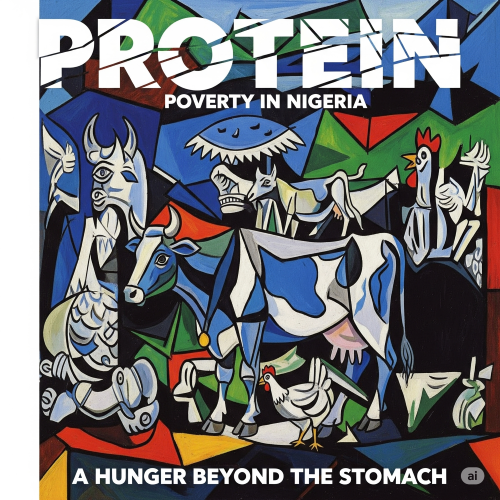
Imagine Ibrahim, a bricklayer in Kaduna. Every morning, before the sky stretches itself awake, he is already on his feet, bent under the weight of his tools and hopes. By dusk, he returns home drenched in cement dust and silence. His body aches not just from the day’s labour, but from something deeper—a quiet, gnawing emptiness that rice and bread cannot fill. A boiled egg, once a poor man’s quick strength, now costs ₦250. Meat? ₦500 for a slice so thin it might as well be a shadow. So he settles for garri, sometimes soaked in water, other times in Coke, depending on the generosity of his daily pay.
This is not just poverty. This is protein poverty—the kind of hunger that doesn’t just starve your belly, but starves your muscles, your nerves, your immune system. It is the hunger that sits in your bones, that makes your back ache even when you're lying down, that makes your legs feel hollow like bamboo, and your recovery from the simplest cut stretch out like punishment.
Nigeria is becoming a country where protein is a luxury.
Why has protein become so scarce and so expensive?
The answer lies in the slow collapse of Nigeria’s local livestock and poultry systems. Insecurity across the Middle Belt and northern grazing routes has turned vast tracts of farmland into war zones. Herdsmen flee attacks, farmers abandon crops, and cattle are stolen or killed in clashes. The cost of feed for both cattle and poultry has skyrocketed—driven by inflation, import dependence, and the devaluation of the naira. Farmers who once raised chickens in their backyards can no longer afford the feed, vaccines, or diesel to power their coops. The price of maize and soy—the foundation of poultry feed—has tripled in some regions. Without stable local supply, eggs are now a luxury. A tray that used to be ₦800 is now ₦3,000 in many cities. Meat too, has become a mirage, filtered through middlemen and insecurity, until only a sliver of it reaches the average market—and even that, priced like gold.
Across Lagos, Kano, Enugu, Port Harcourt—across homes that once shared pots bubbling with goat meat stew on Sundays, now the aroma is a memory, not a menu. In many families, children don’t know the joy of cracking an egg because it’s reserved for the sick. The growing child in Benue, whose father tills cassava but can't afford meat, chews on dreams instead of chicken. And even our beans—once the protein fallback of the poor—now feel like myths because they are either too expensive or adulterated.
Yet, the body keeps asking. The human body is stubborn that way. It needs protein to grow, to fight, to move, to heal. A man lifting cement blocks under the scorching sun needs around 70–90 grams of protein a day, but he might only get 15 grams—from beans watered down by hunger, and bread stretched out with nothing inside. Children, depending on their age, need 19 to 34 grams daily. Many Nigerian children are lucky if they get even half of that. So their bones don’t grow right, their immune systems stagger like drunkards, and their dreams become too heavy for their underfed bodies to carry.
Some talk about the youth being lazy, yet we forget they are eating like they’re preparing to sit, not to work. Muscle doesn’t build on rice and Coke. Strength doesn’t rise from white bread. Painkillers become the food group of choice—Panadol in the morning, ibuprofen in the evening. We mask what is, at its root, a nation slowly breaking down from the inside. Our sickness is silent but certain. You cannot build a strong nation on weak bodies.
Social Insight
Navigate the Rhythms of African Communities
Bold Conversations. Real Impact. True Narratives.
And so we march forward—on hungry legs, with hollow stomachs and heavy hearts. A teacher in Aba tells her class to dream big, while her own children eat yam with palm oil, night after night. A seamstress in Jos eats the crust of the bread she sells by the roadside, saving the middle for her son. The hunger is quiet. It wears no ragged clothes. It goes to work every day. It is presentable. But it is there.
What future are we preparing for when our present is so malnourished?
We are not just underfed. We are undermined. A protein-deficient nation cannot think sharply, cannot heal quickly, cannot resist disease, cannot build muscle, and ultimately—cannot thrive. We speak of youth empowerment and economic growth while our young people run on empty.
This is not just a food issue. It’s a national issue disguised as normal.
