Political Earthquake: Germany's Left Takes Berlin as Far-Right AfD Rises in East!
Germany's recent state elections have significantly altered the political landscape in Berlin and Mecklenburg-Western Pomerania. The Left party emerged as the strongest force in Berlin, while the AfD secured the lead in Mecklenburg-Western Pomerania, leading to complex coalition challenges and a national dialogue on the future direction of German politics.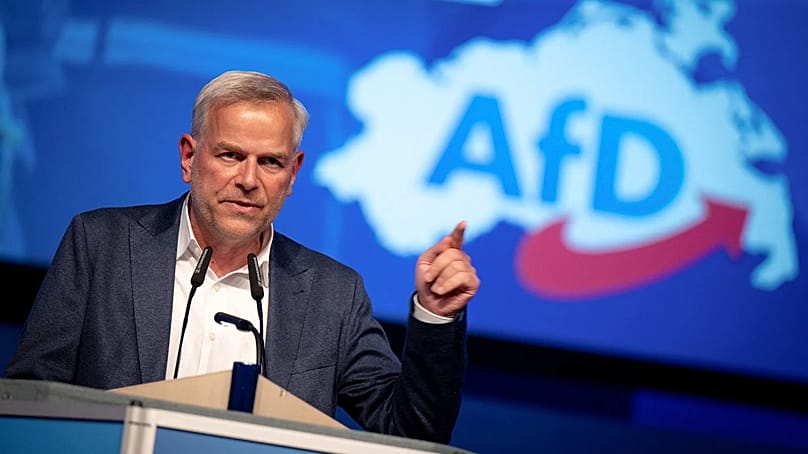
Germany's political landscape has been significantly reshaped following the final state elections of the year in Berlin and Mecklenburg-Western Pomerania. These elections have seen new political dynamics emerge, with notable shifts in power and strong performances from various parties, leading to complex coalition challenges and reflections on the nation's future.
In Berlin, the Left party, led by Elif Eralp, has emerged as the strongest political force for the first time. The latest Infratest dimap projections indicate the Left securing 25.7% of the vote. This outcome places the Christian Democratic Union (CDU) in second with 18.8%, followed by the Alternative for Germany (AfD) at 16.3% and the Greens at 14.3%. The Social Democratic Party (SPD) saw a decline, falling to 12.1%, while the Bündnis Sahra Wagenknecht (BSW) narrowly managed to clear the parliamentary threshold. This shift in voter preference means that the capital's previous CDU-SPD governing coalition no longer commands a majority, setting the stage for potentially challenging coalition negotiations.
Elif Eralp's campaign for the Left party heavily focused on social issues and the pressing problem of affordable housing in Berlin. Drawing inspiration from New York, where left-wing Democrat Zohran Mamdani won the mayoral election, Eralp campaigned on the belief that a similar left-wing success was possible in Berlin. As a candidate whose parents fled Turkey for Germany in 1980, and being born in Munich, Eralp stands to become Berlin's first governing mayor from a migrant background. Her policy proposals included tighter regulation of rents, an increase in social housing provisions, and further initiatives to bring large housing portfolios into public ownership, addressing the core of the city's housing crisis.
However, the path to forming a government for the Left party in Berlin is not without obstacles. Both the SPD and the Greens, potential coalition partners, have made it explicitly clear that any cooperation would be contingent upon how the Left addresses the issue of antisemitism. This concern gained prominence following an incident at a Left campaign event in Berlin's Neukölln borough, where chants such as "Death to the IDF" and "Yalla Yalla Intifada" were reportedly heard during an appearance by rapper Dahabflex. Elif Eralp has since distanced herself from these remarks, calling for an investigation and subsequent consequences. She affirmed that the overwhelming majority of the Left party is committed to protecting Jewish life, acknowledging that antisemitism is a societal problem that also exists within the Left, and expressed her dedication to protecting Jewish, Palestinian, and Muslim communities. SPD lead candidate Steffen Krach and Green lead candidate Werner Graf reiterated their parties' firm stance, stating that any coalition agreement must include a clear position against antisemitism.
Meanwhile, in Mecklenburg-Western Pomerania, the AfD has emerged as the leading party, securing 38.2% of the vote. The SPD, under state premier Manuela Schwesig, followed closely with 35.5%. The CDU experienced a historic setback, recording its worst-ever result in the state with a mere 4.9%, potentially failing to win seats in the state legislature for the first time in German history if the final count confirms this figure. The Left, Greens, and BSW all hovered around or just above the parliamentary threshold. Leif Erik Holm, the AfD's candidate for minister-president in Mecklenburg-Western Pomerania, garnered over 37% of the vote and claimed the right to form the next state government. Holm indicated the party's willingness to engage in discussions with other parties to "get things moving," highlighting the AfD in Mecklenburg-Western Pomerania is not under surveillance by the Federal Office for the Protection of the Constitution, and promoting a "conservative programme" focused on education, economy, and security.
Despite the AfD's lead, SPD state premier Manuela Schwesig could potentially retain her position. Schwesig notably centered her campaign around the slogan "Woman against Blue," a direct reference to the AfD's party color. She described this election as the "toughest state election" her party had ever encountered, emphasizing that the SPD had confronted the AfD "with substance, with people, with clarity and with a united effort." Schwesig also addressed her controversial past support for the Nord Stream 2 pipeline, having established the Foundation for Climate and Environmental Protection MV in 2021 which backed its construction. Following Russia's invasion of Ukraine, she acknowledged her earlier stance as a mistake and, during a visit to Kyiv in 2024, explicitly stated that "Ukraine must win this war" and supported further arms deliveries.
The national reaction to these election results was also significant. German Chancellor and CDU leader Friedrich Merz unequivocally described his party's result in Mecklenburg-Western Pomerania as a "disaster," stating there was no way to "sugar-coat" it. He attributed the CDU's poor performance to being "squeezed out" in a contest that largely became a battle between the SPD and AfD. Conversely, Merz acknowledged CDU lead candidate Stefan Evers' "respectable result" in Berlin despite challenging circumstances. Reflecting on the broader situation in Germany, Merz expressed concerns about the country's increasing complexity, the economy facing profound change, and a growing divisiveness in public debate alongside declining trust in institutions. He advocated for further reforms, asserting that the inevitable disruption and unpopularity of such measures must be accepted. Merz concluded with a stern warning against the "authoritarian poison" and "fascination with authoritarianism" he perceives as permeating society, pledging to take responsibility as CDU leader and chancellor to make Germany a "country of new beginnings."