Mystery Surrounds 'Cursed Amethyst' and Its Owners' Fate
A small purple amethyst housed in London’s Natural History Museum is steeped in a chilling legend of a deadly curse, meticulously detailed by its former owner, Edward Heron-Allen. While historical skepticism suggests the tale might have been a clever hoax to promote a novel, the stone's captivating story continues to inspire, garnering new accounts of its supposed malevolence even in the 21st century.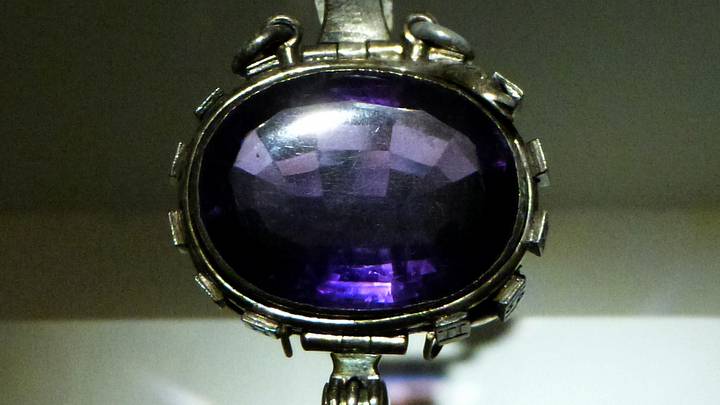
Deep within the Vault gallery of London’s Natural History Museum lies a small purple stone, elegantly set in a silver ring adorned with two scarab beetle beads. This unassuming amethyst carries a legendary legacy, steeped in tales of disaster, tragedy, and death. So profound was its supposed malevolence that its previous owner reportedly kept it locked within seven nested boxes inside a bank safe until his demise. Recent reports even suggest its ominous influence may still persist today.
The primary source of the amethyst's notorious reputation comes from a letter penned by Edward Heron-Allen, the stone's last private owner before its acquisition by the Natural History Museum. In his chilling note, Heron-Allen described the stone as “trebly accursed and stained with blood” and strongly advised anyone who might acquire it to immediately cast it into the deepest ocean. A polymath, scholar, and renowned violin-maker, Heron-Allen claimed the amethyst was plundered from the Temple of the God Indra at Cawnpore (now Kanpur) during a significant 19th-century mutiny, where Indian forces rebelled against British colonial rule. He asserted that a Bengal cavalryman, Colonel W. Ferris, subsequently brought the stone to England.
According to Heron-Allen’s account, the curse began to manifest almost immediately. Colonel Ferris soon found his life plagued by an unending string of chaos and misfortune, ultimately leading to the loss of almost all his possessions. The same dire fate, he claimed, befell Ferris's son after he inherited the stone. Consequently, the son bequeathed it to a friend, who later committed suicide, but not before returning the amethyst to the Ferris family through his will.
In 1890, Edward Heron-Allen himself purchased the stone, only to report that his life, too, became instantly beset by various calamities and disasters. He recounted giving the stone to a singer who, he wrote, experienced a sudden and inexplicable loss of her singing voice, never to perform again. Desperate to rid himself of the cursed object, Heron-Allen claimed he threw the amethyst into a canal, yet it mysteriously found its way back to him after being discovered by a dredger.
Following this undeniable return, the scholar made a drastic decision to secure the stone. He expressed fears that it was "exerting a baleful influence over my new born daughter." As a protective measure, he meticulously packed the amethyst into seven distinct boxes and deposited them at his bankers, issuing explicit instructions that it should not be exposed to light again for thirty-three years following his death. However, his daughter evidently disregarded his wishes. In 1944, less than a year after Heron-Allen's passing, she opened the sealed case and donated the infamous stone to the Natural History Museum, thus introducing its legend to a wider public.
Despite the captivating nature of these tales, historians have raised significant doubts regarding the authenticity of Heron-Allen's claims. Many theorize that his dramatic letter and the elaborate story of the cursed stone were a clever, posthumous marketing strategy designed to draw attention to his 1921 novel, *The Purple Sapphire*. Written under the pseudonym Christopher Blayre, the book features a strikingly similar narrative: a cursed gem that torments a colonel who comes into its possession. Scholars have also pointed out a factual error in Heron-Allen's account, noting his incorrect assertion that the Cawnpore insurrection occurred in 1855, when it actually took place in 1857.
Regardless of its factual basis, the cursed amethyst has undeniably enthralled countless individuals, thanks to the intricate web of legends woven around it. In more recent times, this very amethyst served as a powerful inspiration for one of the most celebrated books of the 2010s: Anthony Doerr’s Pulitzer Prize-winning novel, *All the Light We Cannot See*. Doerr’s work prominently features a cursed diamond known as the “sea of flames,” and the author explicitly cited the tales of the amethyst, alongside the broader cultural fascination with valuable jewels, as his muse. As Doerr explained to the American Booksellers Association in 2014, he was intrigued by humanity’s inherent desire to covet such objects, pondering, “What is it about us that covets these things, finds beauty in them? And isn’t it arbitrary that we decided diamonds are so valuable in the first place?”
The Cursed Amethyst is far from an isolated case; museum halls around the world house numerous supposedly haunted stones and objects. There seems to be a particular hold on people's imaginations by artifacts, especially stones, believed to be stolen from colonized or war-torn lands. This is likely due to their potent symbolism of greed and corruption. Art critic Hettie Judah aptly notes, “the suggestion that riches and power are founded on something dark and rotten is irresistible; the enigmatic diamond dazzling as a crystalline emblem both of magnificent wealth and of wickedness.”
Today, the amethyst continues its silent vigil within the halls of London’s Natural History Museum. However, for some, its supposed reign of terror may not be entirely over. Natural History Museum member John Whittaker has added a modern chapter to its lore, claiming that in 2004, while transporting the stone to an event, he and his wife were trapped in their car during an intense thunderstorm, an experience he described as the “most horrific” of his life, suggesting the ancient curse may still exert its influence.