Moving Futures: The Best Public Transportation Systems in Africa
Find out which African countries have the best emerging technology and public satisfaction in the transportation sector.
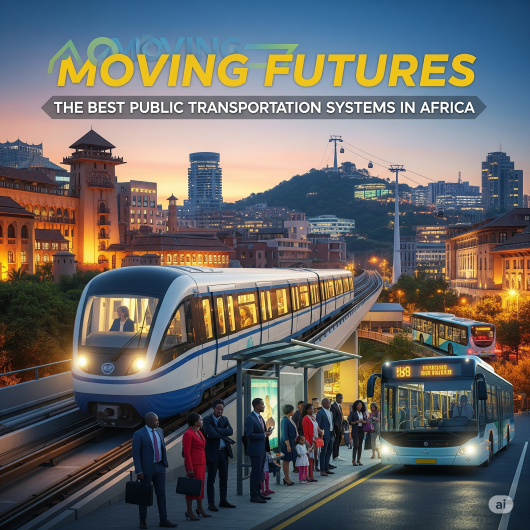
In the popular imagination, Africa’s transport story is often told through images of bustling minibuses, colorful taxis, or improvised routes stitched together by the informal economy. These narratives are not untrue, but they are incomplete. Across the continent, new experiments in public transportation are quietly reshaping how millions move, reclaiming urban time, and altering the possibilities of city life.
Among the most compelling examples are Senegal’s electric Bus Rapid Transit in Dakar, Tanzania’s ambitious BRT in Dar es Salaam, and Mauritius’s small-island model of integrated satisfaction. Taken together, these three nations reveal how public transportation can serve not just as infrastructure, but as a mirror of identity, governance, and ambition.
Dakar: A City Runs on Sunu BRT

Image Credit: Sunu BRT
When Dakar launched Africa’s first fully electric Bus Rapid Transit (BRT) system, it was more than just an engineering feat. It was a statement: that an African city could leapfrog straight into the front lines of sustainable mobility. Known locally as Sunu BRT—“Our BRT” in Wolof—the project introduced 144 articulated electric buses and 32 feeder routes, designed to carry over 300,000 passengers daily.
Before the BRT, commuting across Dakar often meant long, punishing journeys that could consume hours of the day. With the system in place, travel time between key points has been cut almost in half—from an average of 95 minutes down to 45. More tellingly, the share of residents who can now reach the city center in under an hour jumped from 12 percent to 69 percent. That change is not simply logistical—it is economic, educational, and deeply social. A student from Pikine can get to university without sacrificing dawn hours; a vendor in Guédiawaye can reach markets with goods still fresh.
The choice of electric buses also speaks volumes. Dakar’s leaders framed the project not only as a response to congestion but as a commitment to climate resilience. In a coastal city already threatened by rising seas and air pollution, the image of a silent, emission-free bus weaving through the boulevards is as much a symbol as a service. The project has made Senegal a global reference point, often cited alongside Latin American BRT pioneers.
But Dakar’s achievement is not without challenges. Maintenance of electric fleets, integration of informal transport operators, and digital ticketing reliability remain ongoing battles. And yet, the Sunu BRT has already shifted how Dakarois imagine their city: no longer as a place condemned to endless gridlock, but as one experimenting with time, technology, and trust.
Dar es Salaam: Africa’s BRT Pioneer

Image Credit: All Africa
If Dakar represents the leap into a clean-energy future, Dar es Salaam tells the story of scaling innovation under pressure. Tanzania’s largest city is home to one of Africa’s most ambitious Bus Rapid Transit systems, known asUDART, which began operation in 2016. Designed to serve nearly 180,000 passengers a day, the system covers more than 20 kilometers in its first phase, with dedicated lanes, modern stations, and articulated buses carrying up to 150 passengers each.
Before UDART, Dar es Salaam’s commuters depended almost entirely on daladalas—small, informal minibuses that were cheap but overcrowded and unpredictable. The BRT brought not only efficiency but also dignity to daily travel. Trunk and feeder routes link suburbs to the city center, while integration with ferries across the harbor extends its reach. Travel times that once stretched endlessly in traffic have been shortened dramatically, restoring hours of productivity to workers and students alike.
The symbolism of the BRT is just as powerful as its logistics. Dar es Salaam is one of the fastest-growing cities in the world, projected to reach over 10 million residents by 2030. The BRT stands as proof that African megacities can plan ahead, rather than remain trapped in reactive improvisation. Its modern ticketing systems, elevated pedestrian walkways, and orderly stations present a different face of Tanzanian urbanism—structured, modern, and globally recognizable.
Challenges remain. The system often struggles with overcrowding, and the expansion to additional phases has faced funding delays. Yet even with its imperfections, Dar es Salaam’s BRT has become a model studied by other African cities—from Nairobi to Lagos—seeking to tame traffic while maintaining affordability. The lesson is clear: with political will and phased investment, cities can transform how millions move.

Mauritius: An Island of Satisfaction

Image Credit: Yashveer Poonit
At first glance, Mauritius might seem an unlikely contender in discussions of African public transit. A small island nation of just 1.3 million people, it lacks the megacities and sprawling networks of its continental peers. Yet surveys consistently place Mauritius at the top of African rankings for transport satisfaction.
Part of the secret lies in scale. Unlike Dakar or Dar es Salaam, where millions jostle for space, Mauritius designs its networks around an island logic: frequent buses, accessible taxis, car hires, and even helicopters for inter-island or emergency mobility. Its Metro Express light rail, launched in 2019 and steadily expanding, provides a backbone across urban centers while connecting seamlessly with buses. Road infrastructure is among the best maintained on the continent, and authorities have invested heavily in passenger information systems.
But the Mauritian example is also cultural. Transport here is viewed less as a burden than as a service. Fares are subsidized for students and seniors, and the island has experimented with digital passes and real-time route updates. The small size of the nation creates an unusual intimacy: operators are often locally known, routes are predictable, and the expectation of accountability is high. In a continent where public transit can often feel precarious, Mauritius offers a glimpse of something rare: a system that inspires trust.
Of course, challenges remain. Congestion plagues Port Louis, and the environmental footprint of buses and cars is still significant. Yet Mauritius has embraced a holistic view of transportation as both infrastructure and national branding. For a country dependent on tourism and trade, the ability to showcase smooth, modern mobility is more than convenience—it is strategy.
Shared Lessons, Divergent Paths
Placed side by side, Senegal, Tanzania, and Mauritius sketch three different stories of African transit futures. Dakar tells of bold technological leaps and climate-sensitive planning. Dar es Salaam illustrates the possibilities of scaling BRT under the pressure of rapid urban growth. Mauritius demonstrates how scale, governance, and cultural expectations can create a high-satisfaction model even without the drama of megaprojects.
Together, they challenge the stereotype that African mobility is synonymous with chaos or improvisation. Instead, they reveal cities and nations experimenting, learning, and insisting that how people move is inseparable from how they live.
Conclusion: Transport as Destiny
Public transportation is never merely about buses or rails. It is about time reclaimed, air breathed, futures imagined. When Dakar’s electric buses glide down their dedicated lanes, when Dar es Salaam commuters queue for articulated BRT buses, when Mauritian residents check real-time updates on their Metro Express, something more profound than logistics is at work. These are societies articulating what they value—sustainability, inclusivity, satisfaction—and embedding those values in steel, wheels, and wires.
Africa’s transportation revolution will not look the same everywhere. It will be messy, uneven, and deeply local. But the stories of Senegal, Tanzania, and Mauritius remind us that even on a continent too often caricatured by its deficits, there are places where buses and rails are already carrying far more than passengers. They are carrying the weight of possibility.