Middle East Erupts: US, Israel Strike Iran, Tehran Retaliates in Fiery Escalation
The Middle East is gripped by severe escalation after US and Israeli coordinated military strikes on Iranian territory, met with swift retaliation from Iran targeting US bases and Israel. The attacks, launched amidst faltering diplomatic talks on Iran's nuclear program, have led to widespread airspace closures, flight cancellations, and international calls for de-escalation, raising fears of a broader regional conflict.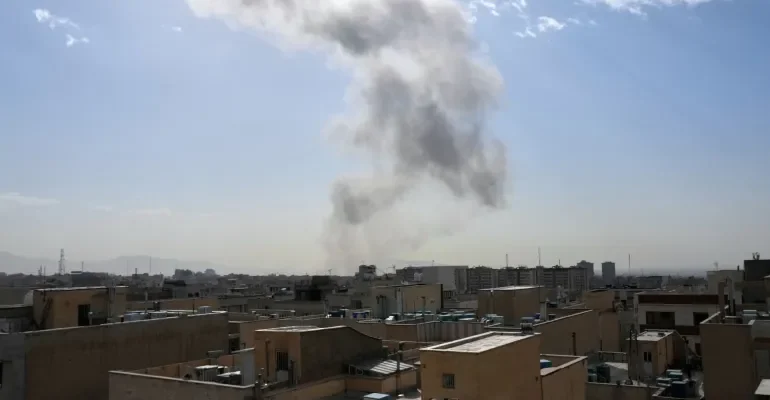
A significant escalation of tensions gripped the Middle East on February 28, 2026, as the United States and Israel launched coordinated military strikes on Iranian territory, triggering widespread explosions and columns of smoke, particularly in the capital, Tehran. US officials, speaking to Al Jazeera, indicated that several missiles struck areas like University Street, the Jomhouri area, and the Keshvardoost and Pasteur districts in Tehran. US President Donald Trump and Israeli officials, including Defense Minister Israel Katz and Prime Minister Benjamin Netanyahu, justified the operation as a means to “eliminate imminent threats from the Iranian regime” and “remove threats to the State of Israel,” specifically citing Iran's nuclear and missile programs. The attacks were described as a joint operation involving US fighter jets and warships, with reports of Tomahawk missiles hitting targets.
Initial reports suggested high-level targets, with Israel's Kan reporting that Supreme Leader Ayatollah Ali Khamenei and President Masoud Pezeshkian were among those targeted. However, Iranian state television quickly confirmed President Pezeshkian was “safe and sound,” and the Fars News Agency reported that other senior officials like Parliament Speaker Mohammad Baqer Qalibaf and SNSC head Ali Larijani remained unharmed. An Iranian official told Reuters that Khamenei had been moved to a secure location. While an Iranian official stated no damage to property, reports from the UAE's state news agency confirmed one person was killed in Abu Dhabi after Iranian missiles were intercepted, and another Iranian provincial official reported 24 deaths after a school in Iran was hit.
Iran swiftly vowed a “crushing” retaliation. The Islamic Revolutionary Guard Corps (IRGC) confirmed launching strikes on US bases across the Middle East, including Bahrain, Kuwait, Qatar, and the United Arab Emirates, along with targets in Israel. The IRGC declared all US assets in the region as legitimate targets. Explosions were heard across Saudi Arabia, Bahrain, Qatar, UAE, Israel, and Iraq. Qatar’s Defense Ministry confirmed thwarting several attacks, intercepting all missiles before they reached Qatari territory. In Bahrain, missiles reportedly struck the headquarters of the US Navy 5th Fleet. An Iraqi military base housing the pro-Iran group Kataeb Hezbollah was also bombed, killing at least two fighters, prompting the group to vow attacks on American bases.
The widespread military action immediately led to a cascade of regional disruptions. Iran, Iraq, Israel, Kuwait, Syria, Jordan, and the UAE all closed their airspaces to civilian traffic. Airlines including Virgin Atlantic, British Airways, Wizz Air, Emirates, Lufthansa, Air India, Turkish Airlines, and Kenya Airways announced significant flight cancellations and re-routings across the Middle East. Security advisories were issued by various embassies, with the US Embassies in Qatar and Bahrain urging citizens to shelter in place. The Embassy of Ghana in Doha and the Kenyan Embassy in Doha both issued urgent alerts for their nationals to seek shelter and exercise extreme caution due to the volatile situation and reported missile impacts in Doha. Mobile phone services were disrupted in several Tehran districts, and sirens sounded in Jerusalem with a proactive alert for incoming missiles.
The strikes unfolded amidst faltering diplomatic negotiations. US President Trump expressed frustration with Iran's stance on its nuclear and missile programs, despite ongoing indirect talks. The third round of US-Iran nuclear talks, held just two days prior in Geneva on February 26, ended without a breakthrough. Oman, which mediated these talks, offered a more optimistic view, stating Iran had agreed to zero stockpiling of enriched uranium and to degrade current stockpiles. However, Trump had previously withdrawn from the 2015 nuclear deal during his first term. US Secretary of State Marco Rubio, who designated Iran a state sponsor of wrongful detentions, was scheduled to travel to Israel for talks on Iran.
The rhetoric surrounding the attacks was particularly severe. President Trump, in a video message, vowed to “destroy their missiles and raze their missile industry to the ground” and “annihilate their navy.” He issued a stark warning to ordinary Iranians to “stay sheltered” and urged them to “take over your government,” offering Iranian forces, including the Islamic Revolutionary Guard Corps (IRGC), “immunity or in the alternative, face certain death” should they surrender. Prime Minister Netanyahu echoed these calls, urging Iranians to “cast off the yoke of tyranny.” Reza Pahlavi, the exiled son of Iran's last shah, also called for Iranians to rise up and “take back and rebuild Iran.”
Internally, Iran's Supreme National Security Council (SNSC) advised citizens to travel to safer areas, avoid crowded shopping centers, and maintain calm. It announced the closure of schools and universities, while banks would continue services and government offices would operate at 50% capacity. The SNSC reassured the public that essential goods were secure. Iran's unique political structure, a theocracy-republic hybrid since 1979, is led by the Supreme Leader, with the IRGC serving as its elite military arm, tasked with both combating foreign enemies via its Quds Force and enforcing Islamic morality domestically through the Basij volunteer force. The Guardian Council and Assembly of Experts also play key roles in this clerical system.
International reactions largely condemned the escalation and called for restraint. The European Union’s foreign policy chief called developments “perilous.” Switzerland expressed deep alarm and urged all parties to protect civilians. Malaysia’s Prime Minister warned the region was at the “edge of catastrophe,” urging diplomatic solutions. Slovenia voiced concern over the “serious escalation of regional tensions.” Ukraine, while blaming Tehran, wished security to Iranians. Australia supported the US in preventing Iran from obtaining nuclear weapons and stood with the Iranian people. India advised its nationals in the region to exercise utmost caution. The UN nuclear watchdog, IAEA, called on Iran to cooperate constructively.