Kyiv Under Siege: Relentless Russian Air Raids Continue for Second Day
Russia has unleashed relentless waves of jet-powered drone attacks on Kyiv for a second consecutive day, causing widespread disruption to daily life and critical infrastructure. This strategic assault aims to exhaust Ukrainian air defenses and the population, resulting in significant civilian damage, including the destruction of numerous warehouses and homes.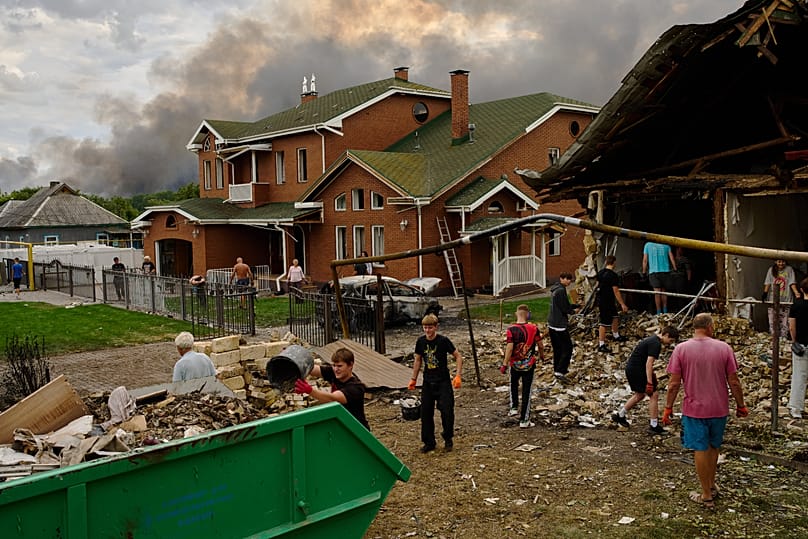
Russia has continued to unleash waves of drone attacks on Ukraine's capital, Kyiv, for a second consecutive day, forcing residents into shelters and causing widespread disruption across the city. This follows an intense period on Thursday, when Kyiv endured almost 15 hours of air-raid warnings and 13 separate siren activations, according to the Foreign Ministry. The relentless assaults have resulted in at least 23 air-raid alerts in under two days, significantly impacting work, transportation, and everyday life for the city's inhabitants.
The state railway operator, Ukrzaliznytsia, reported considerable delays due to the prolonged air-raid alerts, with disruptions anticipated to persist. While no long-distance trains have been canceled, several services have been running hours behind schedule as repeated aerial threats interrupted operations, highlighting the profound impact on critical infrastructure and daily routines.
Ukrainian officials indicate that much of the sustained disruption is a result of Russia's strategy of launching small groups of jet-powered drones in successive waves, rather than in a single mass barrage. This tactic is designed to repeatedly renew the threat and trigger new air-raid alerts, with the stated goal of exhausting both air defenses and the civilian population, as explained by Andrii Kovalenko, head of Ukraine’s Center for Countering Disinformation.
Russia has escalated its use of jet-powered drones in recent months. Unlike the more common propeller-driven Shahed-type drones, which typically fly at speeds up to 300 km/h, these newer weapons can reach speeds of up to 500 km/h. This increased velocity places them beyond the effective reach of many Ukrainian interceptor drones, potentially compelling Ukraine to deploy its more scarce and considerably more expensive air-defense missiles to counter the threat. On Thursday alone, between 7 am and 7 pm, Ukraine's Air Force reported approximately 140 attack drones launched against the country, with over 100 of them being jet-powered, and the majority directed specifically at Kyiv.
The continuous attacks have inflicted extensive damage on civilian infrastructure in Kyiv and the surrounding region. On Friday, one person was killed and two others injured in the Kyiv region. Regional authorities also reported significant destruction, including 14 warehouses, 16 private homes, three apartment buildings, and 16 vehicles. Warehouses and distribution centers have been particularly targeted in these recent Russian attacks. Agriculture Minister Taras Vysotskyi stated that around 90% of Ukraine’s modern storage facilities for goods have been destroyed by Russian strikes. While this destruction will not lead to a food shortage for Ukrainians, it is forcing retailers to extensively reorganize their supply chains, including by directly delivering goods from producers to shops.
Despite the well-documented damage to homes, schools, warehouses, and businesses, the Kremlin maintained its consistent narrative on Friday. Kremlin spokesman Dmitry Peskov reiterated that Russia was attacking only military and military-related infrastructure. He stated, "Strikes on Kyiv are continuing. They are continuing systematically and deliberately. We continue to destroy the military and paramilitary infrastructure. Our military knows what it is doing and how it is doing it," a claim that stands in stark contrast to the widespread civilian devastation observed on the ground.