Huawei Unleashes Fintelligent to Supercharge Banks with AI Agents
Huawei has launched its Fintelligent AI Solution to empower financial institutions in managing and controlling their AI infrastructure. This platform provides a shared foundation for developing and operating AI agents, addressing challenges like cost management, knowledge alignment, and agent governance through its Agent, Token, and Data-Knowledge Factories. It aims to help banks own their AI architecture, reuse assets, and maintain control over their AI evolution.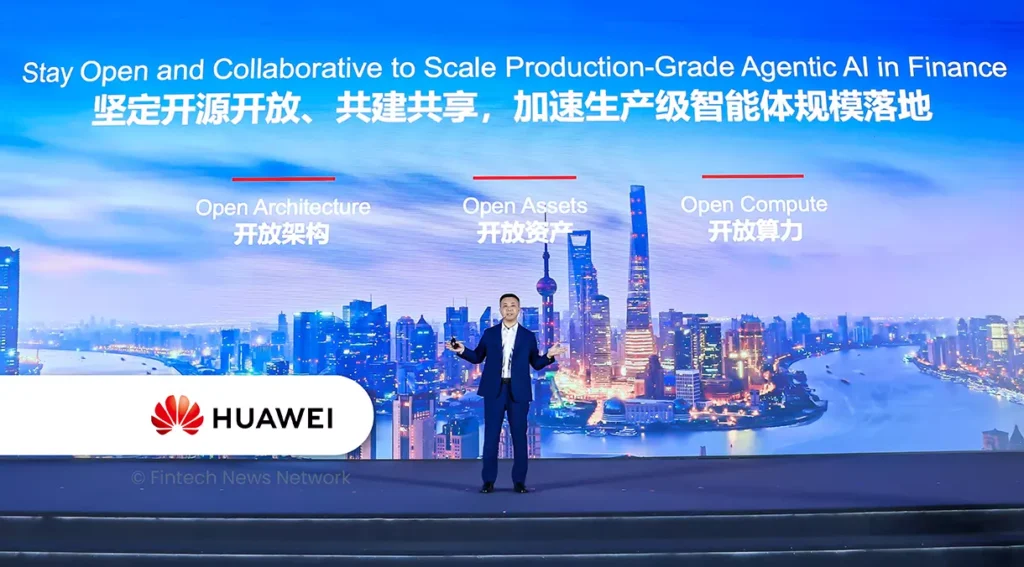
The increasing adoption of Artificial Intelligence (AI) within financial institutions presents significant challenges regarding control and management. Banks, for instance, need to ensure that AI agents reviewing credit memos utilize current lending policies and relevant customer records. As different departments independently develop and deploy their own AI agents, issues such as duplicated efforts, reliance on outdated policy versions, and difficulties in tracking costs across the organization arise.
Addressing these critical concerns, Huawei launched its Fintelligent AI Solution at the Global Finance Summit during HUAWEI CONNECT 2026 in Shanghai on September 18, 2026. Jason Cao, CEO of Huawei Digital Finance BU, positioned Fintelligent as a comprehensive solution enabling banks to maintain ownership and control over their AI development and usage. This philosophy emphasizes a bank's ability to make meaningful choices regarding its AI architecture and models, build reusable knowledge and agent assets, and continuously operate and improve these capabilities.
Huawei’s Fintelligent solution is built on an open hybrid AI architecture and comprises three core components designed to foster a shared foundation for AI development and operation: the Agent Factory, Token Factory, and Data-Knowledge Factory. This approach promotes the reuse of agents and knowledge across different teams within a bank.
The **Agent Factory** directly tackles the challenge of managing AI agents across the bank. Research from Cambridge in 2026 indicated that while 81% of surveyed financial-services firms were adopting AI, only 14% considered it transformational to their strategy. As an example, DBS's credit-memo tool supports approximately 1,500 employees globally, handling over 70 associated tasks, with human managers retaining final responsibility. Huawei's Agent Factory is centered on openJiuwen, an open-source agent platform that provides a robust foundation for banks to develop, run, manage, and govern their agents. openJiuwen also facilitates the creation of an Agent Marketplace, allowing departments to share and reuse agents and skills institution-wide. This aligns with the Monetary Authority of Singapore’s (MAS) AI risk guidelines, issued on October 7, 2026, which mandate that financial institutions remain accountable for AI used in their services, maintain AI inventories, and apply proportionate controls, including human oversight.
The **Token Factory**, named TokeNexus, focuses on managing the cost of AI at scale. Processing extensive documents for due diligence reports differs greatly from requiring quick responses for customer account details, necessitating varying model and computing resource choices. TokeNexus supports token planning, production, scheduling, and optimization to help banks effectively manage AI operating costs, performance, and capacity. Tokens represent the units of content processed by AI models. Huawei offers both public-cloud and on-premises deployment options, allowing banks to align choices with their workload, security, and performance requirements. This component is crucial given Cambridge's finding that 76% of large financial institutions struggle to measure the value of AI deployment.
The **Data-Knowledge Factory**, specifically its Financial Agentic Data Solution, ensures that agents remain aligned with the bank's evolving knowledge base. Policy updates must reach both staff and AI agents to prevent the application of outdated rules. This solution supplies financial agents with up-to-date data and knowledge drawn from institutional records, documents, and rules, with pipelines designed to continuously provide relevant material as the bank’s information changes. Furthermore, this factory enables the capture of investigator experience as reusable knowledge to support case analysis and rule refinement in agent-assisted fraud operations as fraud patterns evolve.
Complementing these solutions, Huawei's **AI Coding Solution** assists in preserving business rules embedded in legacy systems. When replacing applications, developers can extract these rules as structured knowledge for use in new software, thereby preserving critical business logic during modernization. These operational questions underscore the practical definition of owning AI: a bank's ability to choose its technology, retain its business knowledge, and continuously improve its capabilities as AI adoption expands.