Gaza Fallout: Israeli Envoy Demands Hamas Disarmament, Slams 'Genocide' Tag in Ghana
The Israeli Ambassador to Ghana, H.E. Roey Gilad, has critically engaged Ghanaian officials, refuting accusations of genocide against Israel and appealing for Ghana's diplomatic leverage to compel Hamas's disarmament. He emphasized Israel's security imperatives and the profound human tragedy in Gaza, urging for a future where innocent Palestinians can coexist with Israel, free from Hamas's influence.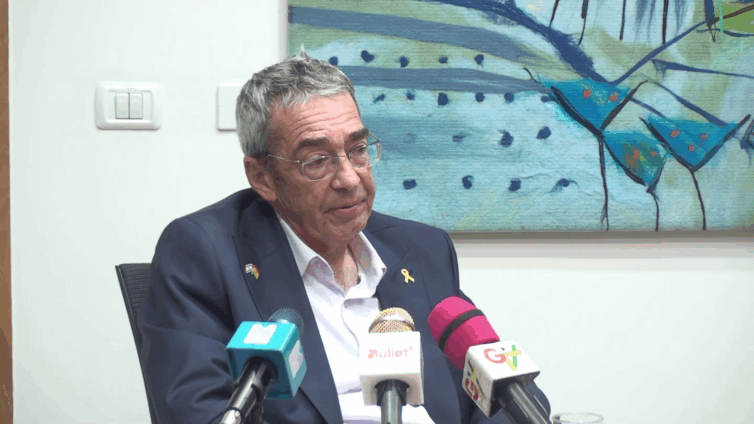
The Israeli Ambassador to Ghana, H.E. Roey Gilad, has been actively engaged in Ghana, addressing contentious diplomatic matters and appealing for the nation's influential voice in promoting regional peace. Ambassador Gilad recently criticized Ghana's Minister of Foreign Affairs, Samuel Okudzeto Ablakwa, for adopting a United Nations report that accused Israel of conducting genocide in the Gaza Strip. During a press briefing, Gilad labeled this move as "a very wrong thing to do," challenging the premise of the accusation which followed the release of a comprehensive report by the UN's Independent International Commission of Inquiry on the Occupied Palestinian Territory.
Ambassador Gilad underscored the immense historical gravity associated with the term "genocide," especially when directed at the Jewish state. He highlighted that the term was coined by Polish-Jewish lawyer Raphael Lemkin, a Holocaust survivor, in 1944 to describe the atrocities of the Holocaust. Gilad firmly stated that "Genocide is a very, very serious blame, especially when you blame Israel."
A core aspect of the Ambassador's defense revolved around the legal definition of genocide, which necessitates establishing a specific intent (known as "dolus specialis") to "annihilate completely" a national, ethnical, racial, or religious group. Gilad explained, "The main definition of genocide is the intent. If you have an intention to annihilate completely, to destroy the other side, this is genocide." He unequivocally redirected the accusation of genocidal intent to Hamas, the non-state actor controlling the Gaza Strip. "The attitude of Hamas towards Israel is genocidal. They say there is no room for a Jewish sovereign state in the Middle East," Gilad asserted, adding, "Actually, if you can blame somebody for being genocidal, this is the Hamas. Israel was forced to conduct a war in Gaza against a terror organisation."
Acknowledging the profound human cost of the conflict, which the 70-page UN report detailed, the Israeli envoy described the situation in Gaza as a "huge tragedy." He confessed, "What we saw in Gaza was a huge tragedy. That has to be said. We are not happy with what happened. It was a huge tragedy for the Palestinians, and it was a huge tragedy for us, the Israelis." However, he emphasized that the scale of loss does not equate to responsibility, asserting that Israel's military operation was necessitated by Hamas's strategy of operating within civilian populations. Gilad cited the challenge of targeting approximately 25,000 Hamas terrorists/activists who utilize extensive tunnel networks and take "shelter behind human shields, behind 2 million Palestinians." He detailed the operational complexities, including 251 Israeli citizens held hostage in Gaza, and the inevitability of civilian casualties, noting that Israeli forces even "killed by mistake some of our own people."
In a controversial move to contextualize civilian casualties, Ambassador Gilad compared Israel’s performance in Gaza to recent Western military campaigns in Iraq and Afghanistan. He claimed that Israel "did a better job" comparatively, reiterating, "There was no intent to destroy the Palestinian people. There was an intent to destroy Hamas." Despite his strong critique of the Ghanaian minister's endorsement of the UN report, Gilad concluded that the matter was "already water under the bridge" in diplomatic terms.
Shifting focus, Ambassador Gilad also issued an urgent appeal to the Ghanaian government, urging it to leverage its "strong voice" in Africa to pressure Hamas into fully disarming. He identified this as a critical, non-negotiable precondition for the successful implementation of the second phase of the Trump Peace Plan. At a separate press briefing in Accra regarding the multi-phase peace initiative, Gilad emphasized that the future of Gaza and Israel's security hinge on Hamas's commitment to lay down its weapons, as outlined in the 20-Point Plan.
The Ambassador specifically called upon Ghana, noting its commitment to stability through its long-standing participation in the United Nations Interim Force in Lebanon (UNIFIL), where it contributes a significant peacekeeping battalion. "Ghana is not just another state. It's not just another one of the 54 states in the AU. It has a very strong voice... We expect now Ghana, which has a very strong voice in Africa, to use its own voice to echo through the AU and add its voice to the Arab states and all the European states and the United States that are calling that 'Hamas, enough is enough.'"
Gilad also pleaded for the welfare of the Palestinian people, stressing that Hamas should not be part of Gaza's future governance. "The future of the Palestinian people is more important than the future of Hamas... They should not have a role in the future of Gaza. The future of Gaza should be, in the long run, in the hands of innocent Palestinians who would like to live next to Israel and not instead of Israel." He underscored Israel's existential security concerns, contrasting its small size (less than 25,000 square kilometers) with Ghana's (250,000 square kilometers) to illustrate its vulnerability, stating, "often people in the world think that Israel is a superpower... No, that's not the case."
The Ambassador clarified that the Trump-sponsored peace plan is structured in three phases. The first phase, involving Israel's limited redeployment and the release of living Israeli hostages, is largely complete. However, the second phase faces a major roadblock: the disarmament of Hamas. "The biggest challenge is the disarming of Hamas... It seems to us that they have no intention to disarm... For us, this is one of the most important parts of the agreement, of the 20-point agreement." Phase two requires Israel to pull back further to pre-October 7th border lines, short of a one-to-two-kilometer military perimeter, in exchange for Hamas disarming. This demilitarized area would then be governed by a Special Peace Council, reportedly headed by President Trump and former British Prime Minister Tony Blair, overseeing a technocratic Palestinian committee and an International Stabilisation Force (ISF).
Ambassador Gilad warned that Hamas's apparent refusal to disarm threatens to halt the entire process. "If Hamas will not disarm itself, Israel will not pull back to the international border, short of the perimeter... Without it, the second phase will not be completed unless they disarm themselves." He referenced the precedent set by the Irish Republican Army (IRA) in 2005, which fully disarmed after the Good Friday Agreement, suggesting, "That can happen here."