From Sand to Skyscrapers: How Qatar, UAE, and Singapore Created Wealth
Discover how three small nations transformed from modest beginnings into global powerhouses through bold planning, innovation, and strategic investment.
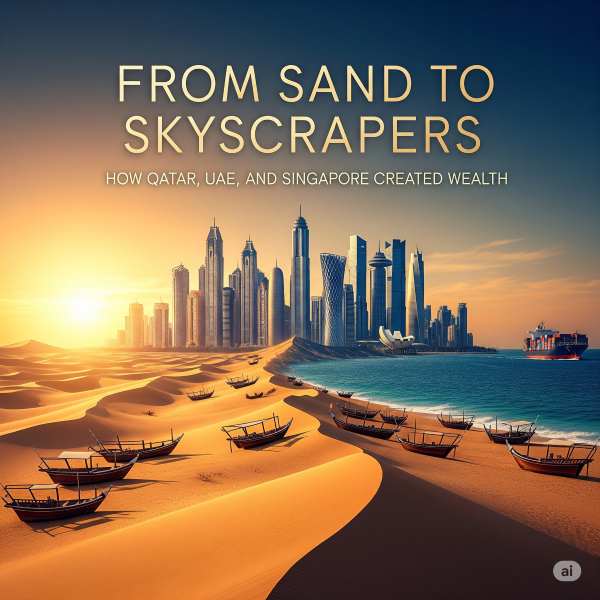
In the early 20th century, the desert coastline of the Arabian Gulf and the humid island of Singapore had little to suggest the futures that awaited them. Qatar was a sparsely inhabited desert economy, where most families relied on fishing and the risky business of pearl diving. Dubai, then a small trading settlement under British protection, had few modern amenities and even fewer prospects—its economy too dependent on the fragile maritime trade of the Gulf. Singapore, meanwhile, was often described as a swampy colonial outpost, plagued by high unemployment, ethnic tensions, and no natural resources.
Today, all three are symbols of affluence. Qatar boasts one of the highest per-capita incomes in the world. Dubai is synonymous with glittering skyscrapers and a bustling global service economy. Singapore, once dismissed as unviable after its expulsion from Malaysia in 1965, is now one of the most advanced economies in Asia. Their transformations were not accidents of fate, nor the result of simple luck. They were the product of resource exploitation, strategic geography, deliberate governance, and visionary leadership.
The Gulf’s Oil-Fueled Ascent

Image Above: Dubia. Credit: Spot Blue
For Qatar and Dubai, the story begins with oil and natural gas. Before hydrocarbons, the economy of the Arabian Gulf revolved around pearling. Generations of men dove for pearls in harsh conditions, while women and children struggled to make ends meet onshore. The collapse of the pearl industry in the 1930s, due to Japanese cultured pearls, devastated the Gulf’s fragile economies. Families fell into poverty, and prospects for recovery seemed dim.
That changed with the discovery of oil. In Qatar, petroleum exploration began in the 1930s, but it was after World War II that oil exports brought in significant revenue. The real breakthrough, however, came with the discovery of the North Field, one of the world’s largest natural gas reserves. By the late 20th century, Qatar had become a global leader in liquefied natural gas (LNG), exporting to Europe and Asia. Unlike some resource-rich nations that misused revenues, Qatar invested heavily in infrastructure, healthcare, and education, while establishing the Qatar Investment Authority, a sovereign wealth fund that now manages hundreds of billions in assets worldwide. The country transformed itself from desert hardship to one of the wealthiest societies on earth.
Dubai’s path was different. Oil was discovered there in the 1960s, but reserves were modest compared to its neighbor Abu Dhabi. Sheikh Rashid bin Saeed Al Maktoum, recognizing that oil would not sustain Dubai, pursued diversification from the very beginning.
He invested in infrastructure like Port Rashid in 1972 and later Jebel Ali Port, today one of the busiest shipping hubs globally. The creation of Emirates Airlines in the 1980s extended Dubai’s reach as a global transit point. Later, bold real estate projects such as the Palm Islands and the Burj Khalifa established Dubai not merely as a Gulf city, but as a cosmopolitan hub for finance, trade, tourism, and luxury. Oil revenues gave Dubai its first push, but its vision for diversification made the transformation lasting.
Singapore: From Colonial Outpost to Global Trade Titan

History
Rewind the Stories that Made Africa, Africa
A Journey Through Time, Narrated with Insight.
Image Above: Singapore Port. Image Credit: Bloomberg.
Where the Gulf states had oil and gas, Singapore had none of it. At independence in 1965, after a bitter separation from Malaysia, Singapore was written off by many as unviable. It had no natural resources, a small land area, ethnic tensions between Chinese, Malays, and Indians, and high unemployment. Yet underLee Kuan Yew, Singapore turned its disadvantages into a disciplined program of nation-building and economic strategy.
The island leveraged its geography as the gateway between the Indian and Pacific Oceans. Shipping lanes that carried goods from East Asia to Europe passed directly by Singapore, and its leaders seized the opportunity. The government modernized the port, turning it into one of the busiest in the world. Simultaneously, Singapore positioned itself as a safe and predictable destination for foreign investors. Rule of law, political stability, and English-speaking workers made it attractive to multinational corporations.
The government pursued a deliberate path of export-oriented industrialization. In the 1960s and 70s, this meant attracting manufacturing in textiles, electronics, and later semiconductors. By the 1980s, Singapore had moved up the value chain, with policies that encouraged banking, finance, and high-tech innovation. The Economic Development Board (EDB) guided industries strategically, almost like a venture capitalist choosing where to place bets. Education policies created a highly skilled workforce, and housing programs reduced poverty while promoting social cohesion.

By the 1990s, Singapore had become a high-income economy, a financial hub for Asia, and a model that other developing nations sought to emulate. Its success was not resource-driven, but built on human capital, trade, and governance.
The Power of Governance and Vision
What unites the Gulf and Singaporean experiences is the central role of governance and vision. Oil and gas discoveries alone did not guarantee prosperity—many countries with similar resources have languished under corruption or instability. Qatar and Dubai invested revenues with long-term goals in mind. Their monarchies centralized decision-making, allowing them to quickly implement large-scale infrastructure and diversify economies.
Singapore, in contrast, had no resources to mismanage. Its leaders ruled with pragmatism, even authoritarian efficiency at times, but always with an eye toward stability and growth. Corruption was stamped out, bureaucracy was made efficient, and the state carefully managed social policies to prevent ethnic divisions from threatening progress.
Both regions understood the value of global integration. Dubai positioned itself as a business-friendly hub connecting East and West, with liberal visa regimes and free zones that attracted expatriates and investors. Singapore did the same with multinational corporations, embedding itself in global supply chains. Both opened themselves to global capital, talent, and trade at a time when many other nations turned inward.
Common Threads and Key Divergences
Despite their different starting points, Qatar, Dubai, and Singapore share common themes in their transformations:
Strategic Geography: Gulf states exploited their location as energy suppliers near global markets; Singapore capitalized on its maritime crossroads.
State-Led Development: Governments played active roles in steering growth, whether through sovereign wealth funds or industrial boards.
Global Orientation: Integration with world markets was not an afterthought but a central strategy.
Yet the differences are equally telling. The Gulf’s wealth is tied to finite resources, though Dubai has diversified more successfully than most. Singapore’s wealth is built entirely on human capital, stability, and governance, showing that natural resources are not a prerequisite for prosperity.
Conclusion: Wealth by Design, Not Destiny
A century ago, Qatar was a cluster of fishing villages, Dubai a dusty trading port, and Singapore a struggling colonial outpost. Today they are among the world’s wealthiest societies. Their rise underscores a vital lesson: wealth is rarely an accident. It is not destiny that transforms nations from poverty to prosperity, but vision, governance, and the ability to seize opportunity.
In the Gulf, hydrocarbons provided the spark. In Singapore, it was geography and leadership. In both, it was a willingness to look outward—to trade, to attract talent, to build institutions—that turned fragility into fortune. From the sands of the Arabian desert to the swamps of Southeast Asia, prosperity was designed, not inherited.