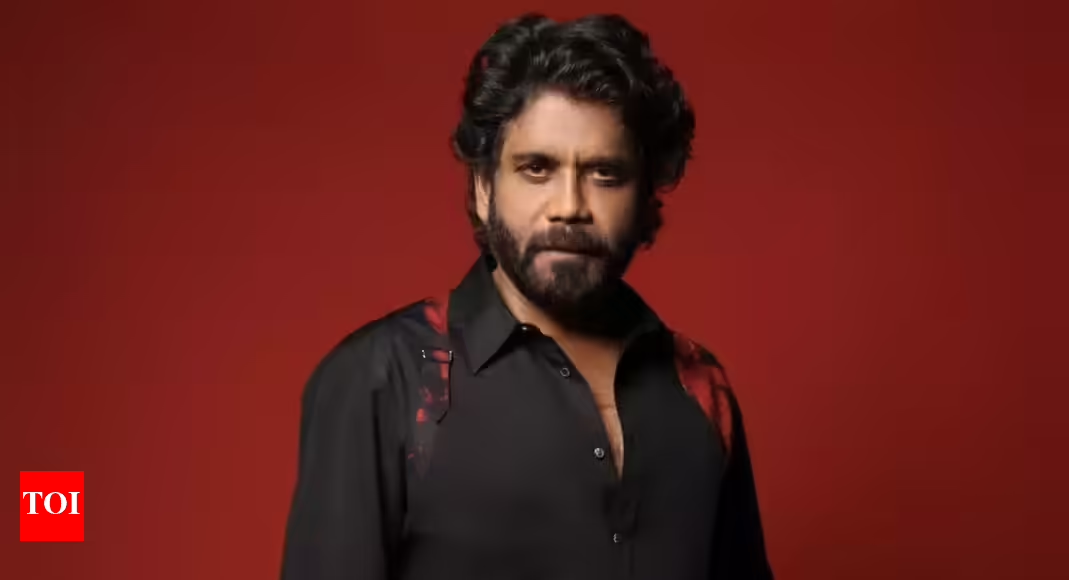
Film Icon Nagarjuna Akkineni Marks Four Decades, Unveils 100th Film Secrets

Akkineni Nagarjuna, a prominent figure in Indian cinema, marks four decades in the industry as he approaches his 100th film. The son of the legendary Akkineni Nageswara Rao, a titan of Indian cinema, Nagarjuna meticulously carved his own formidable career starting in the mid-1980s. His early filmography includes landmark works such as Mani Ratnam’s 1989 romantic drama “Gitanjali,” which won an Indian National Film Award, and Ram Gopal Varma’s seminal 1989 action thriller “Shiva.” Beyond these, he is celebrated for devotional epics like “Annamaya” and “Sri Ramadasu.” His versatility extends to Bollywood, notably with Ayan Mukerji’s 2022 fantasy action film “Brahmastra,” and upcoming roles include a former CBI officer in Sekhar Kammula’s “Kuberaa” opposite Dhanush, and a villainous turn opposite Rajinikanth in Lokesh Kanagaraj’s “Coolie.” In parallel to his acting, Nagarjuna also presides over Annapurna Studios, one of India’s most historically significant production and technical facilities.
Nagarjuna pinpoints “Gitanjali” as the pivotal moment when his identity as an actor truly crystallized. While his earlier Telugu films performed well, it was this romantic drama that fundamentally altered his perception and approach, enabling him to “find [his] feet.” This was soon followed by “Shiva,” which, according to him, “locked the whole thing, sealed the whole thing.” He attributes the success of these films to a broader cultural shift around 1988-89, where younger audiences in south India were actively seeking a departure from conventional filmmaking. He considers himself fortunate to have been an “early bird” to capitalize on this nascent demand for change.
His extensive work across various Indian film industries reinforced a core conviction: that stories deeply embedded in Indian culture, sentiments, and emotions are the ones that resonate and endure. He regards trends involving foreign locations or Western sensibilities as ephemeral, passing phases. Discussing star culture, Nagarjuna candidly observes the unparalleled devotion of audiences in the Telugu and Tamil industries, a phenomenon he traces back to his father’s era and the legendary N.T. Rama Rao. He describes the “immense” and “very, very high” star following, where audiences eagerly await films and deeply associate themselves with particular stars.
Among his most personally transformative projects are the devotional films “Annamaya” and “Sri Ramadasu,” which uniquely blended spiritual themes, music, and mainstream appeal in Telugu commercial cinema. In the 1997 K. Raghavendra Rao film “Annamaya,” Nagarjuna portrayed Annamacharya, the 15th-century Vaishnavite saint-poet whose thousands of kirtanas dedicated to Lord Venkateswara of Tirumala remain widely heard. He recalls an unexpected spiritual awakening during production, noting a palpable shift in himself and a profound sense of respect among the unit members, who felt they were working for God. This deep connection, he believes, stemmed from the long absence of such mythological and devotional films from Telugu screens since the 1950s and 60s, which audiences had missed. Similarly, “Sri Ramadasu,” based on the saint-composer he knew from childhood textbooks, also proved to be an “incredible awakening.”
Nagarjuna approaches the subject of his father's legacy with a blend of pride and philosophical insight, asserting that legacy is not transferable but must be respected and earned through individual merit. While he feels fortunate to have upheld his father's reputation, he emphasizes that his sons, actors Naga Chaitanya and Akhil Akkineni, must independently prove themselves to the audience. He states, “It’s for the people to decide. We just have to try.”
Regarding Telugu cinema’s recent global breakthrough with films like “Baahubali,” “RRR,” “Pushpa,” and “Kalki,” Nagarjuna offers a perspective that challenges conventional wisdom. He contends that the scale and ambition were always inherent in Telugu and Tamil films, which had reached international markets like Japan long before the current wave. The unchanging element, he suggests, is the deep-rooted sensibility of the filmmakers themselves, many of whom remain connected to their village traditions and perceive heroes as larger-than-life figures. The crucial new factor, he believes, is that technological advancements have finally caught up with this long-standing ambition, enabling directors to realize their grand visions. “They don’t know anything else to do,” he quips, referring to their inherent larger-than-life storytelling approach.
At this advanced stage of his career, Nagarjuna has consciously broadened his acting repertoire, actively seeking diverse and experimental roles. He cites his part in “Kuberaa,” portraying a former CBI officer navigating extreme socio-economic divides, as an example of the challenging roles he now pursues. His willingness to take on a smaller yet significant role in “Brahmastra” further exemplifies this expanded range. He articulates his current approach as a balance: “Now I don’t have to be the lead man – and I will have to be the lead man. Both. I’m working on both of them. My choices have become much wider. I’ve opened up the doors.”
As the head of Annapurna Studios, Nagarjuna has spearheaded significant advancements. He recently launched a state-of-the-art motion capture facility, which S.S. Rajamouli has already utilized for key sequences in his film “Varanasi.” Nagarjuna notes that such a facility should have been established sooner, pointing to international productions like “Avatar” and parts of “Brahmastra” relying on foreign motion capture. He stresses the importance of directors and cinematographers training to fully leverage this technology, acknowledging its potential to “achieve impossible things” for actors. Additionally, the Annapurna College of Film and Media, established over a decade ago, was born from a shared vision with his father to formalize film education in India, moving beyond the traditional guru-assistant model. In partnership with Jawaharlal Nehru Architecture and Fine Arts University, the college offers bachelor’s and master’s degrees across various filmmaking disciplines. Its unique placement within a fully operational studio ensures students are immersed in an active production environment, leading to graduates finding success in international festivals and the advertising industry.
Nagarjuna is currently approximately 45% complete with his 100th film, tentatively titled “King 100.” Directed by Ra Karthik, he describes it as a “total commercial script” centered on a father-daughter drama with a rags-to-riches narrative. The film will employ de-aging technology to depict his character across a wide age range, from 25 to 60. The cast includes Tabu, Sushmita Bhatt, and Vijayendra, with additional casting yet to be finalized. Nagarjuna is deliberately keeping further details under wraps, planning a grand unveiling. He firmly rejects the notion of this milestone marking a “next phase” in his career, stating, “There is no next phase. I never thought of it like that.”
You may also like...
10+ Crypto Projects Died in the First Three Months of 2026, Here Is What Killed Them
Over 20 crypto projects, from DeFi protocols and NFT marketplaces to Bitcoin miners and blockchain games, have shut down...
Film Icon Nagarjuna Akkineni Marks Four Decades, Unveils 100th Film Secrets

Akkineni Nagarjuna, a four-decade veteran of Indian cinema, is nearing his 100th film while reflecting on his impactful ...
Chaos Erupts: 'Tomb Raider' Production Halted by Sophie Turner Injury

Production on the Prime Video "Tomb Raider" series has paused as lead Sophie Turner recovers from a back injury, potenti...
Airspace Mayhem: Army Probes Apache Helicopter Buzzing Kid Rock's Nashville Mansion!

The U.S. Army is investigating an incident involving two Apache helicopters performing low-altitude maneuvers near Kid R...
Global Domination: RM Thanks Fans As BTS Conquers Billboard Charts!

BTS has achieved monumental success with their new album ARIRANG and its lead single “SWIM,” topping both the Billboard ...
Public Skepticism Grows: AI Adoption Soars, But Trust Fails

Despite increasing adoption of AI for daily tasks, Americans harbor significant mistrust and concern about the technolog...
AI's Golden Age: How Governance Unlocks Billions in Financial Growth

Financial institutions are shifting from using AI for mere efficiency to prioritizing compliant and ethical deployment d...
John Oliver Unravels US Conservative Fixation on Hungary in Blistering Critique

Hungarian President Victor Orbán has surprisingly become a celebrated figure among American conservatives, with his auth...