Europe on Edge: Ceuta Migrant Crisis Deepens, EU Leaders Demand Emergency Talks
The Spanish enclave of Ceuta experienced an unprecedented migrant crisis with over 60,000 arrivals, sparking a major European debate. While Italy, Finland, and Denmark called for Spain's suspension from the Schengen zone, Spain and the EU Commission rejected the move, emphasizing solidarity and border security. The crisis highlighted deep divisions in European migration policy and led to calls for urgent ministerial meetings.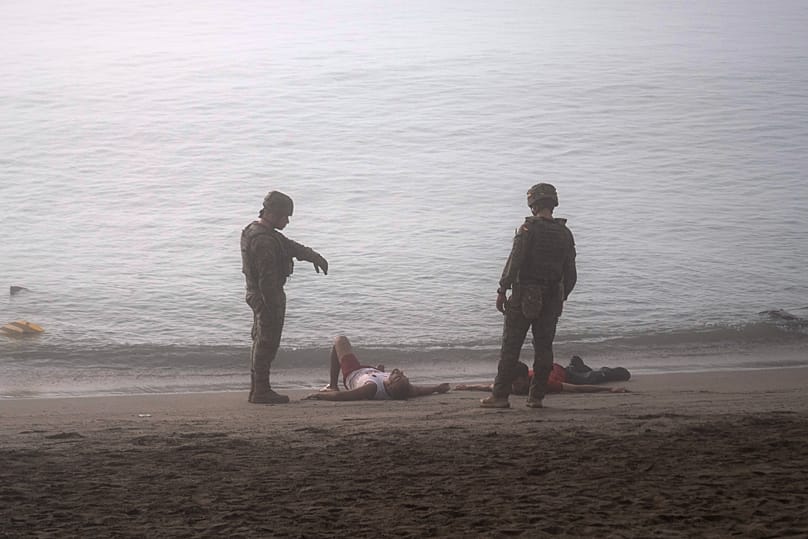
Europe faced an unprecedented migration crisis this week as the Spanish enclave of Ceuta, located in North Africa, was overwhelmed by more than 60,000 migrant arrivals. This surge, during which at least 67 people died from drowning or in a stampede, marked the largest number of irregular arrivals ever recorded on a single day in EU territory. The dramatic scenes from Ceuta quickly sparked vivid concerns among European governments, leading to intense debate over migration policies and border security within the Schengen area.
Italy, through Prime Minister Giorgia Meloni, was quick to react, calling for Spain's suspension from the EU's visa-free Schengen travel zone. Meloni described the images from Ceuta as "shocking" and demanded "extraordinary measures" to defend Italy's borders, stating her government would not "yield an inch" on illegal immigration. The hard-right Brothers of Italy party proposed the suspension, and Italy subsequently reintroduced air and maritime border controls with Spain for a month. This stance received support from Denmark, whose Prime Prime Minister Mette Frederiksen suggested considering a "suspension of Schengen cooperation," and Finland, where Interior Minister Mari Rantanen asserted that "Countries that do not fulfil their obligation to protect the external border cannot be members of Schengen."
Right-wing figures across Europe echoed these concerns and linked the crisis to Spain's domestic policies. Italian Foreign Minister Antonio Tajani criticized Madrid's decision to grant Spanish citizenship to over 500,000 irregular immigrants, calling it "profoundly wrong" and an encouragement to human trafficking. Manfred Weber, German leader of the centre-right European People's Party (EPP), labeled the situation "appalling" and a direct consequence of the "pull factor of massive regularisation." Alice Weidel, leader of the far-right Alternative for Germany, warned that Germany, likely the destination for most migrants, must secure its borders. Jordan Bardella, France's radical right leader, called for an urgent debate in the European Parliament on the developments in Ceuta and the perceived failure of EU migration policies.
Spain, however, vehemently rejected these criticisms. Prime Minister Pedro Sánchez blasted Italy's "demagoguery" and summoned its ambassador to Madrid to lodge a protest. Sánchez described the arrival of migrants as an an "attack" and a "violation of Spain's territorial integrity," lamenting a "rather asymmetric" response from some EU partners who chose to "attack Spain and to call for its temporary exclusion from the Schengen Area" instead of showing solidarity. Spanish left-wing S&D MEPs, including Juan Fernando López Aguilar, Javi Lopez, and Cecilia Strada, condemned Italy's position as "unworthy of a European partner" and "right-wing propaganda at its worst," emphasizing that Europe should respond with solidarity in humanitarian emergencies.
Other EU countries adopted a more tempered approach. France reinforced its border controls with Spain but President Emmanuel Macron clarified that Ceuta has a particular status and does not benefit from free movement to the rest of the Schengen Area. French diplomatic sources expressed support for Spain. German Chancellor Friedrich Merz called for the "without delay" implementation of the EU Return Regulation, supporting Spain's intention to prevent illegal migrants from reaching the European mainland. The Portuguese Government reaffirmed the importance of strict border control but did not call for Spain's temporary removal from Schengen. The Dutch Foreign Minister, implicating Morocco, stated they counted on both Spain and Morocco to protect the EU's external borders.
The European Union's executive also weighed in. EU chief Ursula von der Leyen described the scenes in Ceuta as "unacceptable" but rejected Italy's call to suspend Spain from the Schengen free-travel zone. A European official stressed the priority was "securing our external borders" and noted that the crisis concerned the enclave of Ceuta, located on the African continent, with no movement detected so far into mainland Europe. Von der Leyen later confirmed that "the vast majority of those who arrived illegally have returned to Morocco," praising the "effective work of Spanish and Moroccan law enforcement" and stating that "Not a single person reached mainland Spain or the rest of the EU."
According to the Schengen Borders Code, suspending a country's participation is a "last-resort measure" applicable only in cases of "persistent serious deficiencies relating to external border control." Such a move would require a European Commission proposal approved by other EU member states, followed by a recommendation for the concerned country to reinstall internal border controls. However, EU officials indicated no such procedure was imminent, also highlighting that special rules apply to Ceuta and Melilla, making them de facto external territories when it comes to free movement. Any EU country can, however, temporarily reintroduce internal border checks, as Italy did for one month, and France already has in place for other reasons.
Spanish officials reported that almost all of the estimated 60,000 migrants who entered Ceuta had returned to Morocco by Saturday, August 1, 2026. Under the watch of Spanish soldiers and police, the remaining young migrants continued crossing back over the border. Many had swum around a small border barrier to enter Ceuta. Spain's interior minister Fernando Grande-Marlaska emphasized that cooperation with Morocco allowed Spain "to revert the situation in 24 hours," calling Morocco a "reliable partner." Spain announced it was installing a 500-metre-long containment barrier on the sea border between Ceuta and Morocco. However, people-smuggling networks were reported to have opened new routes, using speedboats and jet skis to ferry migrants from Ceuta to mainland Spain's southern coast, with several landings near Algeciras and La Línea de la Concepción.
In response to the crisis, 22 European Union nations, initiated by Italy and Denmark, called for an emergency videoconference of Interior Ministers to form a "common assessment" and agree on a "coordinated European response." Ireland, holding the EU's rotating presidency, convened this meeting for Tuesday. The signatories emphasized the need to prevent "uncontrolled mass crossings" and to reinforce external borders, including considering "reintroducing temporary internal border controls." Separately, Spanish Prime Minister Sánchez formally asked the European Council to convene an urgent video conference of EU interior ministers, stressing shared responsibility for protecting external borders.
The motivations behind the influx were multifaceted. Social media was reportedly "awash with posts encouraging Moroccans to try to enter Ceuta days before it began," providing practical information. Researchers noted migrants' desperation, having "tried other ways to build a life and failed," driven by the obligation to support their families. Soufian, a 42-year-old security guard earning 10 euros a day, attempted to cross to visit his ill mother in Madrid, stating, "everyone wants to move up, wants a good future, something that doesn't exist in Morocco." Previous migrant surges, such as in 2021 when 10,000 migrants entered Ceuta in two days, have also occurred during periods of diplomatic tension between Spain and Morocco, though Rabat denied instrumentalizing migration this time.