Can Africa Really Build Its Own Freelance Economy, Or Are We Underestimating the Challenge?
Can Africa build its own freelance economy? WorkKE's ambition raises bigger questions about trust, infrastructure, digital payments, and whether Africa can create a marketplace that rivals global platforms.
Every African freelancer has probably imagined or experienced this scenario at least once. You complete a project for an international client. The work is excellent, the client is satisfied, and payment is approved.
But along the line between payment and withdrawal, something changes. Your account suddenly goes under review.
A verification request appears on your profile without warning. Your withdrawal is delayed. Or worse, you discover your country is treated differently from others on the very platform that promised to connect talent with opportunity.
For years, platforms like Upwork and Fiverr have defined the global freelance economy, connecting businesses with designers, developers, writers, marketers and consultants across continents. They transformed freelancing into a multi-billion-dollar industry and became the default marketplace for digital work.
Now, Kenyan startup WorkKE believes Africa should stop depending on platforms built elsewhere and begin building its own digital work ecosystem, in a sector some analysts expect to generate 10 million freelance jobs by 2030 as the continent's digital economy pushes past $180 billion.
It is an ambitious vision. But it deserves scrutiny as the celebration goes up in the air. Building another freelance platform is one thing. Building the trust, liquidity and network effects that turned Upwork and Fiverr into global institutions is something else entirely.
Africa's Biggest Challenge Isn't Talent

For years, conversations about Africa's digital economy have centred on skills. Train more developers. Teach more people digital marketing. Produce more designers, virtual assistants and software engineers.
Yet Africa has quietly produced thousands of freelancers already serving companies across Europe, North America and Asia, with Payoneer's research now placing Africa's share of the world's freelance workforce at roughly 10 percent. The continent's biggest challenge has rarely been talent alone. The friction often begins after the work is done.
Freelancers routinely encounter payment barriers, delayed withdrawals, account restrictions, unfavourable currency conversions and financial systems designed around users in London, New York or Berlin, on a continent where the World Bank still prices the cost of moving money in at close to 8 percent, among the steepest transfer corridors anywhere.
African businesses face a different challenge. Hiring online often means navigating platforms built around dollar pricing, international payment systems and recruitment processes that do not always reflect local business realities. That is the gap WorkKE says it wants to close.
Rather than simply matching freelancers with clients, the startup aims to build an ecosystem that includes local payment rails, escrow services, Know Your Customer (KYC) verification, AI-assisted proposals, digital product sales and, eventually, an online learning academy.
It is an impressive ambition. But ambition has never been Africa's biggest shortage.
Technology Doesn't Build Marketplaces. Trust Does

One of the biggest misconceptions about digital marketplaces is that technology determines success. It rarely does. The internet is already filled with freelance platforms. Most never gain meaningful traction.
What separates the few that dominate from the many that disappear is trust. Clients trust they will find qualified professionals. Freelancers trust they will be paid. Disputes are resolved fairly. Reviews carry credibility. Payments arrive consistently.
Over time, that confidence compounds until the platform becomes the default destination for both buyers and sellers. This is what makes replicating Upwork or Fiverr far more difficult than replicating their features.
A bidding system can be copied. Escrow can be copied. Ratings can be copied. Artificial intelligence can be added. What cannot easily be copied is nearly two decades of user behaviour and institutional trust.
When a company in Germany opens Upwork today, it is not simply choosing software. It is choosing familiarity, scale and a marketplace where millions of freelancers, including Africans who have often cleared tougher verification checks than freelancers in other regions, are already waiting.
That network effect remains one of the strongest competitive advantages in technology, and African freelancers helped build it while working under closer scrutiny than most of the world. Breaking it is extraordinarily difficult.
Perhaps Africa Doesn't Need Another Upwork

Marketplace businesses operate differently from traditional companies. A restaurant needs customers. A supermarket needs products and shoppers. A freelance marketplace needs two groups of people to arrive at the same time.

Without enough clients, freelancers leave. Without enough freelancers, clients stop posting jobs. Growth becomes a constant balancing act. This is why marketplace startups often spend years subsidising one side while trying to attract the other.
Even WorkKE's reported figures reflect that reality. More than 6,800 registered users and over 240 jobs posted suggest genuine interest, but interest alone does not create a thriving marketplace.
The harder question is whether enough businesses will consistently post quality work. Can African SMEs, many of which still recruit through referrals and personal networks, change their hiring habits?
Can international clients be persuaded to trust an African-built marketplace over platforms they have relied on for years? Trust is slow to build and remarkably easy to lose.
That may explain why WorkKE's founder repeatedly identifies trust, not technology, as the company's greatest challenge. It is an honest assessment. Because software connects people, but confidence keeps them coming back.
Perhaps comparing every African startup to Upwork or Fiverr also misses the bigger opportunity.
Africa's competitive advantage may not lie in building another global marketplace. It may lie in solving the problems global marketplaces never prioritised because they were never designed for African users.
Local payment infrastructure. Mobile money integration. Cross-border African transactions. Regional identity verification. Hiring systems tailored to African businesses.
Support that understands the realities of operating across Lagos, Nairobi, Accra and Kigali instead of assuming every freelancer has access to Stripe, PayPal or a US bank account.
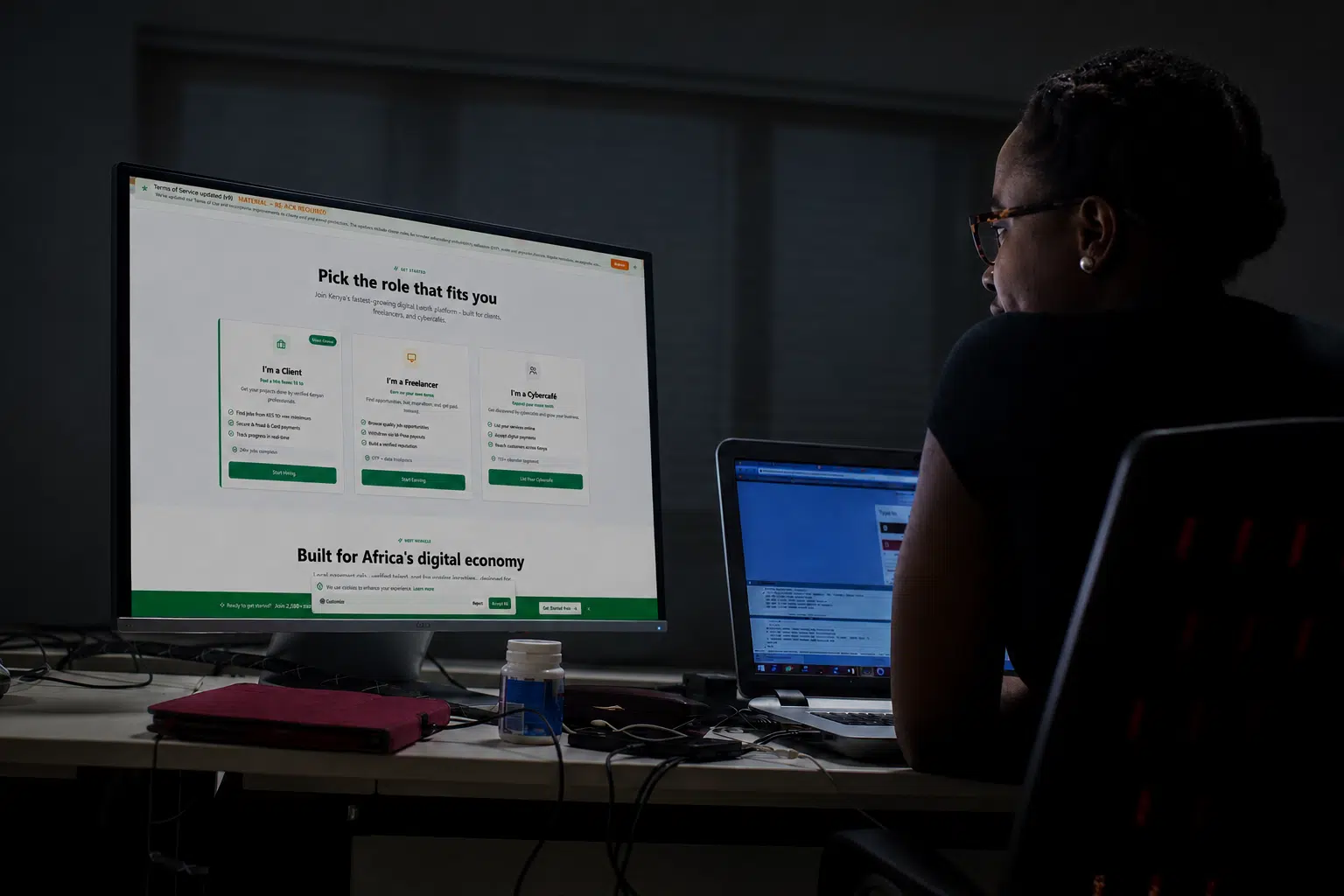
If WorkKE succeeds, it will not simply be because it became Africa's version of Upwork. It will be because it solved African problems that global platforms treated as edge cases. That distinction matters.
History shows that successful technology companies rarely win by building cheaper copies of existing products. They win by solving problems their competitors underestimated.
Whether WorkKE becomes that company remains uncertain. The startup is still young. Its team is lean. Its user base continues to grow, but it remains small compared to the global giants it inevitably invites comparison with.
Still, its existence reflects something larger than one company's ambition. It reflects a growing belief that Africa should participate in the global digital economy on infrastructure it helps build, rather than platforms it merely uses.
That ambition deserves attention. It also deserves patience.
Building Africa's freelance economy will require far more than launching another marketplace. It will demand trusted payment infrastructure, regulatory cooperation, client confidence and millions of users willing to change habits built over decades.
Perhaps the real question is no longer whether Africa can build its own Upwork. It is whether Africa is prepared to build everything that made Upwork possible in the first place.