Bloody Clashes Erupt: Lagos Police Clash With Anti-Demolition Protesters, Several Injured And Arrested
Residents of numerous Lagos communities staged widespread protests against ongoing demolitions and forced evictions, demanding an immediate halt to the destruction of homes. The peaceful demonstrations at the Lagos State House of Assembly complex were met with aggressive police action, including teargas and gunfire, leading to injuries and arrests. The contentious issue highlights a clash between the state's urban regeneration plans and accusations of land grabbing, with legal experts citing ignored court orders.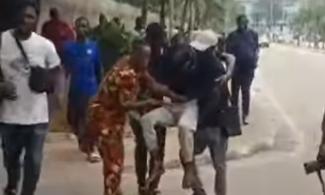
On Wednesday, widespread protests erupted in Lagos State as residents from numerous communities marched to the Lagos State House of Assembly complex in Alausa, Ikeja, to condemn ongoing demolitions and forced evictions. These peaceful demonstrations, organized by the Coalition Against Demolition, Forced Eviction, Landgrabbing and Displacement in Lagos, escalated dramatically when officers of the Nigeria Police Force, Lagos State Command, unleashed teargas and gunfire on unarmed protesters, including women and children, leading to injuries and arrests.
The protest commenced at 7 a.m. at Ikeja Underbridge, where activist Hassan Taiwo Soweto, a spokesperson for the #EndBadGovernance Movement and the Coalition, addressed the crowd, emphasizing that residents were not opposed to development but condemned demolitions that render communities homeless. The demonstrators, representing communities such as Makoko, Oworonshoki, Sogunro, Otumara, Ayetoro, Owode Onirin, Ajegunle, Bariga, Oko Agbon, and Iwaya, carried placards with powerful messages like “Lagos Is Not For The Rich Alone,” “Stop Forced Evictions,” “Homes Before Hotels,” “Save Our Souls,” and “Stop the Killings, Stop Demolition of Our Homes.” They also carried a symbolic coffin intended for Governor Babajide Sanwo-Olu, dramatizing their strong opposition to the forced evictions. The march then proceeded along Awolowo Road to the Lagos State Government Secretariat and the Assembly complex, where protesters sought to press their grievances before lawmakers and the state government, demanding an immediate halt to the destruction of homes and displacement of residents, and a direct meeting with the governor and top officials.
Despite the Lagos State Police Command having rejected the coalition’s notification for the rally on Tuesday, police presence was heavy, taking over strategic points and initially accompanying the protesters. However, the situation quickly deteriorated. Witnesses reported that police officers fired teargas indiscriminately at both protesters and observers. Opeyemi Lawal, a reporter with the Foundation for Investigative Journalism (FIJ), described being tear-gassed to the point of collapse, noting that “Many people passed out” and she herself “passed out at some point because I couldn’t breathe.” Lawal also alleged that police attempted to arrest her while she was covering the event, only relenting after she showed her ID card, but proceeded to arrest others. A PREMIUM TIMES reporter recounted being pushed into teargas and shot at close range by officers, one of whom reportedly stated, “We don’t like journalists. Join them now or I’ll shoot you.” Eyewitnesses also claimed that two unnamed female lawmakers allegedly instructed Police Commissioner Jimoh Moshood to disperse the protesters and journalists.
The aggressive police action led to several arrests and injuries. Hassan Taiwo Soweto, a key spokesperson for the Coalition, was violently arrested by the police and dragged into the State House of Assembly. Elderly people from Makoko were also apprehended in front of the Assembly, and a woman identified as Kafayat Muftaudeen from the Oworonshoki Community was tear-gassed and injured. Vehicular and pedestrian movement around the complex was disrupted as people fled the choking fumes and gunfire, which continued past 1:20 p.m., ultimately causing the crowd to disperse. As of the time of filing this report, security personnel remained stationed at the scene.
The civil society groups and affected communities vehemently condemned the demolitions, accusing the Lagos State Government of prioritizing “elite interests over the survival of poor and working-class residents.” They alleged that Governor Sanwo-Olu and “powerful business interests” were engaging in land grabbing, seizing land from poor communities to make way for luxury homes, hotels, and commercial developments. Within the last year alone, tens of thousands of homes have reportedly been demolished across waterfront and low-income communities. Traders at the Owode Onirin spare parts market and residents of Ajegunle are among those currently facing imminent forced eviction. Protesters argued that such “development that destroys lives is not development,” warning that if unchecked, these actions would push low-income earners out of Lagos entirely, rendering thousands homeless, disrupting livelihoods, and deepening poverty in Africa’s most populous city, all without adequate notice, compensation, or resettlement plans.
In response, the Lagos State Government defended the demolitions as essential for public safety, infrastructure protection, and environmental preservation. Officials, including Commissioner for Information and Strategy Gbenga Omotoso, stated that buildings along critical waterways and beneath high-tension power lines pose significant safety risks, and the law mandates prescribed setbacks. Olajide Babatunde, Special Adviser on e-GIS and Urban Development, added that these actions are part of a broader urban regeneration plan aimed at enforcing planning standards and enhancing Lagos's resilience.
Human rights lawyer and Senior Advocate of Nigeria (SAN), Femi Falana, strongly criticized the Lagos State Government for allegedly disregarding multiple court orders protecting residents' homes. He cited a June 2017 Lagos State High Court ruling that had declared previous government-ordered evictions unlawful and awarded N3.5 million in damages to affected families. Furthermore, Falana referenced a Federal High Court ruling prohibiting demolitions in Makoko, Oko-Agbon, Sogunro, and Iwaya waterfront settlements, and a 2024 Supreme Court ruling affirming the Federal Government’s exclusive authority over navigable inland waters. The state's actions, he argued, contravene these legal precedents.
The Wednesday protests underscored the deep-seated conflict between Lagos State residents and the government over urban development policies. While the state insists on enforcing planning standards for safety and resilience, civil society organizations and affected communities continue to condemn the demolitions as anti-poor and unlawful, demanding justice and accountability for the displacement and violence experienced.