African Creation Stories
Prepare to step into a world where the universe is born from cosmic vomit, where people rise from beneath the earth, and where stars emerge from pulsating eggs.
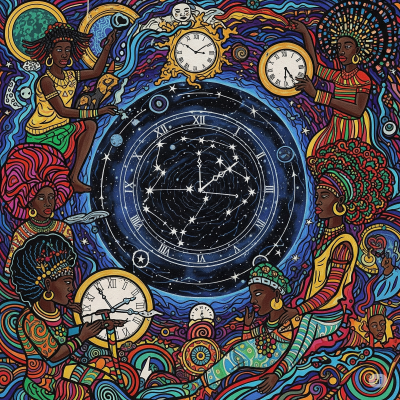
At a time when no nations marked the land, there were gods. And from those gods came stories, carried on the wind, whispered over embers, and etched into stone.
You’ve heard the story of Adam and Eve. Perhaps you've encountered ancient tales from East Asia. But how much do you know about the extraordinary creation stories of Africa?
Prepare to step into a world where the universe is born from cosmic vomit, where people rise from beneath the earth, and gods descend from the sky on golden chains. This is not a history lesson, it’s a fantastical, metaphor-rich, and at times even humorous journey through the origin myths of Africa’s many cultures.
These are the stories of how we came to be.
Bakuba: Mbombo’s Cosmic Vomit

There was no darkness. No stars, no shadows, no edges. Only Mbombo, a vast, luminous being of overwhelming whiteness, so intense it burned the eyes of imagination. This wasn’t the soft white of clouds or snow, it was pure, raw brilliance, endless and absolute. A world without shape or color. Just light so blinding, it erased all contrast, all form, all time.
He floated alone in the vast dark, and within him, creation churned violently. The pain in his belly grew unbearable. And then, in one cosmic upheaval, he vomited.
Out came the sun, blazing and defiant. Then the moon, cool and distant. Then came the stars, scattered like sparks across the sky. But he did not stop. He spewed forth animals, trees, rivers, and finally humans, all of existence expelled from the aching depths of his body.
Mbombo, emptied and gasping, looked upon his creation. And rather than rule it, he taught the beings how to create for themselves. In the Bakuba vision, the universe was not sculpted—it was expelled.. Creation was not a design. It was a release of something that had always been.
Yet, while Mbombo's body spilled the heavens above and the creatures below... another world remained sealed beneath the earth in South Africa, waiting.
The San: The Ascent from Beneath

Far to the south, beneath the skin of the earth, there was another kind of creation story.
There, in the warmth of the underground, humans and animals lived together in peace. No fear. No fire. They drank from the same pools. They spoke the same tongue. Life pulsed in quiet unity.

Their god, Kaang, walked among them, a gentle guide with eyes that saw the world not as it was, but as it could be.
One day, Kaang said, “There is something more above us—a place of light, of change.” And so he carved a passage upward.
The first humans emerged blinking into the sunlight, carrying the sacred fire Kaang had given them. But that light—so new, so bright, terrified the animals. They scattered, fleeing from the ones they had once called kin. In their hands, the humans held warmth and wisdom… and the curse of separation.
From the dark womb of the earth, they were born again, but at a price. Harmony shattered. Unity lost.
Where Mbombo’s agony poured the world into being, Kaang’s longing led his people out of the deep. One creation was a violent expulsion—chaotic and raw. The other, a careful emergence—deliberate and filled with quiet awe.
But the story of beginnings extends beyond violent births or those who rise from the earth. Some origins unfold from the sky, guided by order and bound by purpose.
Yoruba: Obatala’s Descent from Heaven

Far to the west, the heavens churned with quiet intent. The supreme god Olodumare gazed down upon a boundless watery void and called forth Orunmila, the god of wisdom.
“The time has come,” Olodumare said. “Let the earth be born.”
Orunmila turned to Obatala, one of the Orishas—celestial artisans in service to the divine order. Among them, Obatala stood apart for his patience, his steady hands, and the quiet wisdom in his work. Of all the heavenly beings, he was the one entrusted with the sacred task: to bring form to the formless, to give shape to the earth.
Into his hands, Orunmila placed a golden chain, a snail shell filled with sand, a white hen, a black cat, and a palm nut. Simple objects, yet each held a hidden purpose. Together, they would become the tools of creation.
Obatala began his descent, link by golden link, he climbed down from the heavens, the chain gleaming against the sky. Below him stretched a vast, endless sea, silent and still, waiting to be changed. As he reached the surface, the tools of creation in his hands, the work began.
He tipped the snail shell, and grains of sand spilled into the water. Then came the white hen, scratching and scattering the sand with her claws, casting it wide in all directions. Slowly, the water gave way. Hills rose. Valleys sank. The first land took shape, rising from the deep like a breath long held.
Then Obatala planted the palm nut. From the soil sprang a great tree, and from its roots spread the first forests.
With wet clay in his hands, Obatala began to shape human beings. Each figure formed with care, smoothed and molded. When his work was done, Olodumare breathed life into the forms, souls entering bodies of earth.
But not all was perfect. In a moment of pride and distraction, Obatala drank too much palm wine. His hands faltered. Some of his creations were made with flaws, with bent limbs, twisted forms, or missing parts.
Ashamed, Obatala vowed never to drink again. He became the guardian of those born different, the gentle protector of imperfection, and a god of humility.
From clay and sky, we were shaped and given breath. However, in other lands, our beginnings were not molded... they were cracked open like an egg.
Dogon: Amma’s Egg and the Song of Sirius

High in the sandstone cliffs of Mali, the Dogon people tell of a beginning unlike any other, not rooted in earth or sea, but written in the language of stars.
In the vastness of space, there was Amma, the Supreme One, who crafted a perfect, pulsing cosmic egg. Within it stirred the essence of all things—matter, time, rhythm, and life itself. Then came the rupture.
The egg split open, and from its core burst the four elements: fire, water, air, and earth—the scaffolding of existence. From this celestial birth emerged the first divine beings: the Nommo, twin spirits of balance and creation. But harmony did not last. One twin, Ogo, grew restless. He broke away and descended to earth prematurely, unraveling the order Amma had woven.
To restore what was lost, Amma made the ultimate sacrifice. The perfect twin was slain, his divine body dismembered and scattered across the cosmos. From his essence came all life, mountains, rivers, breath, stars. Even the heavens bore his mark.
Among these stars wasSirius B, a dense, hidden companion to the bright Sirius. Though invisible to the eye, the Dogon knew of its existence long before modern astronomy confirmed it. They spoke of its weight, its orbit, its presence, an ancient memory carried in myth.
To the Dogon, creation is more than a beginning. It is a map, a sacred chart of chaos and restoration, written across the sky.
And while they traced their origins in the stars, others found their beginnings not in galaxies… but in reeds, rivers, and the dark pulse of the earth.
Zulu: Unkulunkulu from the Reeds

In the beginning, when the world was still unformed, there was only water—and reeds. Tall, silent, swaying reeds. And from among them emerged Unkulunkulu, the Great Ancestor, the first being to pull himself into existence. He rose not from sky or soil, but from the living stalks of the marshland.
Once awake, Unkulunkulu set about shaping the world. With his hands, he molded rivers and carved valleys. He called forth animals, trees, and finally, people. He taught them language, farming, fire, and craft. He was the bringer of life—and its laws.
But creation came with a cost. It was Unkulunkulu who introduced death. It was he who declared that humans would not live forever. That mortality was part of the order, and that from every ending, something new might take root.
From the reeds of the south, we now turn eastward, toward highlands where gods breathe among the clouds, and mountains hold the memory of first footsteps
Kikuyu: Ngai’s Mountain and Sacred Land

On the forested slopes of Mount Kenya, the Kikuyu speak of Ngai, the god of sky, thunder, and rain. From the peak of the sacred mountain, Ngai looked upon the world and shaped the first man, Gikuyu, and the first woman, Mumbi.
He led them down from the heights and gave them the land, a place of rivers and forests, wild animals and fertile soil. It was not just a gift, but a covenant. “Tend this land,” he said, “for it is both your inheritance and your responsibility.”
Ngai taught them the ways of balance: to honor the ancestors, to walk in harmony with nature, to see the earth not as a possession, but as a living spirit. In Kikuyu tradition, land is sacred, not for what it yields, but for what it remembers.
Final Notes
From the San’s emergence through the earth, to Obatala’s descent on a golden chain, to Amma’s ruptured egg in the heavens, Africa speaks with many voices, yet tells a single truth: creation is beautiful, and dangerous.
It is not only about how we came to be, but how we are meant to live. The myths endure, not as distant relics, but as living reminders that we are still being created.