Zambia Unveils Staggering K253 Billion Budget for 2026: Full Breakdown Revealed
Zambia has unveiled a record-breaking K253.1 billion budget for 2026, focusing on significant allocations for public services, economic affairs, and social sectors. This ambitious financial plan aims to drive economic expansion through mining, manufacturing, tourism, and citizen empowerment initiatives, ahead of the 2026 general elections.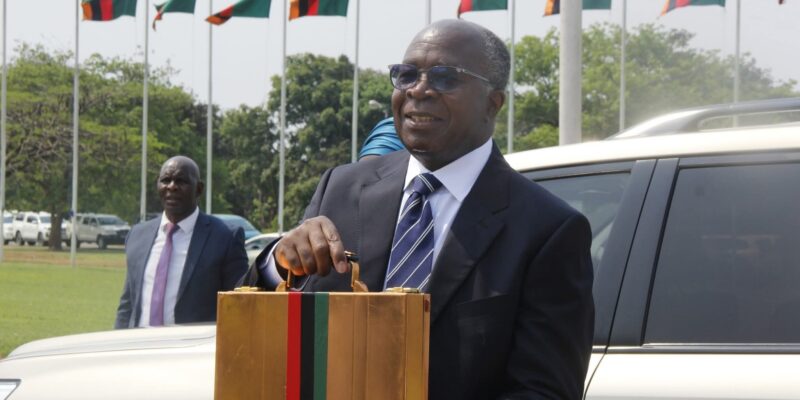
Zambia's Finance Minister, Musokotwane, has unveiled a record-breaking K253.1 billion budget for 2026, a significant increase from K217.1 billion in the preceding year, presented as the nation approaches the 2026 general elections. This ambitious financial plan is primarily funded by domestic revenues, which account for K206.5 billion (81.6% of the total budget and 22.3% of GDP). Additional financing sources include K12.1 billion (4.8% of the budget) from grants provided by cooperating partners and K34.5 billion (3.7% of GDP) from domestic and external borrowing.
The budget outlines detailed sectoral allocations, with General Public Services receiving the largest share at K92.6 billion, representing 36.6% of the total. A substantial portion of this allocation, K52.0 billion, is earmarked for domestic debt payments, an increase attributed to the maturing Treasury bills and bonds issued between 2015 and 2021. External debt payments will consume K21.7 billion. Other key expenditures within this sector include K1.2 billion for the conduct of general elections, K1.4 billion for the Local Government Equalisation Fund, K810.2 million for the Compensation Fund for court cases, and K4.7 billion dedicated to dismantling arrears owed to suppliers.
Economic Affairs is allocated K58.6 billion, constituting 23.2% of the budget, reflecting a focus on growth-driving sectors. Agriculture, fisheries, and livestock will receive K15.5 billion, with K9.2 billion supporting the Farmer Input Support Programme, K2.1 billion for strategic food reserves, and K764.7 million for animal health initiatives and the Zambia Beef Export Project. Infrastructure development is prioritized with K14.5 billion for roads construction and maintenance. The mining sector is allocated K1.2 billion, which includes K541.5 million for geological mapping, K449.5 million for artisanal and small-scale mining support, and K75.9 million for the Mineral Regulation Commission. Tourism receives K1.54 billion, building on the sector's robust recovery post-COVID-19, evidenced by international arrivals reaching 2.2 million in 2024 (up from 1.1 million in 2022) and domestic visits increasing to 530,110 (from 312,195 in 2022). Hotel occupancy in Livingstone hit 70% in 2024 (up from 40% pre-2023), with an average length of stay extending to 5 days (from 3 days pre-2024). Additionally, the Constituency Development Fund (CDF) sees an allocation of K6.2 billion, translating to K40 million per constituency, up from K36.1 million. Provincial airports development receives K1.1 billion, while the Zambia Credit Guarantee Scheme and various empowerment funds are allocated K1.44 billion, and the Electricity Fund gets K500 million.
The social sectors also receive significant attention. Education is allocated K33.0 billion (13.0%), with K2.4 billion for the free education programme, K2.3 billion for school and university infrastructure, K1.4 billion for the Higher Education Loans and Scholarship Board, and K300 million for the revised national education curriculum. Health services will receive K26.2 billion (10.3%), including K6.4 billion for drugs and medical supplies (a 30% increase from 2025), K953.5 million for essential medical equipment, and K1.7 billion for health infrastructure, including mini-hospitals. Housing and Community Amenities are allocated K3.2 billion, with K1.8 billion directed towards ensuring safe drinking water access, particularly in rural and peri-urban areas.
Public Order and Safety are allocated K9.6 billion, including K940.7 million (an 18% increase) for law enforcement agencies, K217.8 million for the Integrated National Registration Information System, and funds for security modernization and infrastructure improvements. Social Protection receives K15.7 billion, encompassing K7.6 billion for the Social Cash Transfer Programme, K4.9 billion for pension payments, and K1.5 billion for the Food Security Pack (up from K1.2 billion). Other Functions, including Defence, Environment, Recreation, Culture, and Religion, are allocated K14.1 billion, with K200.6 million (a 25% increase) specifically for Chiefs’ affairs.
Beyond the budget, Zambia's economic and investment landscape shows positive trends. The mining sector is targeting 1,000,000 tonnes of copper production in 2025, up from 736,747 tonnes in 2023 and 820,676 tonnes in 2024. Artisanal and small-scale copper production is projected to reach 80,000 tonnes in 2025, a substantial increase from 13,300 tonnes in 2020. New mines at Mwekera, Mingomba, and Kitumba are expected to add 700,000 tonnes per year to capacity, complemented by First Quantum Minerals' S3 Expansion, adding 270,000 tonnes annually.
Manufacturing and industrial investments have seen K4 billion injected over four years by 20 companies, generating 31,000 jobs, bringing total manufacturing investments to over $4 billion. Multi-Facility Economic Zones (MFEZs) and industrial parks across various locations, including Lusaka South, Jiangxi (Chibombo), Chambishi, Kalumbila, Luano, Chilanga, Kazungula, Monze, and Kafue, are fostering growth in key sectors such as ceramics, steel, starch, milk processing, copper rods, electric cables, conductors, pharmaceuticals, textiles, and fertilisers. The Zambia-China Mulungushi Textiles is poised to commence production following machinery installation, supporting farmer outgrowers.
SME and Citizen Empowerment initiatives have supported over 103,000 individuals and 9,800 MSMEs with K2.9 billion. The Citizens Economic Empowerment Fund has benefited over 83,000 individuals, while the Zambia Credit Guarantee Scheme has aided 19,819 SMEs and farmers as of August 2025 (a dramatic increase from 18 in 2021), facilitating K1.6 billion in loans (up from K10 million in 2021). Statutory Instrument No. 45 of 2025 further strengthens this by mandating preference for SMEs in public procurement.
The overall impact highlights include sustained economic expansion driven by mining and industrial growth, significant job creation across various manufacturing and industrial sectors, a strong revival in tourism reflecting increased domestic and international demand, and empowerment programs that are actively improving livelihoods and access to education for citizens.