Uganda's Museveni Secures Contentious Seventh Term, Extends Decades-Long Rule
Uganda's President Yoweri Museveni has secured his seventh term, extending his four-decade rule amidst widespread allegations of electoral fraud and violence from challenger Bobi Wine. The election was marred by an internet shutdown, biometric machine failures, and restrictions on the opposition, intensifying concerns over democratic integrity in the nation.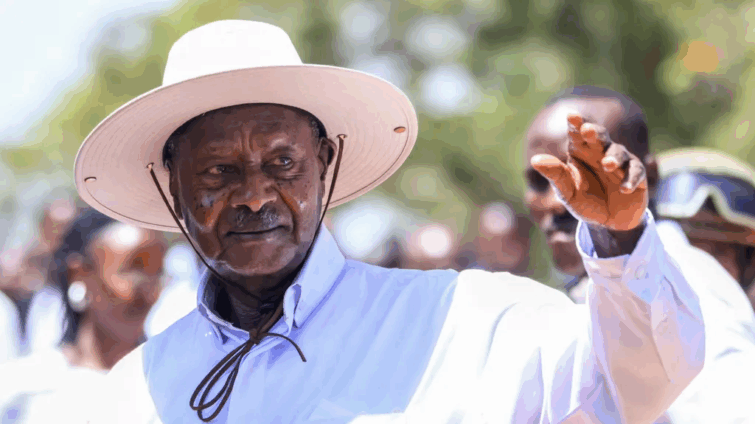
President Yoweri Museveni has been declared the winner of Uganda's latest general election, extending his four decades in power by another five years. Official results announced on Saturday indicated Museveni secured approximately 71.65% to 72% of the vote, defeating his closest challenger, Bobi Wine, who garnered around 24.72% to 25%. This victory marks Museveni's seventh term as president.
However, the election process was heavily criticized by Bobi Wine, a 43-year-old musician-turned-politician whose real name is Kyagulanyi Ssentamu. Wine condemned the outcome, describing it as "fake results" and a product of "ballot stuffing" and an "unfair electoral process." He cited an internet shutdown, military deployments, and alleged abductions of his polling agents as key irregularities. Electoral officials also faced scrutiny over the failure of biometric voter identification machines, which caused delays in urban areas, particularly opposition strongholds like the capital, Kampala. Polling officials resorted to using manual voter registers, a move that is expected to form the basis for any legal challenges to the official result.
The campaign period and the election itself were marred by violence and repression. Wine claimed that at least 21 people had been killed across the country in recent days, although authorities confirmed seven deaths. Opposition activities were reportedly disrupted, and security forces were accused of assaulting and detaining Wine's supporters, allegations dismissed by police spokesperson Kituuma Rusoke, who accused opposition supporters of being disruptive. Access to the internet was cut across the country days before the election, a measure authorities stated was necessary to prevent misinformation, fraud, and the incitement of violence. This internet blackout was condemned by the UN human rights office as "deeply worrying," and Wine demanded its restoration.
In the immediate aftermath of the election, Wine's party reported that he had been abducted from his home in Kampala, a claim denied by the police. Wine later issued a statement indicating he had evaded a night-time raid by security forces and was in hiding, having previously stated he was under house arrest. Police confirmed Wine's movements were restricted, stating his home was in an area of "security interest" and that they could not allow places to be used to "gather and cause chaos."
Yoweri Museveni, now 81, first came to power in 1986 as a rebel leader, ending years of bloodshed and chaos under tyrannical rulers. He has since won seven elections, including those in 1996, 2001, 2006, 2011, 2016, 2021, and the most recent one. Born in 1944 into a cattle-keeping family in southwestern Uganda, Museveni studied revolutionary violence in Tanzania in the 1960s. He later helped overthrow Idi Amin's regime and led the Ugandan Bush War after a rigged 1980 election, capturing Kampala in 1986.
Despite once musing that leaders overstaying their welcome lay at the heart of Africa's problems, Museveni has become one of the world's longest-serving leaders, outlasting nearly every other ruler on the continent. Once hailed by the West as a model African leader, he has since fused state and party, crushing political opposition and making any real challenge to his National Resistance Movement (NRM) seemingly impossible. He has also overseen two constitutional changes to remove term and age limits for the presidency. Rights groups have consistently criticized the increasingly violent repression of challengers.
Bobi Wine positions himself as a representative of Uganda's largely youthful population, where most citizens are under 30. During his campaign, he promised to tackle corruption and implement sweeping reforms. In contrast, Museveni maintained that he was the sole guarantor of stability in Uganda, a nation with a history of conflict. Museveni, described by a journalist in 1984 as a "dreamer, a revolutionary" with a "faraway look," has proven to be a pragmatic leader, bending to Western demands for neoliberal reforms to stabilize the economy. He has also served as a useful military partner to the West, notably contributing troops to fight Islamist insurgents in Somalia, even amidst concerns over his suppression of democratic rights. He also weathered renewed criticism in 2023 over a harsh anti-gay law.