SAPH Profit Plunges: Port Congestion and Weak Prices Devastate Q1 Earnings
SAPH, Côte d'Ivoire's leading rubber processor, reported a substantial 78% decline in first-quarter 2026 net profit, attributing the slump primarily to port congestion and weaker global rubber prices. Despite the immediate challenges, the company anticipates a recovery driven by finished goods sales, improved export prices, and strategic expansion, alongside its commitment to EUDR compliance for sustainable rubber exports.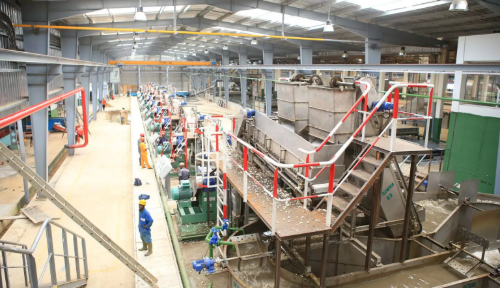
SAPH, Côte d'Ivoire's leading rubber processor and a subsidiary of the SIFCA Group, reported a significant collapse in its net profit during the first quarter of 2026. The company posted a net profit of 2.6 billion FCFA ($4.7 million), marking a sharp 78% drop from 11.8 billion FCFA ($21.1 million) recorded in the same period of 2025. This downturn represents one of the most substantial earnings declines among industrials listed on the BRVM exchange during the current reporting season. Concurrently, revenue for the quarter decreased by 24% to 71.8 billion FCFA ($128.3 million).
The primary drivers behind this collapse were identified as a 11% reduction in sales volumes, largely due to severe congestion at the port of San Pedro which disrupted shipments, and a 17% decrease in average selling prices compared to the previous year, reflecting a weakening in global rubber markets. The operating result consequently bore the brunt of these factors, plummeting by 73%. It is worth noting that the company indicated that Q1 2025 had an unusually strong performance, suggesting that the year-on-year comparison partially reflects a high baseline rather than solely the severity of the current quarter's performance.
Despite the challenging first quarter, SAPH expresses optimism for a recovery in the coming months. This expectation is underpinned by several factors: the company held a substantial stock of finished goods at the end of March, with sales commencing in April 2026 and projected to continue. Furthermore, these upcoming sales are anticipated to benefit from export prices that are higher than domestic rates. Macroeconomic indicators also suggest a more favorable pricing environment, as the global rubber benchmark, the SICOM 20, averaged $1.91/kg in Q1 2026, an increase from the full-year 2025 average of $1.76/kg.
SAPH is also strategically positioning itself for future growth and market demands. The company is actively expanding its Soubré processing plant to meet the stringent requirements of the EU market under the European Union Deforestation Regulation (EUDR). As Côte d'Ivoire's largest natural rubber processor, operating extensive industrial plantations and sourcing from numerous village farmers, SAPH plays a crucial role in the country's status as the world's largest natural rubber producer. Given that the EU is a significant destination for Ivorian rubber exports, the EUDR holds immense importance for SAPH's operations.
The EUDR mandates that exporters must prove their rubber products originate from land not deforested after December 31, 2020. While the deadline for large operators to comply was extended to December 30, 2026, granting companies like SAPH additional time to establish robust traceability systems, SAPH has affirmed its unwavering commitment to supplying sustainable rubber irrespective of the regulatory timeline. This proactive stance on sustainability is expected to confer a commercial advantage, as European buyers increasingly prioritize traceable and environmentally responsible supply chains.
While SAPH characterizes the first-quarter weakness, driven by port congestion and the carry-over of lower-priced contracts from late 2025, as