Relics of Crypto's Revolution: The Bank Was Already Burning
Artist Alex Schaefer's 'Banks on Fire' series, depicting financial institutions engulfed in flames, emerged as a potent symbol of protest against the 2008 financial crisis and subsequent bailouts. His 'en plein air' approach and direct critique of 'fiat money' resonated deeply with the Bitcoin community, seeing his art as a visual counterpart to Bitcoin's revolutionary ethos. Schaefer's work, featured in the 'Relics of a Revolution' exhibition, highlights a lineage of dissent advocating for a fundamental shift in the global financial system.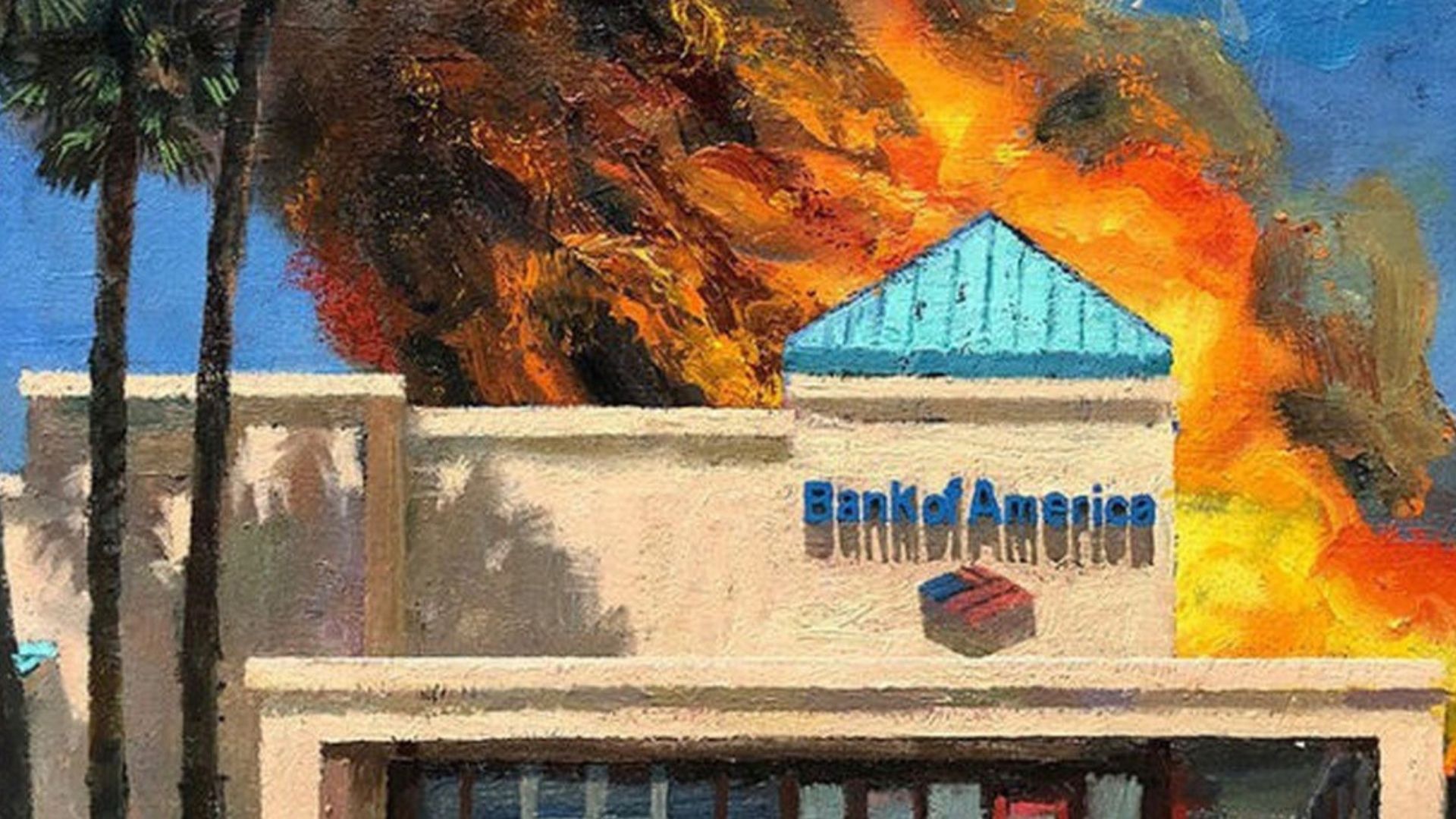
Artist Alex Schaefer gained notoriety for his 'Banks on Fire' series, which began in the immediate aftermath of the 2008 financial collapse. Setting up his easel on sidewalks, notably in Van Nuys, California, Schaefer painted branches of major banks like Chase engulfed in flames, black smoke billowing, yet their corporate logos still discernible. This provocative 'en plein air' approach, reminiscent of Impressionist techniques applied to urban landscapes, served as a direct street-level protest against a financial system he believed was fundamentally flawed.
Schaefer’s work draws a deliberate art-historical lineage to Ed Ruscha’s 'Los Angeles County Museum on Fire' (1965–68), a painting that similarly depicted an institutional building aflame. However, Schaefer consciously swapped the museum for the bank and the oil-crisis era for the bailout era, moving his artistic statement from the studio onto the public sidewalk in front of the very institutions he was critiquing. This direct confrontation led to questioning by LAPD officers, who inquired if he was a terrorist, and an eventual arrest in July 2012 for chalking 'Crooks' next to a Chase logo, resulting in twelve hours in jail on a misdemeanor vandalism charge. Schaefer, born in 1969 and trained at ArtCenter College of Design, transitioned from a career as a digital artist, notably on the original Spyro the Dragon trilogy, to a painting instructor, bringing a honed artistic sensibility to his activism.
For Schaefer, the root of America's problems points to a singular issue: 'fiat' money, or as he puts it, 'the money is bullshit.' He views fiat currency, particularly the US PetroDollar, as an instrument for waging endless wars and funding detrimental policies, fundamentally disrespecting human life and labor. This radical diagnosis resonated deeply within the Bitcoin community, who quickly recognized his artistic expression as a visual counterpart to the message embedded in Bitcoin's Genesis Block – 'Chancellor on brink of second bailout for banks' – a textual critique of the same financial system.
Schaefer articulates that while civilization requires 'money,' it needs 'good money' – a social construct as old as society itself, traditionally fulfilled by scarce, fungible, transportable, divisible, and durable commodities like gold and silver. He posits that Bitcoin embodies the greatest form the concept of money has ever taken, offering a profound solution: 'if we can fix the money, we truly can fix the world! Defund Evil!' His ongoing 'Burning Banks' series, alongside his 'Devaluation' series, aims to visually strike viewers first, then prompt deeper contemplation about the subject matter and the eroding value of the dollar, metaphorically asking at what point the currency becomes so pixelated, so watered down, that it ceases to perform its crucial function.
His artwork is a central component of the 'Relics of a Revolution' exhibition at Bitcoin 2026, which traces a lineage of dissent connecting street-level protest to the birth of Bitcoin. The exhibition puts Schaefer's work in conversation with other notable figures of protest and cypherpunk culture, including Kolin Burges's Mt. Gox protest sign, Mear One’s Occupy-era murals, and Afroman’s flag suit, alongside an original copy of The Times newspaper encoded into the Genesis Block. Through this collection, Schaefer aims for viewers to be visually engaged first, then to understand Bitcoin not merely as a price ticker, but as the continuation of a decades-long fight for financial and societal justice, reinforcing the exhibition's powerful message: 'Fix the money. Fix the world.'