Nigeria Erupts in Nationwide Protests Against Mounting Insecurity
The Nigeria Labour Congress (NLC) launched a nationwide protest on Wednesday, December 17, demanding urgent government action against escalating insecurity. Despite President Tinubu's appeals, the NLC proceeded with demonstrations across multiple states, highlighting the severe impact of insecurity on citizens and economy. Labour leaders called for decisive measures, prosecution of criminals, and enhanced security architecture to restore safety and stability.
The Nigeria Labour Congress (NLC) on Wednesday, December 17, launched a nationwide protest against escalating insecurity across the country, proceeding despite a late-night meeting on Tuesday between President Bola Tinubu and NLC leaders, where the president appealed for a reconsideration of the planned action. NLC President, Joe Ajaero, confirmed that the protest would go ahead as scheduled, explaining that the meeting did not result in its cancellation and that the union would deliberate internally before announcing outcomes later on December 17.
NLC members, alongside civil society allies, including Omoyele Sowore of the Revolution Now Movement, converged across several states such as Enugu, Abuja, Lagos, Ekiti, Cross River, Zamfara, and Plateau. Protesters chanted solidarity songs and displayed placards bearing strong messages including “End insecurity now,” “Nigeria is bleeding,” “End banditry, terrorism and kidnapping now,” “Security and safety are our fundamental rights,” “Stop the killings,” “Federal government, no more excuses and rhetoric! End insecurity now,” and “Poverty fuels insecurity.”
Across the states, labour leaders voiced deep concern over the worsening security situation. Fabian Nwigbo, NLC Chairperson in Enugu State, articulated the shared pain of Nigerian workers, stating: “Our school children are not safe; the teachers are not safe. The farmers are not safe, the workers are not safe. Travellers are not safe. Even the political class. Nobody is safe anywhere.” He stressed that the government’s foremost responsibility is to secure lives and property, warning that the failure to do so has left the nation “bleeding.”
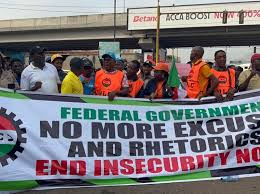
In Abuja, Deputy General Secretary of the NLC, Ismaila Bello, highlighted the “enormous damage” caused by insecurity, which has forced teachers and pupils out of schools and displaced entire communities into Internally Displaced Persons (IDP) camps. He demanded that perpetrators and their sponsors be identified and prosecuted, proposing capital punishment for sponsors of banditry and kidnapping. Bello also disclosed that NLC President Joe Ajaero and other executives were engaging state governors and local government authorities to press for concrete security improvements. Uche Ekwe, NLC’s Head of International Affairs, similarly called for the prosecution of those financing terrorism.
In Ekiti State, NLC Chairman Comrade Kolapo Olatunde described the persistent loss of lives and property as unacceptable, urging both federal and state governments to take urgent and decisive action. He called for better-equipped security agencies, improved intelligence gathering, and strengthened community-based security frameworks. Comrade Oluseyi Olatunde of the Nigeria Union of Local Government Employees (NULGE) echoed this stance, emphasizing the need for a proactive and coordinated approach, while warning that continued inaction would worsen socio-economic conditions.
In Cross River State, NLC Chairman Comrade Greg Olayi declared that workers are no longer safe even within their workplaces, noting that citizens now live in constant fear. He emphasized that the protest was not solely about workers’ welfare but about the safety and survival of all Nigerians, calling on leaders to fulfill their constitutional duty to guarantee security and welfare. Chairman of the Joint Negotiating Council (JNC), Comrade Raymond Afu, described the protest as a “call to conscience,” urging decisive action from governments at both national and sub-national levels to restore peace and stability.
In Zamfara State, NLC Chairperson Comrade Sani Halliru submitted a letter to Governor Dauda Lawal, lamenting how insecurity has crippled economic activities despite the state’s vast potential in mining, farming, and agricultural production. He expressed the union’s concern over the growing security challenges, particularly in Zamfara, which have severely threatened the lives and livelihoods of workers nationwide. Governor Lawal acknowledged the peaceful protest as mature and patriotic, reaffirming his administration’s commitment to collaborate with national authorities to restore peace, while noting that insecurity has affected every sector of society.
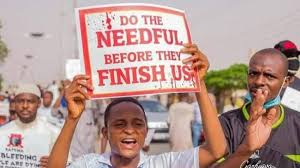
In Plateau State, NLC Chairman Eugene Manji expressed alarm over the “existential threat” posed by insecurity, urging the Office of the National Security Adviser to enhance coordination and deploy modern surveillance technologies to dismantle criminal networks. He questioned why criminals appeared more sophisticated than security agencies and highlighted the prolonged closure of schools due to insecurity, warning that such conditions align with extremist agendas. Manji stressed that insecurity affects all Nigerians, regardless of creed, and called for decisive action against a “common enemy.”
Throughout the protests, security personnel from the Nigeria Police Force, Nigeria Security and Civil Defence Corps (NSCDC), and the Department of State Services (DSS) were deployed to ensure the peaceful conduct of the rallies. The NLC maintained a firm position, insisting that the government must prioritize national security, improve the welfare of security personnel, and engage relevant stakeholders to address the root causes of insecurity, restore public confidence, and safeguard the lives and property of Nigerians.