Musk's Rapid Gas Turbine Push Raises Pollution Alarms
Elon Musk is tackling AI's power grid bottleneck by having SpaceX manufacture complex gas turbine parts in-house, a move he claims will accelerate turbine deployment. While this aims to meet surging data center energy demands, the strategy raises significant environmental and public health concerns due to increased gas turbine emissions.
Elon Musk has announced a novel solution to one of artificial intelligence's most significant bottlenecks: the manufacturing of crucial, hard-to-produce turbine parts.
On Saturday, Musk confirmed the purpose of a secret foundry SpaceX has been constructing in Bastrop, Texas, revealing it is designed for producing 'blades and vanes' essential for natural gas turbines.
This disclosure followed a report by The Information, which cited job listings for a 'blades and vanes foundry' and findings from due diligence specialist Corey Trinetti, detailing SpaceX's acquisition of 830 acres near its Starlink factory.
Musk elaborated on X, stating that both SpaceX and Tesla are rapidly building 100GW/year of solar production capacity.
However, he emphasized that natural gas would be necessary to supplement and bootstrap solar energy for several years.
The primary limiting factor for natural gas turbine production, according to Musk, is the casting of these specialized blades and vanes.
By bringing this casting process in-house at SpaceX, he believes they can accelerate the online deployment of natural gas turbines by up to 18 months, which he describes as a 'profound game-changer'.
The impetus behind this initiative lies in a critical challenge currently facing the AI industry.
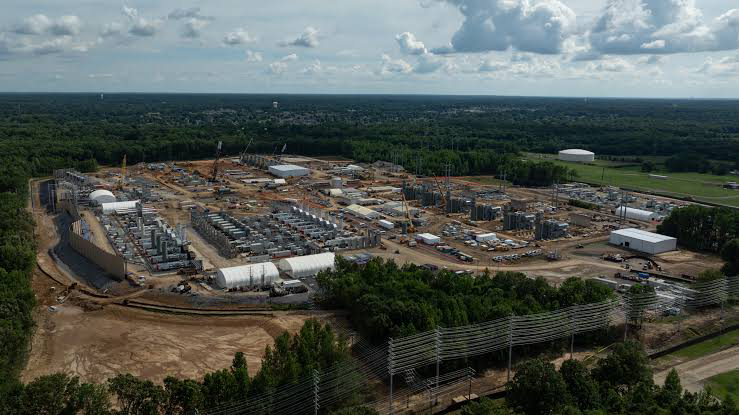
While GPU shortages persist, a more fundamental constraint has emerged: the physical power grid.
The International Energy Agency projects that global data center electricity usage will approximately double by 2030.
Concurrently, major gas turbine manufacturers like GE Vernova report being sold out of production capacity through 2030, largely due to the escalating demand from AI infrastructure.
This severe shortage has compelled hyperscalers such as Amazon, Google, Meta, OpenAI, and Microsoft to adopt a strategy of building private gas-fired plants adjacent to their data centers, circumventing reliance on the strained public grid.
After years of prioritizing renewable energy sources like wind and solar, these tech giants are increasingly betting on natural gas to expedite the operational readiness of their data centers.
The specific casting bottleneck is technically formidable. The blades within a gas turbine's hottest section operate at extreme temperatures, ranging from 3,000 to 3,600 degrees Fahrenheit.
This is significantly hotter – roughly 800 degrees – than the melting point of the metal alloy from which they are constructed.
Such operation is only feasible due to intricate internal cooling channels, advanced thermal-barrier coatings, and a highly specialized casting method.
Critically, each blade must be cast as a single, unbroken crystal, slowly grown inside a vacuum furnace to prevent the microscopic seams that could lead to cracking under stress in ordinary cast metal.
This delicate process is challenging even for smaller jet engine blades, but for the considerably larger blades used in power-plant turbines, producing them at industrial scale without defects is even more difficult.
Currently, only four companies globally possess the expertise to master this casting process at an industrial scale, and all are operating at maximum capacity.

If SpaceX successfully masters this complex manufacturing capability, it would grant a Musk-controlled entity a strategic advantage that is currently monopolized by a tiny oligopoly.
This would provide SpaceXAI with a competitive edge that would be difficult for even well-funded, non-manufacturing competitors to quickly replicate.
More broadly, it would mean a faster rollout of gas turbines, directly addressing the power demands of the rapidly expanding AI infrastructure.
However, the accelerated deployment of gas turbines comes with significant environmental and public health ramifications.
Turbines already in operation are facing federal lawsuits and are subjects of peer-reviewed health research due to the pollution they emit.
These turbines release smog-forming compounds and hazardous chemicals, including formaldehyde, which have been linked to serious health issues such such as asthma, various respiratory diseases, and certain cancers.
One prominent example involves SpaceXAI's Colossus data centers in Memphis, where gas turbines have been powering operations since 2024.
The NAACP has repeatedly accused the company of operating these turbines without the necessary federal permits or pollution controls.
The concern is particularly acute for nearby neighborhoods that already contend with heavy industrial pollution.
Limited analysis by University of Memphis researchers, though acknowledged as restricted, indicated a 'slightly worse' air pollution situation due to the data center's operations.
The issue extends beyond Memphis. In Virginia’s “Data Center Alley,” a study commissioned by the Piedmont Environmental Council, utilizing the EPA’s COBRA health-impact model, projected that emissions from a single facility's eight full-time gas turbines could impact over 2.5 million people across multiple counties.
The study highlighted that the heaviest impacts would fall disproportionately on already-marginalized communities, potentially causing an estimated 3.4 to 6.5 additional premature deaths annually, translating to an estimated $53 million to $99 million in annual health-related damages.
These examples underscore the growing list of complaints and legal challenges associated with the widespread adoption of gas turbines as the default solution for data center power shortages.