Meta AI Faces Stark Talent Exodus: High-Profile Engineers Jump Ship
At least three high-profile AI researchers, including Rishabh Agarwal, have left Meta's Superintelligence Labs shortly after being hired, with some returning to OpenAI. These departures coincide with a reported hiring freeze in Meta's AI division, highlighting the intense competition for top talent. While Mark Zuckerberg defends the significant investment in elite AI talent, Sam Altman has publicly criticized Meta's aggressive recruitment tactics.
Meta's ambitiousSuperintelligence Labs (MSL), a focal point of Mark Zuckerberg's aggressive artificial intelligence (AI) hiring blitz, has recently faced a series of high-profile departures, prompting scrutiny into the fiercely competitive landscape for top AI talent. At least three employees, including Rishabh Agarwal, Avi Verma, and Ethan Knight, have left MSL less than a month after being hired for what were described as extravagant pay packages. Notably, Verma and Knight have returned to Sam Altman-led OpenAI, underscoring the intense back-and-forth between leading AI organizations.
Rishabh Agarwal, an Indian AI researcher with a distinguished background, announced his departure from Meta in an elaborate post on social media platform X, labeling it a “tough decision.” He conveyed that while the pitch from Mark Zuckerberg and Alexandr Wang for the Superintelligence team was incredibly compelling, he “felt the pull to take on a different kind of risk.”
The Irony of Wisdom

Image Above: Agarwal. Image Credit: LinkedIn.
Agarwal, who was reportedly hired for a million-dollar salary just months prior, explicitly cited Mark Zuckerberg's own advice: “In a world that’s changing so fast, the biggest risk you can take is not taking any risk.” During his five-month tenure at Meta, Agarwal noted that he and his team “did push the frontier on post-training for 'thinking' models.”
Agarwal's professional journey is extensive and impressive. An alumnus of IIT Bombay with a degree in Computer Science and Engineering, he pursued his PhD in Artificial Intelligence at Mila – Quebec Artificial Intelligence Institute in Canada. His career includes research internships at Saavn (Search and Algorithms division) and Tower Research Capital (Algorithm Trading team).
He served as a Senior Research Scientist at Google Brain from June 2018 to 2023, focusing on deep reinforcement learning (Deep RL). Subsequently, he joined Google DeepMind, where he spent two years working on large language models (LLMs) using reinforcement learning, self-improvement, and distillation, before being poached by Meta in April. Agarwal also holds an Adjunct Professor position at McGill University.
Nothing To Worry About?
These high-profile exits come amidst reports of a hiring freeze within Meta's AI division, as reported by the Wall Street Journal on August 20. A Meta spokesperson, Dave Arnold, downplayed the significance of the departures, stating that such moves are “normal” during an intense recruiting process, with some individuals opting to remain in their current roles.
Regarding the hiring freeze, another Meta spokesperson informed Reuters that it was merely a "temporary recalibration" rather than a signal of broader strategic retreat. “We continue to invest deeply in AI and remain committed to building general intelligence responsibly and at scale,” the spokesperson said, emphasizing Meta’s long-term vision despite short-term fluctuations.
When The Grass Isn’t Greener On The Other Side, Go Back Home
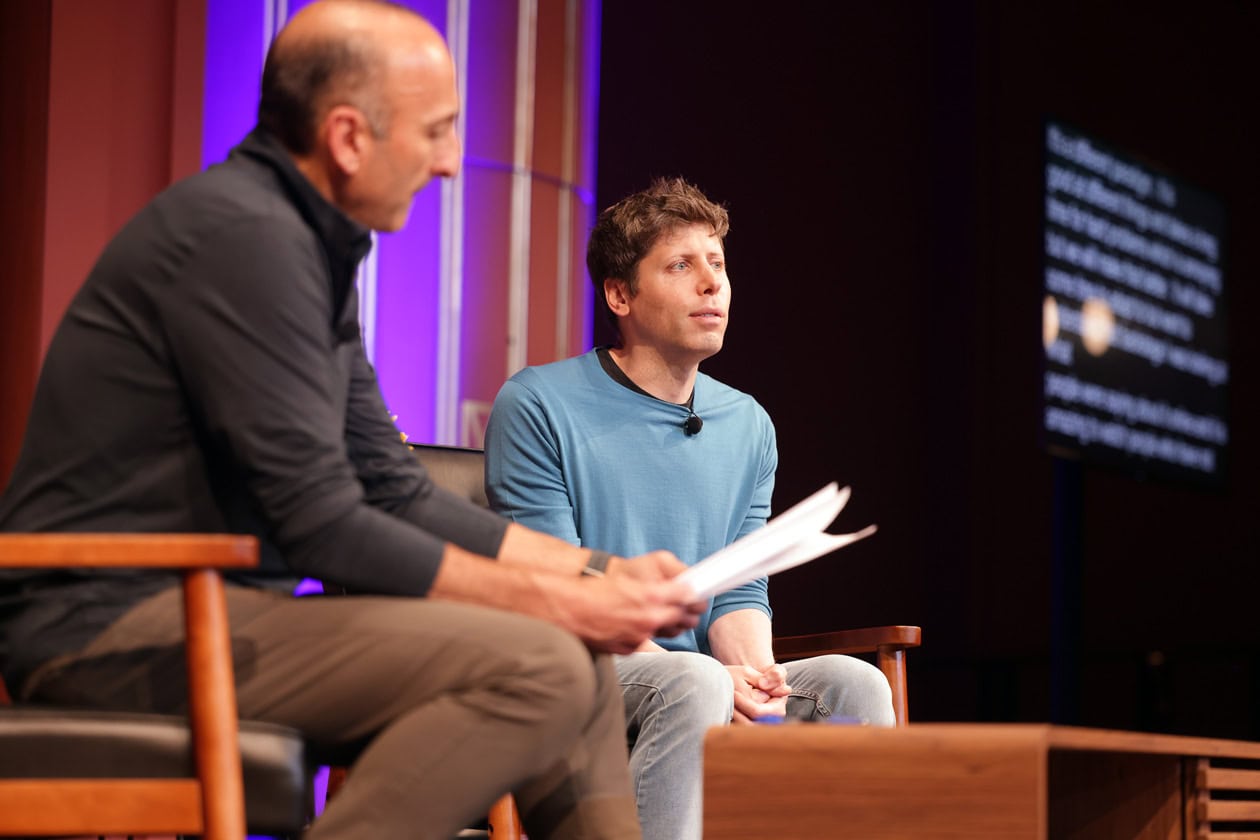
Image Above: Sam Altman in a blue t-shirt. Credit: Michigan Engineering
The return of Verma and Knight to OpenAI, after brief stints at Meta, has reignited speculation about the latter’s internal cohesion and strategic clarity. Both individuals had been key contributors to OpenAI's safety and alignment teams, and their exit, and subsequent return—suggests that the trust and familiarity built at OpenAI continues to outweigh even the most lucrative offers from competitors.
Sources suggest that internal dynamics, including a lack of clearly defined ownership over projects and rapid structural shifts, may have contributed to dissatisfaction.
Meanwhile, OpenAI appears to be doubling down on its talent retention strategy. In recent months, the company has revamped its internal fellowship programs, expanded its safety-focused orgs, and offered greater autonomy to researchers working on foundational models. Sam Altman, during a recent fireside chat, acknowledged the “increasingly chaotic” AI talent wars, adding, “We don’t take it for granted when great people choose to stay or return.”

Conclusion
As the generative AI arms race accelerates, Meta’s ability to stabilize and define the culture at Superintelligence Labs may determine whether it can compete not just in technological capability, but also in building a durable, mission-driven team.
For now, the departures of Agarwal, Verma, and Knight serve as a cautionary signal: even in a world driven by scale and compute, human capital remains the most volatile and vital resource.