Mahama's Solemn Charge to New Judges: Upholding Integrity and Justice in Ghana's Courts
President John Dramani Mahama has sworn in 37 new High Court judges, emphasizing their critical role in Ghana's legal landscape, investor confidence, and national stability. He urged them to uphold judicial independence, integrity, and accountability, stressing that justice is inseparable from the nation's development and democratic values.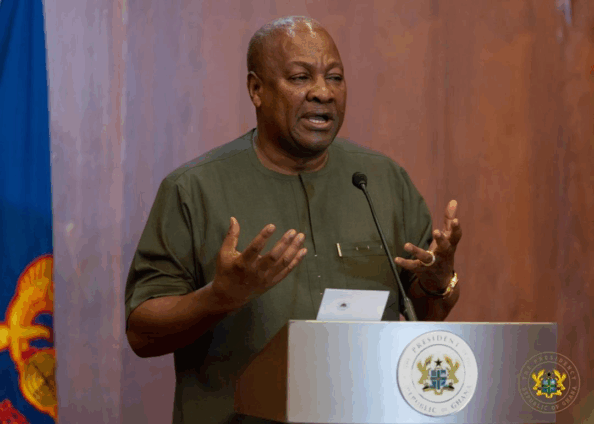
President John Dramani Mahama recently presided over the swearing-in ceremony of 37 new Justices of the High Court at the Jubilee House on Thursday, October 23. During this significant event, President Mahama underscored the profound and multifaceted role the judiciary plays in shaping Ghana’s legal landscape, fostering investor confidence, safeguarding human rights, and ensuring national stability. He emphasized that this occasion was more than a formal appointment; it was a powerful reaffirmation of Ghana’s unwavering faith in the rule of law and the fundamental principle that justice stands as the ultimate cornerstone of democracy.
Addressing the newly appointed judges, President Mahama highlighted that their judgements would extend beyond merely influencing Ghanaian jurisprudence. He cautioned that their decisions would have far-reaching impacts on the country’s democratic fabric, its economic environment, and the very perception of justice. "Your judgment will not only shape our jurisprudence but also affect investor confidence, our human rights, and our national stability," the President stated, reiterating the immense responsibility bestowed upon them.
A central theme of his address was the critical importance of judicial independence, which President Mahama eloquently described as the "lifeblood" of Ghana’s democracy. He unequivocally stressed that this independence must never be compromised, serving as an inviolable pillar of the nation's governance. However, he swiftly clarified that independence should not be misconstrued as isolation. The courts, he insisted, must consistently remain open to rigorous accountability, guided by unwavering transparency, and, above all, maintain absolute fidelity to the Constitution of Ghana.
President Mahama charged the judges to uphold the highest standards of integrity, impartiality, and professionalism in the diligent delivery of justice. He reminded them that the High Court functions as the "people’s court," the arena where the law most directly intersects with the daily lives of citizens. He urged them to be "incorruptible, not only in fact, but also in perception," ensuring that every citizen appearing before them believes their fate rests solely on the evidence and the law, devoid of any influence or undue connections. The President asserted that while the law confers authority, only integrity truly confers legitimacy.
The President reminded the new judges of the solemn duty they owe to the nation—to serve with integrity, courage, and fairness. He described the judicial oath they had taken as not a mere constitutional ritual but a sacred covenant between a judge and the people. Drawing upon the words of the late Chief Justice Philip Acher, he articulated it as "a promise to rise above fear, favour and friendship, and to judge as conscience commands." This covenant, President Mahama explained, binds them to interpret the law with fairness, defend the weak with courage, and uphold the dignity of the Republic through unwavering integrity and dedicated service.
Emphasizing the broader implications of their conduct, President Mahama noted that public confidence in the judiciary fundamentally rests on their actions, both on and off the bench. He stressed that impartiality and moral fortitude are not merely desirable traits but absolutely essential for maintaining the sanctity and credibility of the justice system in the eyes of the populace.
Connecting the dots between justice and national prosperity, President Mahama stressed that good governance, robust investor confidence, and enduring social stability are inextricably linked to a credible and efficient judiciary. He powerfully stated, "Justice and development are not separate ideals; they are inseparable twins of the same mother. A nation that invests in infrastructure but neglects the rule of law builds its progress on shifting sands." He recounted an insightful encounter with a foreign investor who articulated, "Mr President, I can manage my investment risk, but I cannot manage the uncertainty of the courts," underscoring the critical role of judicial credibility in attracting and retaining investment.
Furthermore, President Mahama linked the judiciary’s role to his administration’s ambitious economic goals, including the "24-hour economy" and the "Big Push" infrastructure programme. He asserted that in this era, Ghana requires a judiciary that is not only fair but also actively facilitative—one that efficiently enforces contracts, vigorously protects innovation, and delivers justice without undue delay. The newly sworn-in judges are thus expected to play a pivotal role in strengthening the judiciary’s contribution to national stability, fairness, and trust within Ghana’s vital justice system.