Buhari's Secret Offers to Osinbajo for Presidential Bid Exposed!
Laolu Akande, former spokesman to ex-Vice-President Yemi Osinbajo, has vehemently refuted claims by former SGF Babachir Lawal regarding Osinbajo's 2023 presidential ambition and alleged staff appointments. Akande asserted that ex-President Buhari had explicitly supported Osinbajo and that Lawal's accusations were fabrications, possibly fueled by personal grievances over his removal from office.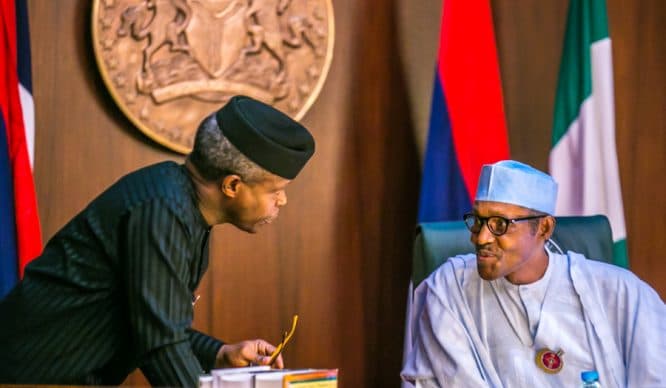
Laolu Akande, the former spokesman to ex-Vice-President Yemi Osinbajo, has vehemently challenged assertions made by former Secretary to the Government of the Federation (SGF), Babachir Lawal, concerning the lead-up to the 2023 presidential election. Akande described Lawal’s accounts as false, drawing on his intimate knowledge of decisions made within the Presidential Villa during his tenure as Osinbajo’s spokesman from 2015 to 2023.
Central to Lawal’s claims was the assertion that ex-President Muhammadu Buhari considered Osinbajo’s 2023 presidential ambition ‘inappropriate’ and ‘highly immoral and distasteful’ due to Buhari’s longstanding relationship with President Bola Tinubu. Lawal reportedly suggested that Buhari would have found it difficult to endorse Osinbajo against Tinubu. However, Akande presented a starkly different narrative, stating that Buhari had personally offered his support to Osinbajo’s presidential aspiration on at least four distinct occasions. According to Akande, Buhari explicitly told Osinbajo, ‘If I don’t support you, who will I support?’ Furthermore, Akande highlighted that Buhari had publicly commended Osinbajo’s campaign during a Federal Executive Council meeting, praising the former Vice-President for conducting an issues-based campaign nationwide. Akande argued that this conduct was inconsistent with a President who found Osinbajo’s ambition distasteful; rather, it demonstrated encouragement and applause.
Akande also refuted Lawal’s account of an alleged memo that supposedly listed more than 20 staff members recommended by Osinbajo. Lawal had claimed that Buhari’s Chief of Staff had initially withheld this memo, leading Lawal to personally deliver it to the President. Akande dismissed this as a ‘complete fabrication,’ insisting that no such document ever existed. He further rejected Lawal’s claim that Buhari had referred to the proposed appointees by their ethnicity, asserting that such a remark would be inconsistent with the former President’s known conduct. Akande clarified that Osinbajo maintained direct access to Buhari, routinely submitting memos for approval before forwarding them to his Deputy Chief of Staff, Ade Ipaye, for communication to relevant government agencies. The SGF’s role, Akande noted, was only required for the subsequent issuance of appointment letters.
Regarding Lawal’s assertion of a three-month delay in the memo’s processing, Akande pointed out that he and several other officials commenced work in the Office of the Vice-President in June 2015, directly contradicting the notion of a significant delay. He also affirmed that Osinbajo submitted numerous memos at various times but never produced any list categorized along religious or ethnic lines. Addressing Lawal’s broader claims of Osinbajo favoring members of his church in appointments, Akande countered by highlighting the diverse religious and regional representation within Osinbajo’s office. He cited Ade Ipaye, a Muslim lawyer, as the most senior official, and noted that three of Osinbajo’s four special advisers were Muslims, including two northerners. Akande also specifically disputed Lawal’s attempt to link former Minister of Industry, Trade and Investment, Okey Enelamah, to Osinbajo’s church, explaining that Enelamah was recommended by two individuals in the financial services industry, and his appointment was communicated to Osinbajo by Buhari’s then Chief of Staff, the late Abba Kyari.
Akande concluded his statement by suggesting that Lawal’s narrative might be influenced by personal grievances, particularly his removal from office. He underscored that it was President Buhari, not Osinbajo, who removed Lawal from his position as SGF over allegations of corrupt practices. This context, Akande implied, provides a crucial lens through which to view Lawal’s allegations, suggesting they are unfounded and possibly driven by resentment over his past professional circumstances.